
AI-powered trade surveillance uses machine learning to flag unusual orders, executions and account behavior for investigation. Its purpose is not to declare a trader guilty. It is to help compliance teams find activity that deserves attention, reconstruct what happened and document their decisions.
The distinction matters. An unusual trade can reflect misconduct, a faulty algorithm or a legitimate response to changing prices. A useful surveillance system separates those possibilities rather than treating every busy trading session as a crime scene.
What AI Adds to Trade Surveillance
Traditional surveillance rules flag predefined conditions, such as unusually large orders or repeated cancellations. Machine learning adds comparisons across several measures: order size, timing, execution patterns, account relationships and market conditions. The two approaches should work together, not compete for the same chair.
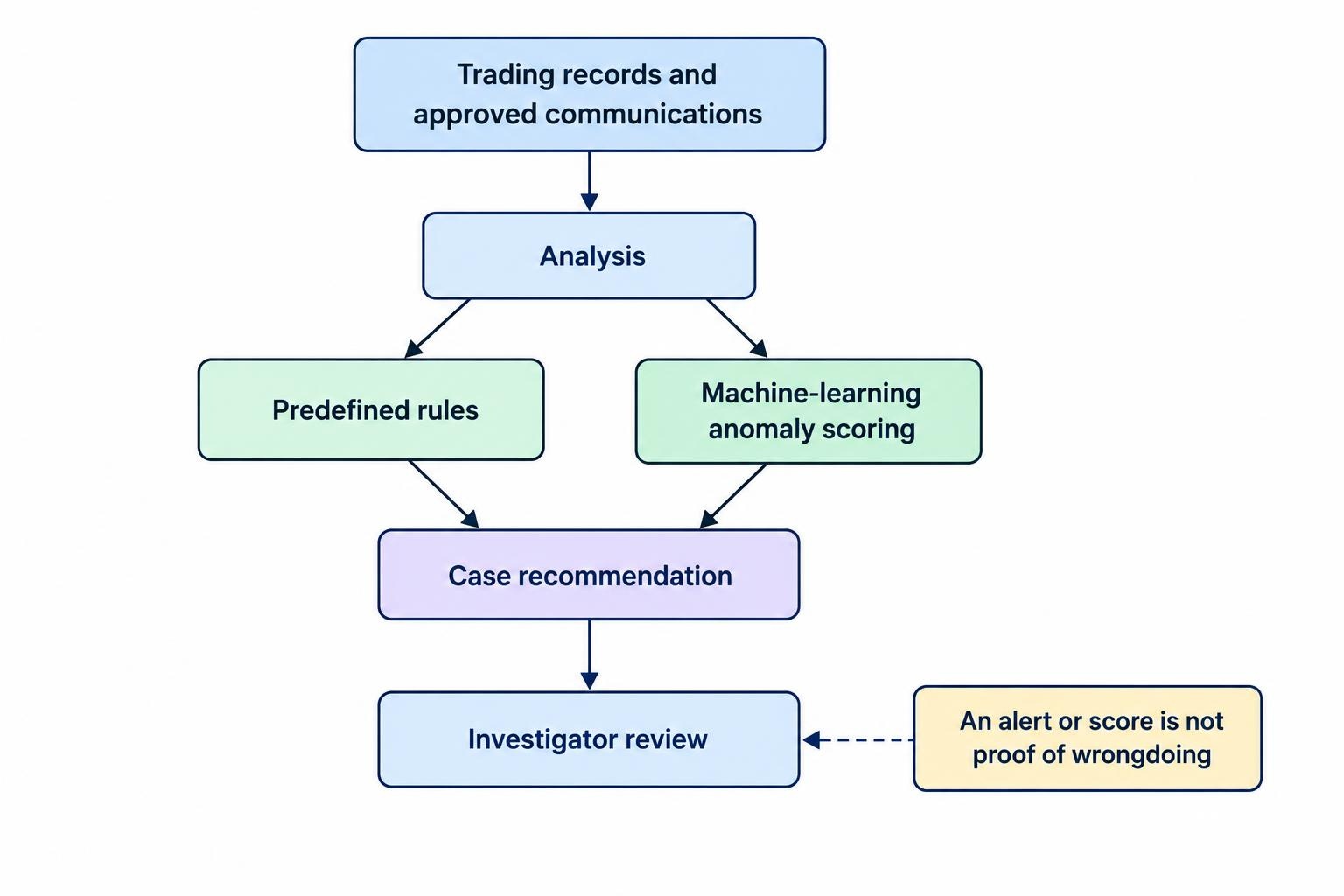
AI can support analysis of both trading records and communications. FINRA’s report on artificial intelligence in the securities industry identifies surveillance applications using structured and unstructured data to detect patterns and anomalies. It also records firms’ expectations of fewer false positives, without validating any particular tool’s effectiveness.
For implementation, distinguish three outputs. A rule identifies a predefined event. An anomaly score measures how unusual activity appears against a chosen baseline. A case recommendation suggests what an investigator should examine next. None should be presented as proof of wrongdoing.
Which Trading Patterns Deserve Investigation?
A surveillance program should start with defined risks and the evidence needed to investigate them. Buying a general anomaly detector first and deciding its purpose later reverses that process.
| Review area | Candidate alert pattern | Context to examine |
|---|---|---|
| Potential spoofing or layering | Repeated order placement and cancellation alongside opposite-side executions | Order sequence, market changes, fills and related activity |
| Potential coordinated trading | Accounts repeatedly trading together in unusual sequences | Account relationships, counterparties and economic purpose |
| Trading before announcements | Activity departing sharply from an account’s established behavior | Public news timing, prior holdings and relevant communications |
| Algorithm malfunction | Sudden bursts of duplicate orders or abnormal trading frequency | Deployment changes, system logs and execution feedback |
These are investigation prompts, not legal tests. For U.S. derivatives markets, the CFTC’s interpretive guidance on disruptive trading practices distinguishes spoofing from legitimate, good-faith order cancellation or modification. Its analysis considers intent, trading patterns and market context. A high cancellation rate alone should not become an automated finding of spoofing.
Build the Evidence Before Scoring the Behavior
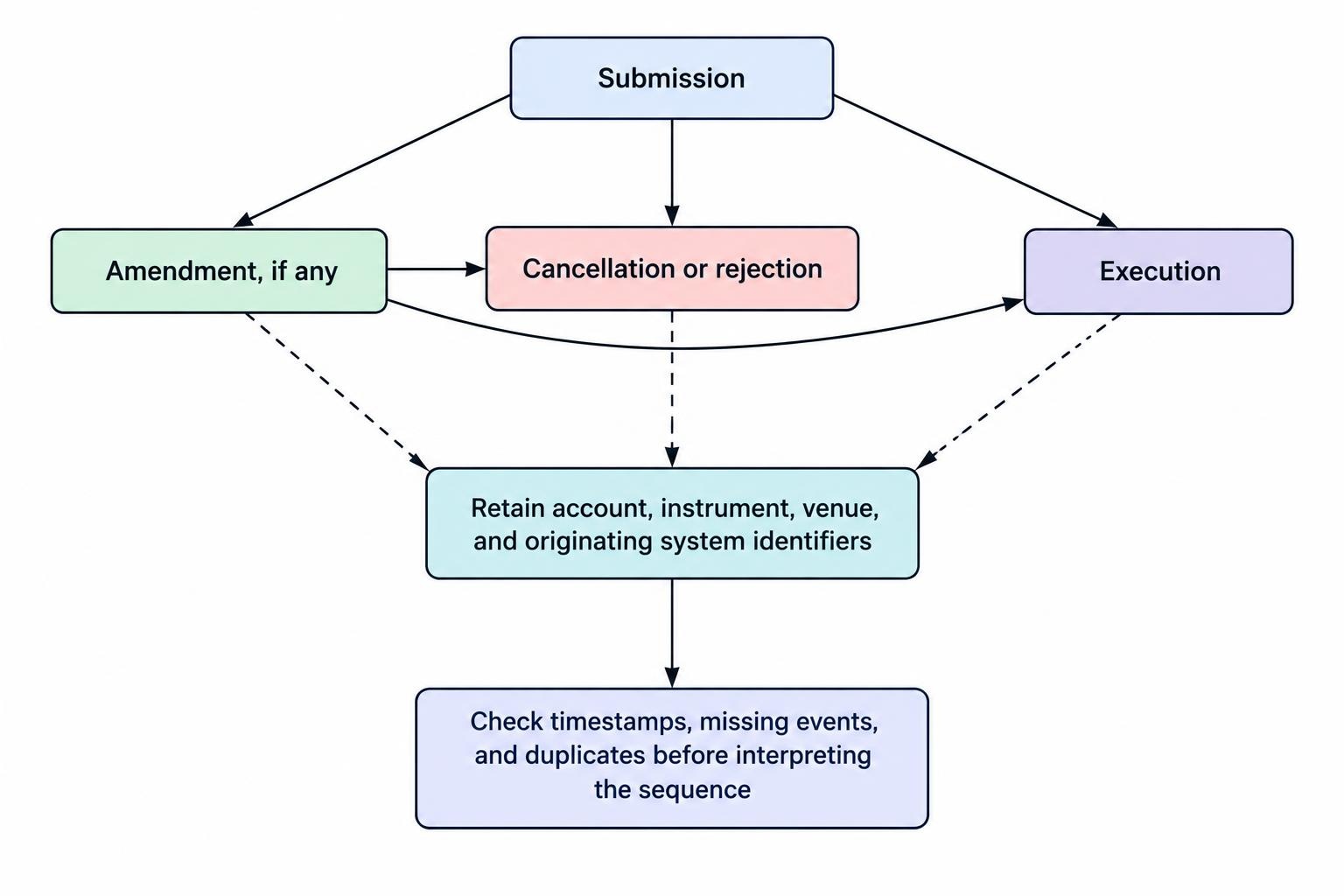
Design the data pipeline to preserve the full order lifecycle: submissions, amendments, cancellations, rejections and executions. Retain identifiers that connect each event to its account, instrument, venue and originating system. Executed trades alone cannot reconstruct orders that disappeared before a fill.
Check timestamp consistency, missing events and duplicate messages before interpreting a sequence. A delayed feed can make a cancellation appear to precede the event that prompted it. The model may produce a confident answer to a question the data never supported.
Use separate baselines where trading behavior genuinely differs. Comparing a market maker with an occasional investor may produce more noise than insight. Instrument liquidity, trading session and strategy should inform the comparison, with enough transparency for investigators to challenge it.
Where communications form part of a case, connect approved records to the trading timeline without stripping away context. Access, retention and review procedures belong alongside the technical design; the related guide to secure messaging and compliance in trading operations covers that broader workflow.
Turn Alerts Into Reviewable Cases
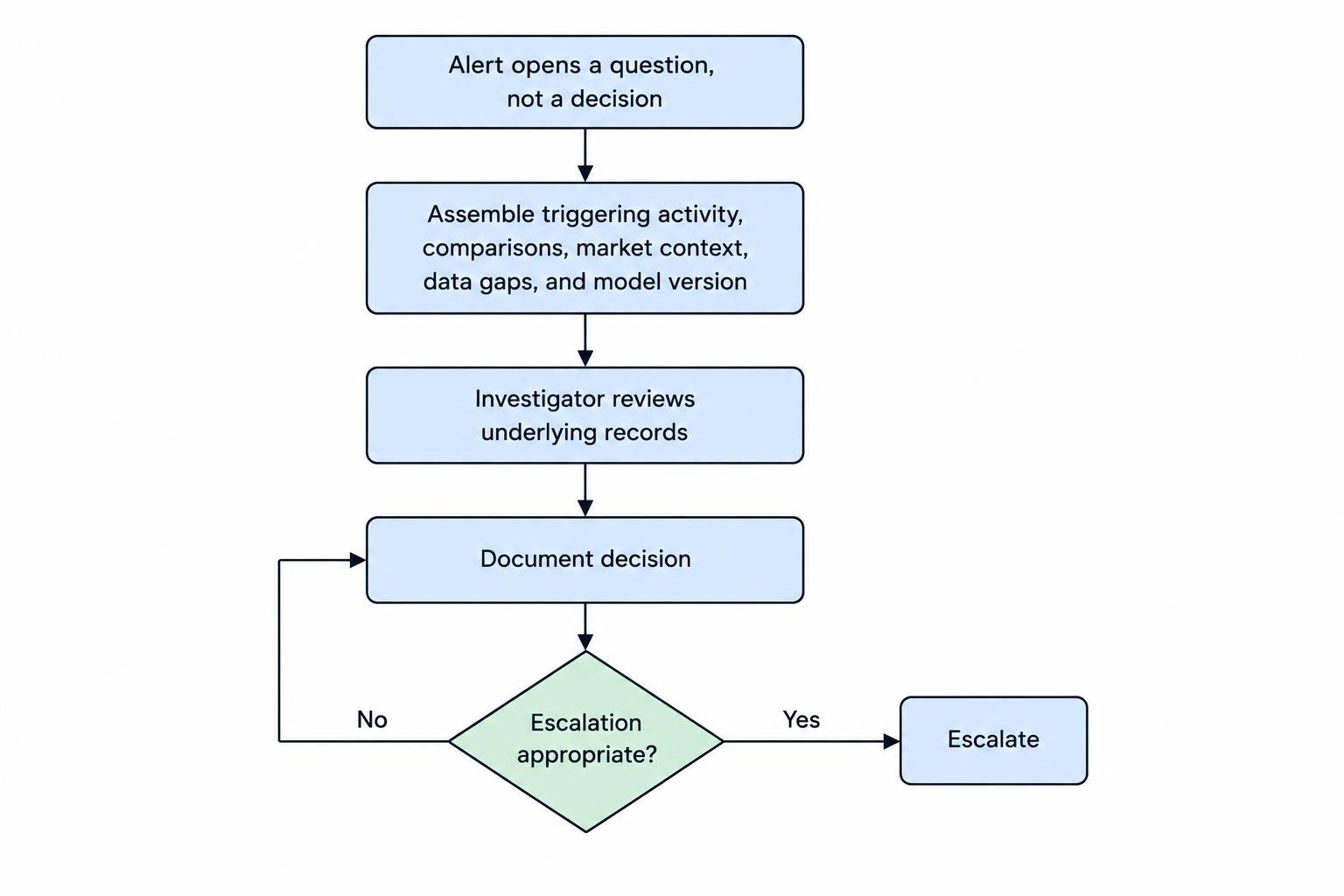
Consider a hypothetical account that repeatedly posts large sell orders, executes smaller purchases and cancels the sell orders. A useful alert would assemble the sequence, show market conditions and identify comparable episodes. An unhelpful alert would display “high risk” and leave the investigator to rebuild everything manually.
Require each case to show the triggering activity, relevant comparison, data gaps and model version. Preserve the underlying records so another reviewer can reproduce the analysis. A score should open a question, not close it.
If a language model drafts case summaries, restrict it to retrieved evidence and require record references for factual statements. Review quotations, amounts and timestamps against the originals. Do not let generated prose fill gaps with a plausible account of a trader’s intentions.
Test Detection Quality, Not Just Alert Volume
Set acceptance criteria before a pilot. Useful measures include confirmed issues detected, investigator review time, alert precision and performance across desks or instruments. Precision measures the share of reviewed alerts classified as relevant under a defined review standard; it does not necessarily measure proven misconduct.
Measure missed detection through known-case replays, controlled scenarios and sampling below the alert threshold. The true number of undetected cases remains unknown, so avoid presenting a single recall figure as complete coverage.
Keep evaluation data separate from training data, including related order sequences that could reveal the same case. The guide to data leakage and overfitting in AI trading tests addresses the same testing hazard: apparent accuracy can come from information the model would not have had in production.
Keep Surveillance Separate From Preventive Controls
Surveillance and order blocking serve different purposes. For covered U.S. securities broker-dealers, SEC Rule 15c3-5 on market access controls requires controls reasonably designed to prevent orders exceeding preset credit or capital thresholds and orders that appear erroneous, alongside other requirements. An anomaly dashboard does not substitute for those preventive controls.
Begin deployment with a defined market, risk pattern and accountable review team. Run the proposed model alongside existing monitoring, investigate disagreements and agree escalation procedures before expanding its role. Require approval for material model changes and a fallback process for feed or system failures.
The practical test is straightforward: can a reviewer identify what triggered the alert, inspect the evidence and explain the decision? If not, adding more AI will not repair the surveillance process.