Economic news belongs in a long-term portfolio review when it changes the assumptions behind your plan, not simply because it moves prices before lunch. Inflation, employment, economic growth and interest rates can raise useful questions about spending needs, business earnings and investment risk. They do not provide a reliable instruction to buy or sell after every release.
The practical task is to separate three decisions: whether to update your expectations, whether to investigate a holding, and whether to change the portfolio. Those decisions need different standards of evidence. A weaker growth report might justify closer monitoring without justifying a trade.
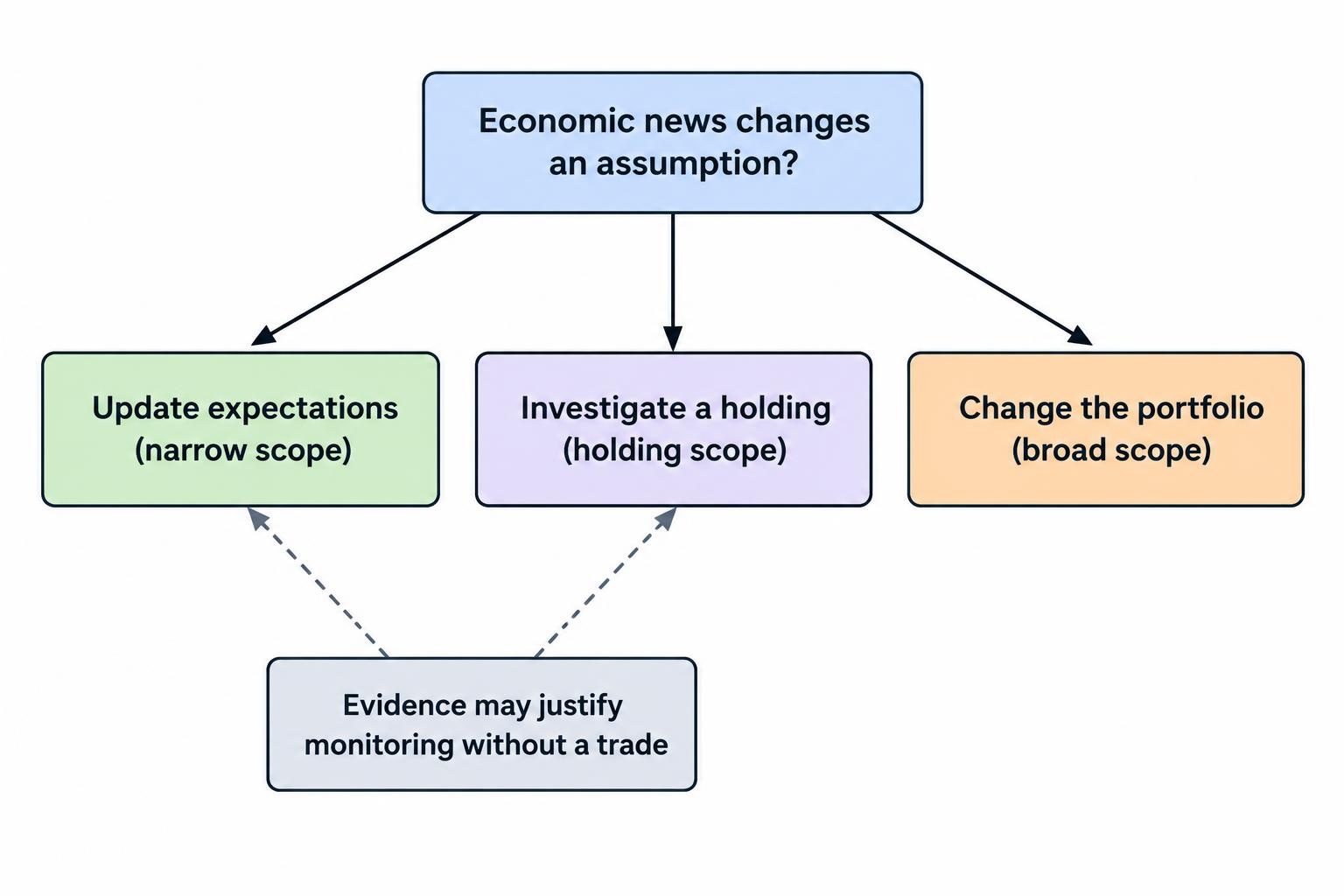
Within a broader approach to using financial news for long-term investing, economic releases should serve as inputs to a repeatable review process. Start with your goals and existing exposures, then ask what the news actually changes.
Start With the Portfolio, Not the Economic Calendar
Before reading the next inflation report, write down what your investments need to achieve. Include the date you expect to use the money, likely withdrawals, ongoing contributions and the losses you could absorb without abandoning the plan. Economic analysis is more useful when it answers a defined question.
A retirement portfolio with withdrawals beginning next year needs a different review from an account receiving contributions for another 25 years. The same recession concern might prompt the first investor to check near-term spending reserves and the second to test whether contributions remain affordable. Neither response requires a confident forecast of the next market bottom.
Keep three layers separate:
- Financial plan: your goals, contribution capacity, spending needs and investment horizon.
- Portfolio structure: the role of each holding, allocation ranges and concentrations.
- Economic assumptions: expectations about inflation, growth, financing costs and business conditions.
Review the third layer without automatically rewriting the first two. Otherwise, a long-term plan can become a collection of short-term reactions wearing a respectable label.
Which Economic News Deserves Attention?
A manageable dashboard is preferable to collecting every available indicator. Select information that tests assumptions you already depend on. The following framework uses U.S. economic releases, but the review questions can also be applied to overseas investments and spending needs.
| Information | Review question | Avoid assuming |
|---|---|---|
| Inflation reports | Does the spending plan still work in purchasing-power terms? | Lower inflation means prices have returned to earlier levels. |
| Employment and wages | Are household contributions or business revenue assumptions becoming less secure? | One strong or weak report establishes a lasting trend. |
| GDP and spending | Does the growth outlook challenge the investment case for exposed holdings? | National economic growth translates directly into shareholder returns. |
| Interest rates and credit conditions | Which holdings or personal commitments need closer financing-risk checks? | A policy rate change has the same effect on every asset. |
Inflation: Check the Spending Plan Before Chasing Protection
The Consumer Price Index measures average changes in consumer prices, not the exact increase in every household’s expenses. A household with unusually high medical or housing costs may experience a different inflation rate. The Bureau of Labor Statistics CPI questions and answers covers both the index’s purpose and why personal inflation can differ.
For a portfolio review, compare your actual spending with the assumptions in your plan. Separate recurring expenses from occasional purchases, and distinguish a higher price level from a faster rate of increase. If inflation slows from a hypothetical 5% to 3%, prices are still rising; they are simply rising more slowly.
A useful response may be to revise future withdrawal estimates or contribution goals. That is different from immediately replacing existing holdings with assets marketed as inflation protection. Define the problem before shopping for an answer.
Employment and Growth: Test the Trend and Its Relevance
Use employment news to examine both the investment portfolio and the income supporting it. Ask whether your job, employer shares and other investments depend on the same industry. If they do, a review should consider that shared exposure rather than treating employment income and investments as unrelated.
For growth reports, record the release version as well as the headline. U.S. GDP figures pass through advance, second and third estimates as more information arrives, and later updates can revise them again. The BEA study of GDP revisions documents this estimation process.
For review purposes, keep the reporting period, release date and estimate version beside each figure. Do not compare an early estimate for one quarter with a revised estimate for another without noting the difference. Precision in the spreadsheet is useful; confidence unsupported by the data is not.
Translate Economic News Into Holding-Level Questions
An economic headline becomes useful only after you identify how it could affect something you own. Work through the connection: the reported change, the business or financial exposure, the evidence needed to confirm an effect, and the decision that might follow.
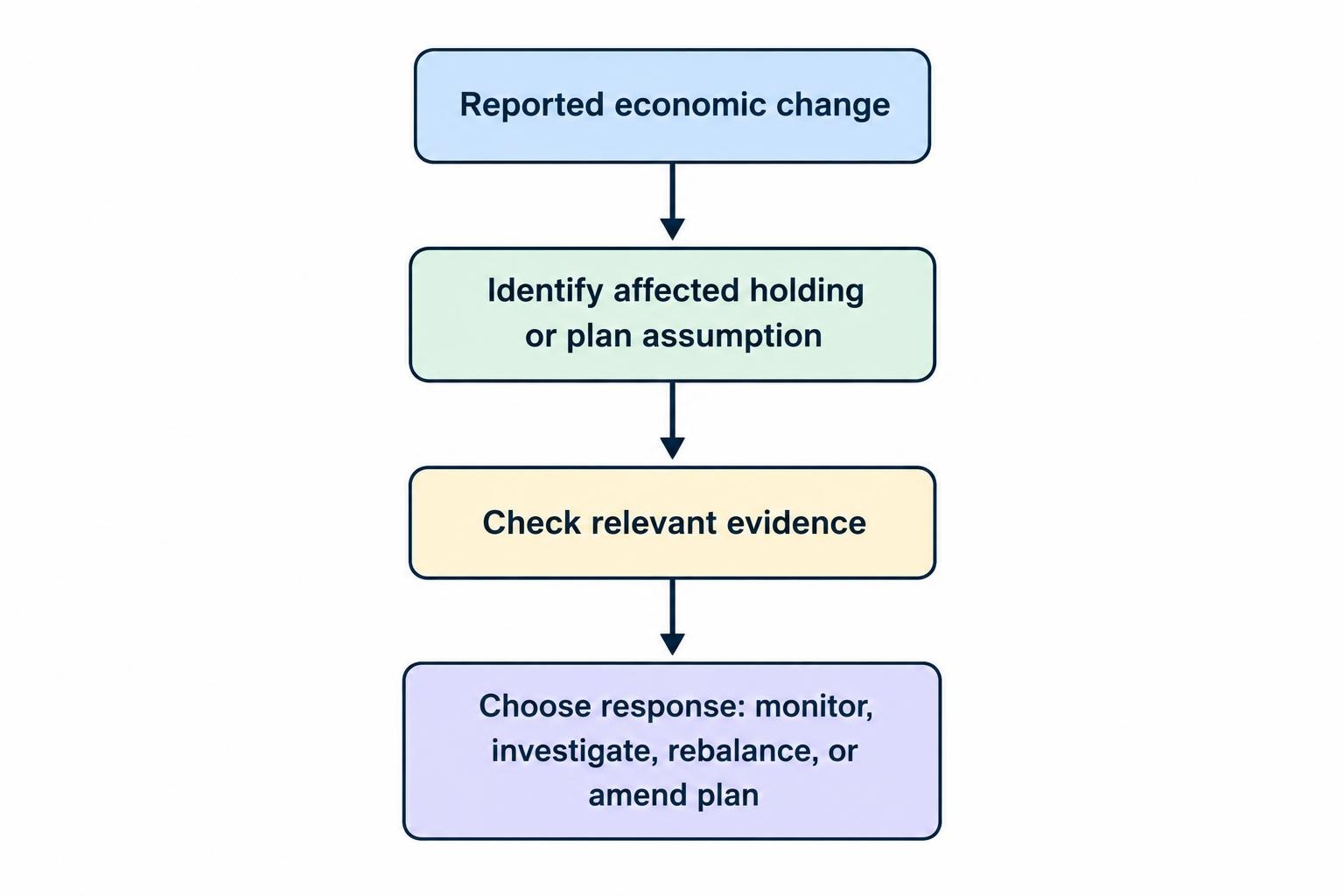
Consider a hypothetical manufacturer facing weaker demand. Rather than selling because GDP disappointed, examine order volumes, margins, cash flow and upcoming debt repayments. Ask whether the original investment case allowed for a downturn. A business performing within an expected range is different from one whose finances no longer support the case for owning it.
Apply the same discipline to funds. Review what they hold and the role they serve, rather than relying on their names. In your review notes, identify shared sector, country or financing exposures across holdings. Several account statements do not necessarily represent several independent sources of risk.
Interest Rates: Distinguish Policy Decisions From Portfolio Exposure
Monetary policy influences financing conditions, but its effects on spending and economic activity take time. A policy announcement is not evidence that households and businesses have already completed their adjustment. The Federal Reserve’s explanation of monetary policy transmission describes these channels and delays.
Translate a rate announcement into questions about your holdings: When does borrowing need refinancing? Are interest costs fixed or floating? Does the investment case depend on financing becoming cheaper? Avoid assuming that a policy change settles all three questions.
The wording of the announcement also deserves a separate review from the rate decision itself. For a fuller treatment of that task, use interpreting central bank statements for long-term investing. Keep this portfolio review focused on exposures and decisions rather than attempting to forecast every policy meeting.
Bonds: Review Price Sensitivity and the Intended Holding Period
Existing fixed-rate bond prices generally fall when market interest rates rise. Longer maturities generally carry greater interest rate sensitivity than otherwise comparable shorter maturities. The SEC investor bulletin on interest rate risk explains the relationship and the effect of coupon rates.
For your review, ask what the bond holding is meant to do. Is it intended to meet a dated spending need, provide income, or form part of a continuing fund allocation? Check the holding’s maturity or duration information against that purpose. Calling something “the defensive part” of the portfolio is not a substitute for examining its risks.
A temporary price decline and a failure to meet a planned cash need are different problems. Document which one you are assessing before choosing a response.
Use Scenarios Instead of One Economic Forecast
A portfolio review does not need a single prediction presented to two decimal places. It needs a way to assess whether the plan remains workable under different conditions.
Build three short scenarios: inflation remains higher than planned; growth weakens more than expected; or growth continues while inflation eases. These are planning exercises, not claims about which outcome will occur.
For each scenario, test contributions, withdrawals and concentrated exposures. Could you keep contributing if employment income fell? Would a large planned expense force sales after a market decline? Does a holding require favourable financing conditions to justify its place in the portfolio?
Give each scenario an observable review trigger. “Review financing assumptions when the company publishes its next debt update” is actionable. “Sell if the economy looks worrying” leaves too much room for mood and headlines.
Also write down what would challenge your interpretation. If the working view is that demand is weakening, identify the operating evidence that would make you reconsider. A review process should permit changed minds without rewarding constant indecision.
Separate Monitoring, Rebalancing and Strategy Changes
Monitoring means gathering evidence without trading. Rebalancing restores a chosen allocation after holdings drift. Changing strategy means altering the intended allocation or the role of an investment. Keep these labels separate in your records.
Rebalancing can follow a calendar or predetermined allocation thresholds. Before trading, consider transaction costs and potential tax consequences, and whether new contributions could restore the balance instead. The Investor.gov guide to allocation and rebalancing describes these approaches.
Suppose a hypothetical portfolio has a 60% equity target and a written review threshold of five percentage points either side. If equities reach 67%, the allocation rule prompts a review. An alarming inflation headline is not needed to validate it, and a reassuring headline does not cancel it. These figures illustrate a process, not a suitable allocation for every investor.
A strategy change needs a broader explanation. Perhaps withdrawals will begin sooner, income has become less dependable, or the original risk assumptions were unrealistic. “The news sounded bad” is not a durable investment policy.
A Practical Quarterly Portfolio Review
One workable routine is a brief monthly information check followed by a fuller quarterly review. Treat this as an organisational choice, not a universal schedule. Bring a review forward when personal circumstances or a holding’s financing position changes enough to threaten the plan.
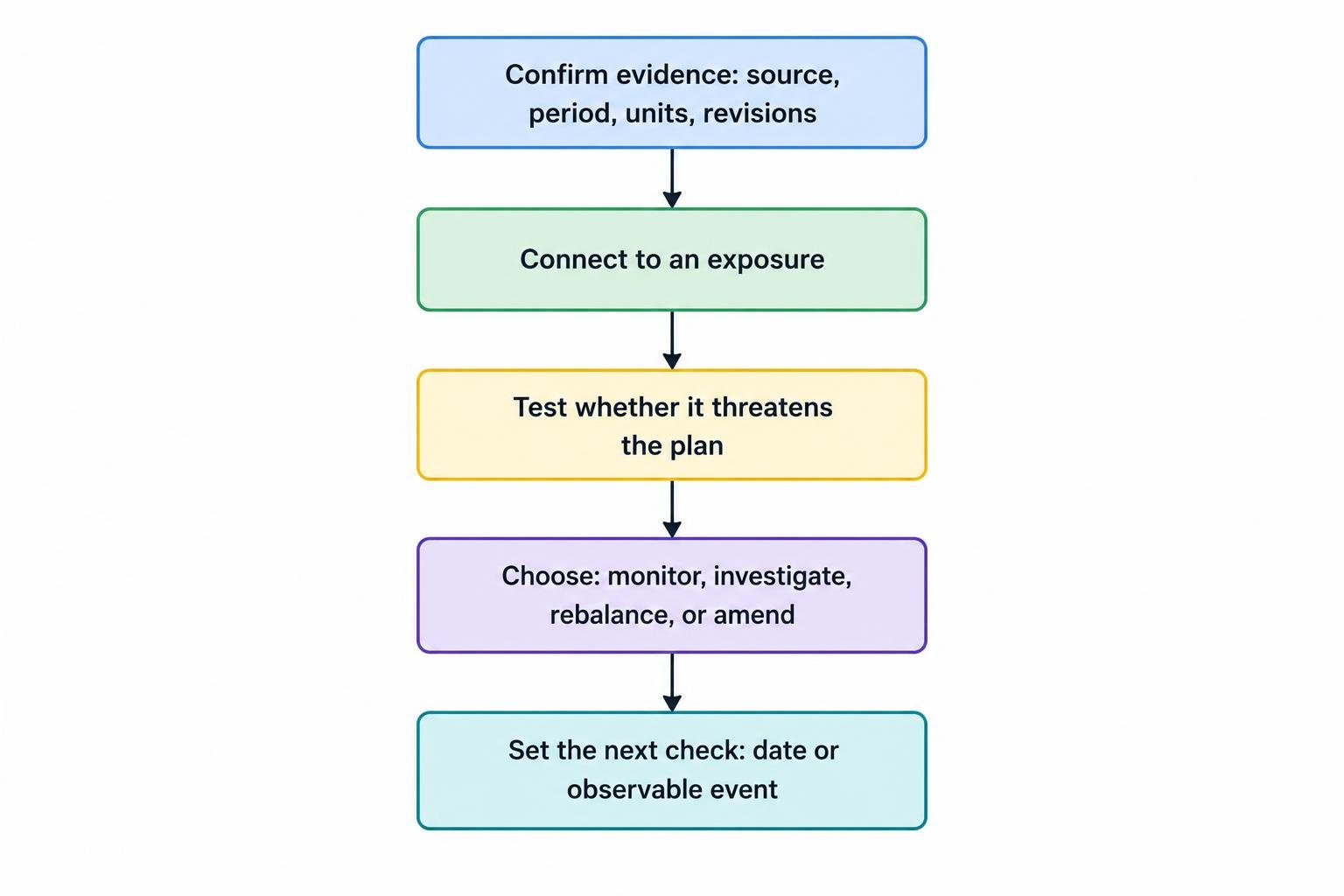
Begin with what changed since the previous review, rather than rereading every headline. Record the economic evidence, the affected exposure, the assumption being tested and the proposed response. Give “no trade” the same written justification you would give a purchase or sale.
- Confirm the evidence. Check the original release, reporting period, units and revisions.
- Connect it to an exposure. Name the holding, spending need or contribution assumption affected.
- Test the size of the problem. Decide whether it threatens the plan or remains within an anticipated range.
- Choose the response. Monitor, investigate, rebalance or amend the plan.
- Set the next check. Specify a date or observable event that will reopen the decision.
If a summary makes a surprising claim, pause before using it. Trace the claim back to the release and distinguish reported facts from forecasts. A repeatable method for verifying financial news sources helps keep commentary from entering the review as established evidence.
What a Useful Review Should Produce
The finished review should be short enough to revisit: an updated set of assumptions, a list of exposures requiring attention, any approved changes and the reason for each. Keep unresolved questions visible instead of disguising them with a confident forecast.
Economic news earns its place when it improves those decisions. It may reveal a spending shortfall, prompt a closer look at refinancing risk, or confirm that no adjustment is needed. The objective is not to predict every economic turn. It is to maintain a portfolio whose risks, cash needs and purpose you can still explain after the headlines change.