Before opening a binary options account, establish who operates the platform, whether its regulatory permissions cover the service, and whether that service is available to someone in your country. A working registration form answers none of those questions.
Company registration, financial authorisation and customer eligibility are separate checks. Complete all three before sending money or identity documents. A licence belonging to a different company, or covering a different activity, does not settle the question.
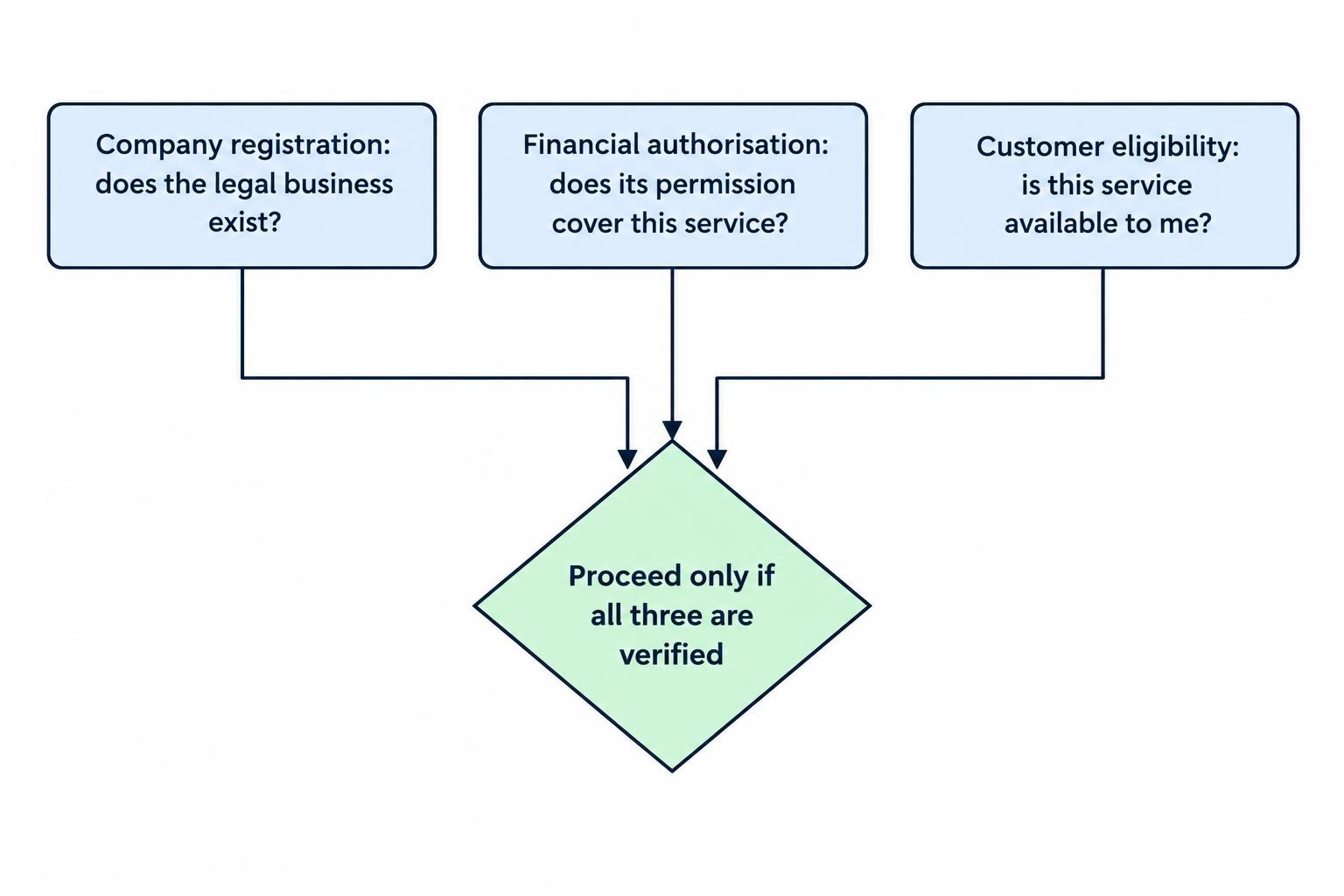
This guide covers that verification process rather than trading strategy. For the broader product background, start with learning how binary options trading works. Here, the task is narrower: deciding whether a platform’s claims survive scrutiny.
What Does “Registered” Actually Mean?
Do not accept “registered and regulated” without asking: registered with whom, under which legal name, and for what activity? Treat the phrase as the beginning of your checks, not the result.
Separate the evidence into these categories:
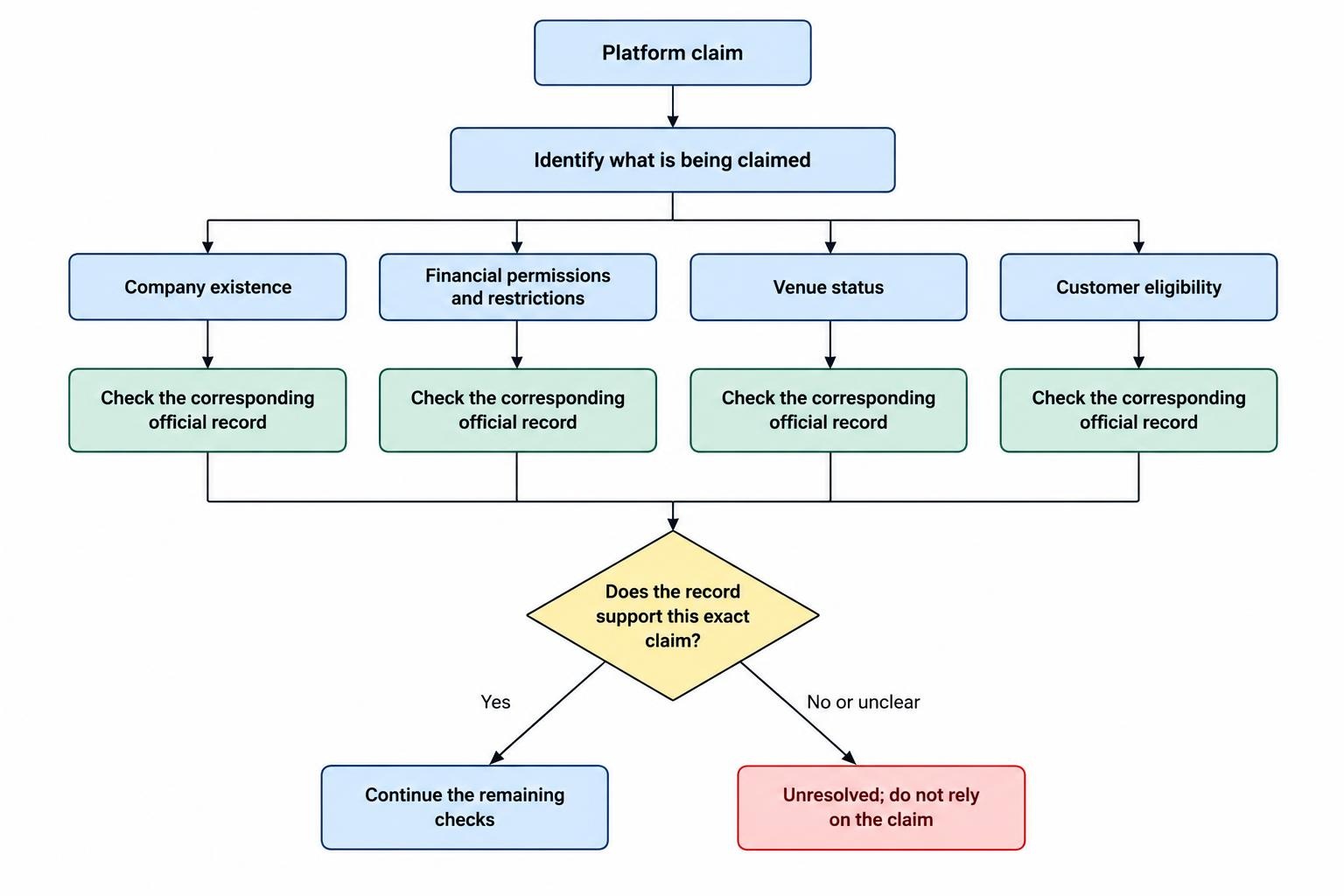
| Claim or document | What to establish | What not to assume |
|---|---|---|
| Company incorporation certificate | Whether the named business exists in the stated jurisdiction | That it has permission to provide binary options |
| Financial register entry | The entity’s current status, activities and restrictions | That every service advertised under its brand is covered |
| Exchange designation | The identity and regulatory status of the trading venue | That every advertised contract is currently offered there |
| Private membership or certificate | Who issued it and what powers that organisation has | That membership replaces statutory authorisation |
| Country acceptance statement | Whether your residence and customer category are eligible | That accepting an application establishes legal availability |
Use a simple evidence standard: the official record must support the claim being made. If a platform presents a company number when you ask for financial authorisation, the question remains unanswered. A certificate can look impressive and still prove the wrong thing.
Check the Rules in Your Country Before Comparing Platforms
Start with your country’s regulator, not a platform’s country selector. The relevant questions include your residence, the contracting entity, your customer classification and the contract being offered. Do not assume that an overseas permission applies wherever a customer happens to live.
United States: Check the Venue and Any Intermediary
U.S. checks require attention to both the contract and the business providing access. Some binary options fall under securities requirements; commodity options raise CFTC requirements. The joint CFTC and SEC investor alert on binary options describes these distinctions and warns about platforms operating without the required registrations.
For an ordinary retail applicant, do not treat an offshore licence as proof of permission to serve U.S. customers. Ask the operator to identify the regulated venue, the legal entity opening your account and any intermediary involved. Verify each role rather than accepting “U.S. traders welcome” as an answer.
Also separate venue status from product availability. An exchange’s regulatory status does not tell you whether the contract you want is currently listed, whether your account can access it, or whether its terms match the advertisement.
United Kingdom: Retail Binary Options Are Banned
Firms acting in or from the UK are prohibited from selling, marketing or distributing binary options to retail consumers. The FCA’s permanent retail binary options ban took effect on 2 April 2019 and also covers securitised binary options.
A claim that a business is FCA authorised therefore does not establish that it can sell binary options to a UK retail customer. Do not let a sales representative turn this into a discussion about which deposit method still works. The product restriction comes before payment convenience.
Australia: The Retail Prohibition Runs Until 2031
Australia’s prohibition covers the issue and distribution of binary options to retail clients. It began on 3 May 2021, and ASIC extended the binary options intervention order until 1 October 2031.
Check any eligibility claim against that restriction before proceeding. Do not agree to an inaccurate customer classification or residence declaration to make an application pass. If an operator proposes an exception, request its legal basis and verify it independently rather than relying on the operator’s assurance.
For other countries, repeat the same process with the relevant national authority. Avoid relying on an old global availability table: a list without a date, product scope and customer category is a poor basis for sending money.
Identify the Company That Would Hold Your Account
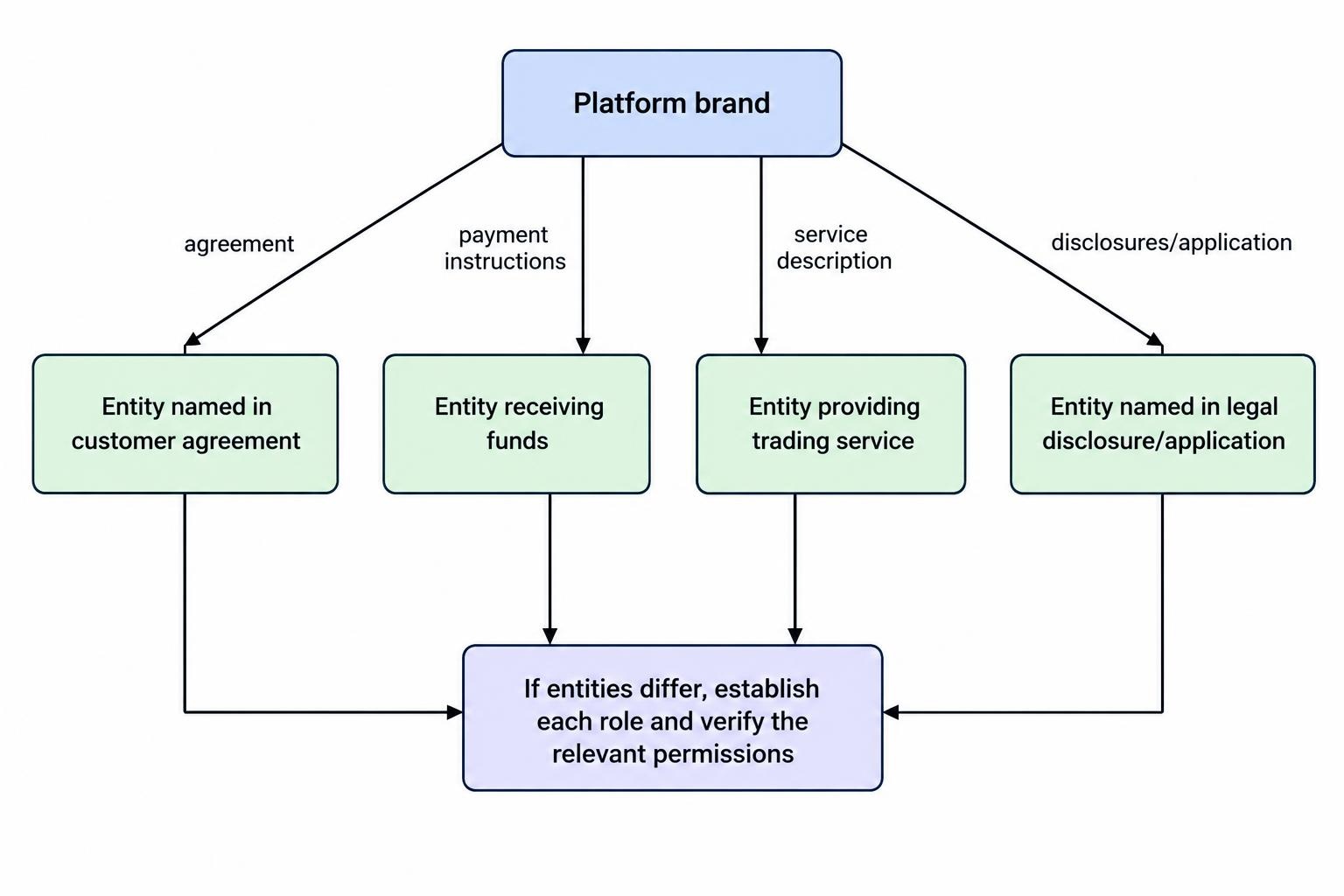
Write down the exact legal entity named in the customer agreement. Then compare it with the legal disclosure, account application and payment instructions. Do this before accepting the agreement, not after a withdrawal becomes urgent.
Check the brand and company separately. If several companies appear, ask which one contracts with you, which one receives your funds and which one provides the trading service. Request a written explanation of any mismatch.
Consider a hypothetical platform called Meridian Options. Its footer names Meridian Technology Ltd, its agreement names Meridian Markets Ltd, and its payment page names a third business. Finding a register entry for Meridian Technology would not complete the check. You still need to establish the role and permissions of the entity opening your account.
Save the agreement version and date alongside the entity’s name. If the operator later asks you to accept a different contracting company, repeat the verification rather than carrying the earlier result across automatically.
Search Official Registers Independently
Open the regulator’s register yourself. Do not rely solely on a screenshot, certificate attachment or link supplied in a sales message. Search by both legal name and reference number, then examine the record rather than stopping at the first matching result.
Verify the Trading Venue
For a venue claiming U.S. designated contract market status, use the CFTC’s designated contract market records. The database distinguishes statuses including designated, pending, dormant and vacated. Finding a name in the database is not enough; read its status and associated documents.
Next, request the contract’s formal name and current specifications. Compare the venue identified in those documents with the venue claimed in the advertisement. An unexplained difference should stop the application until it is resolved.
Verify Any Derivatives Intermediary
Where a U.S. derivatives intermediary is involved, use NFA’s BASIC registration and background database to research the firm. Search the legal name or NFA ID and review its current registration information and disciplinary history. Do not treat a reference number by itself as the result.
Keep the roles separate. Evidence about an exchange does not answer every question about an intermediary, and an intermediary’s record does not establish the status of an unrelated platform using its name.
Check for Identity Mismatches and Clone Firms
The FCA’s Financial Services Register guidance identifies clone firms as businesses falsely claiming to represent genuine authorised firms. Its records also include current and former authorisations, so a search result alone is not proof of current permission.
Compare the website address, email domain, telephone number and legal name wherever official details are available. Contact the genuine firm through independently verified details if anything differs. Do not ask the salesperson who supplied the questionable information to authenticate it.
Search official warning and enforcement records too. Use the legal name, trading name and domain. Treat a warning as a reason to stop; treat the absence of a warning as an unfinished check, not an approval.
Confirm Availability for Your Actual Circumstances
After checking the entity and its permissions, confirm eligibility using accurate information. Ask whether the service accepts residents of your country, whether any state or regional restriction applies, and whether the offered account is intended for your customer category.
Ask for the answer in writing and compare it with the agreement’s restricted-country and eligibility clauses. If support says “yes” but the contract says “no”, do not choose whichever answer is more convenient.
Do not use a VPN, false address or someone else’s documents to get around a restriction. That does not resolve the regulatory question. It also leaves your application inconsistent with your actual circumstances.
Check trading access and funding access separately. Request the permitted deposit and withdrawal methods for your account, including identity verification requirements. A payment going through is not a substitute for permission to provide the trading service.
If you move country or are transferred to another group company, run the checks again before adding funds or placing further trades.
Read Withdrawal and Account Terms Before Depositing
Registration checks answer who may provide the service. They do not replace a review of the agreement. Ask how withdrawals work, which charges apply, how disputes are handled and what happens if the account is closed.
Pay particular attention to bonus conditions, trading-volume requirements, verification procedures and any clause allowing the operator to delay payments. Request clarification of unclear wording before accepting it. Do not depend on a chat promise that conflicts with the contract.
Check the complaints route for the exact entity and service involved. If a platform advertises compensation, insurance or dispute-resolution membership, request the scheme’s name and independently verify eligibility and exclusions. Do not assume that an advertised protection covers trading losses.
Keep this review separate from profitability. A platform can pass identity and permission checks without making its contracts attractive. Review binary options payouts and trading costs only after establishing that the service is available to you.
Warning Signs That Should Stop the Application
Regulatory checks deserve more attention when a representative pressures you to deposit before completing them. Guaranteed profits, unexplained company changes and refusals to identify the contracting entity should end the sales conversation until independently resolved.
The CFTC’s binary options fraud guidance documents complaints involving refused reimbursements, identity theft and software manipulation. It also provides routes for registration checks and reporting suspected violations.
Do not use a small deposit as your first verification method. It puts money at risk before answering the basic questions. Nor should an early withdrawal replace the remaining checks: one completed payment does not establish the operator’s permissions.
A demo account has a different purpose. It can help you examine an interface, but simulated results cannot verify the live account’s legal status or withdrawal process. The distinction is covered in binary options demo accounts versus live trading.
If You Have Already Sent Money
Pause further deposits while you investigate any mismatch. Preserve the customer agreement, account statements, payment receipts, withdrawal requests and messages. Record the domain, legal names and payment recipient exactly as shown.
Contact your bank or payment provider promptly to ask what options exist for the payment method used. Report suspected misconduct through the relevant regulator’s official channels. Recovery is not guaranteed, so do not send another payment based on a promise that it will release the first one.
Keep a Dated Verification Record
Before funding an account, retain a short record of the entity, official register result, relevant permissions, eligibility confirmation and agreement version. Note unresolved questions rather than filling the gaps with assumptions.
The decision rule is straightforward: if the legal entity, regulatory status, product permission or availability remains unclear, do not deposit. A functioning app is not the same thing as a verified service.