A profitable backtest can be wrong in two different ways: the strategy may fit historical noise, or the simulation may use information that was unavailable when a trade supposedly occurred. Overfitting causes the first problem. Look-ahead bias causes the second. Both can produce an impressive equity curve without a repeatable trading advantage.
Avoiding these biases requires more than reserving a test dataset. You need a controlled research process, accurate information timestamps and a clear boundary between developing a strategy and evaluating it. This guide covers those safeguards rather than the broader mechanics of backtesting an automated trading strategy.
Overfitting and Look-Ahead Bias Are Different Problems
Overfitting occurs when strategy selection captures accidental patterns in the research sample. A system might work only with a 17-period indicator, a narrow entry window and three filters added after reviewing losing trades. The rules describe the past beautifully. Their ability to predict anything remains unproven.
Look-ahead bias occurs when a simulated decision uses information from its future. Examples include trading on earnings before publication, calculating a signal from a completed price bar but filling the order before that bar ended, or training a model with outcomes that extend into its test period.
| Problem | Typical example | Main safeguard |
|---|---|---|
| Overfitting | Selecting the best result from hundreds of rule combinations | Control the search and evaluate untouched data |
| Look-ahead bias | Using a closing price before the close | Enforce information availability and execution timing |
| Survivorship bias | Testing historical stock selection using only companies still listed | Reconstruct the eligible universe at each historical date |
| Unrealistic execution | Assuming every touched limit order fills | Use defensible fill, cost and liquidity assumptions |
These problems need separate checks. A simple strategy can contain future information. A perfectly timestamped simulation can still be overfit. Correcting transaction costs does not repair either one.
Control the Research Before Optimizing Parameters
Start with a hypothesis that can fail. “A breakout following a period of low volatility may capture sustained price movement” gives you something to test. “Find whichever combination earns the most” gives the optimizer a treasure map drawn after the treasure was buried.
Before running tests, record the proposed mechanism, eligible instruments, signal inputs, parameter ranges, holding period, execution assumptions and evaluation criteria. Set a research budget too: which variations will you test, and what would justify another round?
Repeated testing creates a selection problem. Even without a useful signal, searching more alternatives gives you more opportunities to find an attractive historical result. The research paper on the probability of backtest overfitting develops a framework for evaluating this selection risk rather than treating the winning backtest as an isolated experiment.
Maintain an experiment log containing unsuccessful variations as well as winners. Count changes to assets, sample dates, filters, objectives and portfolio construction, not just indicator settings. Trying ten strategies across ten markets and reporting the strongest result is not a single test.
Prefer a plausible, stable rule set to the configuration with the highest return. A modest result that survives reasonable changes deserves more attention than a spectacular result balanced on one parameter value.
Use Data That Was Actually Available
A historical observation date is not necessarily its availability date. Quarterly earnings describe an earlier reporting period but become usable only after publication and receipt. Economic observations can also be revised after their initial release.
For macroeconomic inputs, retrieve the historical version available at the simulated decision time rather than automatically using the latest revised series. The St. Louis Fed’s ALFRED vintage data documentation distinguishes observation dates, vintage dates and initial releases. Intraday strategies still need release-time evidence; a date alone does not establish when a number became tradable.
Build the same distinction into company fundamentals, analyst estimates and news records. Retain the period being described, original publication timestamp, receipt timestamp where available, and revision history. Join each decision to the most recent eligible observation, not the nearest observation regardless of direction.
Historical universe construction needs similar care. If the strategy trades index constituents, use membership that applied at that time. If it ranks stocks by size, calculate eligibility from information then available. Do not let present-day classifications choose yesterday’s opportunities.
Keep failed, acquired and delisted securities where the strategy could have held them, with defensible treatment of their final returns. Dropping inconvenient records can remove losses as efficiently as a suspiciously talented optimizer.
Data preparation belongs in the research record, including missing-value treatment, identifier changes and corporate actions. The guide to historical market data quality and cleaning covers those broader preparation decisions.
Separate Signal Time From Execution Time
For every trade, answer four questions: when did the relevant event occur, when did the system receive the information, when could it calculate the signal, and when could the order reach the market?
Consider a hypothetical strategy using a five-minute bar that finishes at 10:00 a.m. If its entry condition depends on that bar’s final closing price, the completed signal becomes available only once the bar has finished. The backtest cannot assume it submitted an order earlier using that completed value.
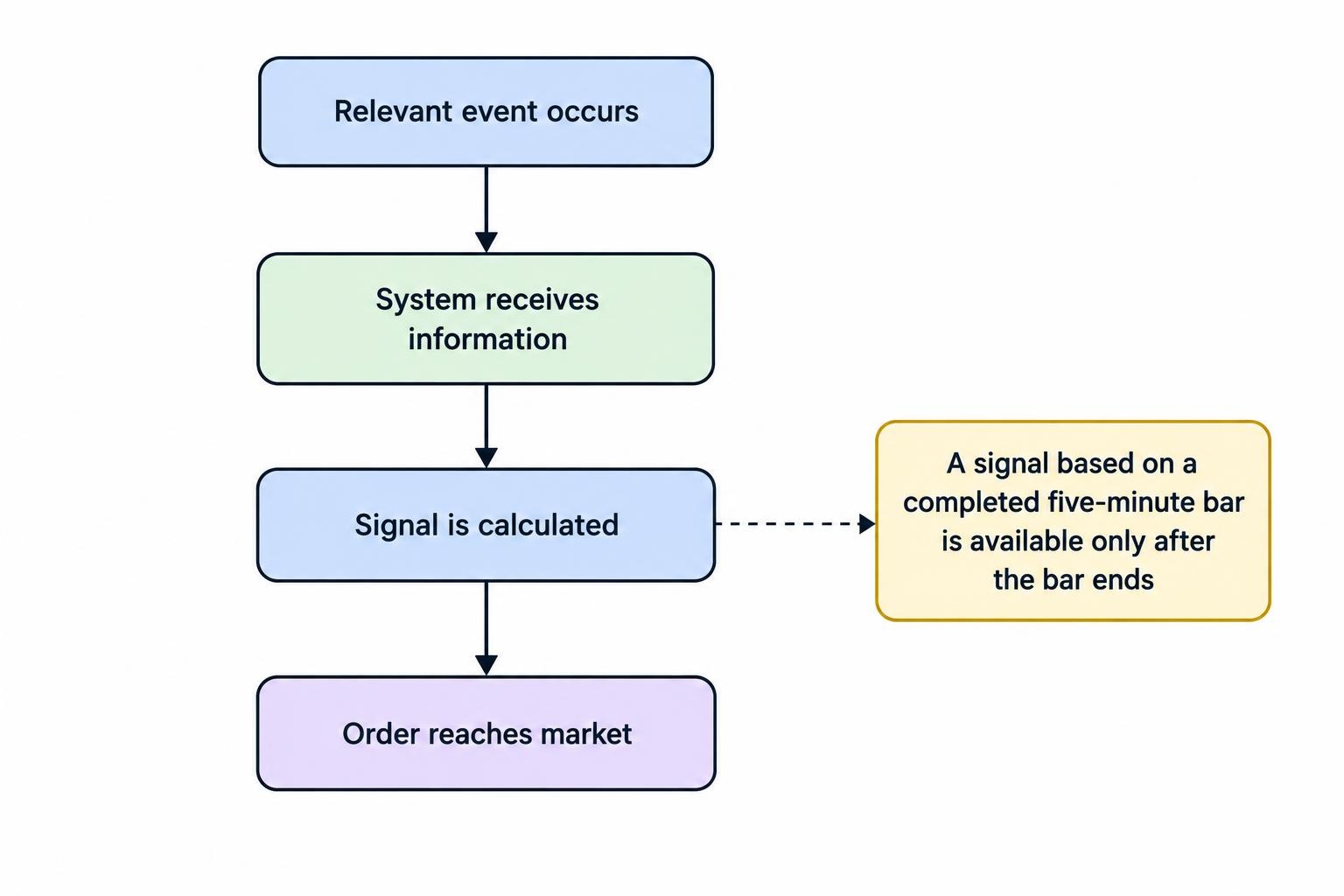
Filling at the next bar’s opening price may be a reasonable simplified assumption for some research, but it is not automatically an achievable execution price. State the assumption and test sensitivity to delay, spread and slippage.
Daily strategies face the same issue. A signal requiring the official closing price cannot also assume a closing-auction order submitted before the applicable cutoff using that final price. Either calculate the signal from information available before submission or model a later execution.
Bar data also leaves uncertainty about price sequence. If both a stop and a profit target fall within one bar, its high and low do not establish which was reached first. Use finer data or a documented conservative rule, rather than selecting the profitable sequence.
Keep Preprocessing Inside the Training Boundary
Leakage can occur before a model receives its first training sample. Scaling an entire dataset, selecting features using all outcomes, or filling missing values with statistics calculated across future observations can contaminate the evaluation.
Fit learned transformations on training data only, then apply those fitted transformations to validation or test data. This applies to normalization, imputation, dimensionality reduction and feature selection. The scikit-learn guidance on preventing data leakage documents this boundary and the role of pipelines in keeping preprocessing within each training split.
A trailing indicator can use earlier observations to initialize the first test-period value, provided those observations would have been available in production. That is different from fitting a transformation using the test period’s future distribution.
Audit the complete route from raw data to orders. Checking only the final model leaves plenty of room for future information to slip through a spreadsheet, cached feature file or preprocessing step.
Validate in Chronological Order
For a strategy that will learn from the past and trade the future, make that sequence the default evaluation design. Randomly shuffling observations can place later market information in training while earlier observations appear in testing.
A chronological splitter creates training periods followed by evaluation periods. The TimeSeriesSplit documentation describes this arrangement and an optional gap between training and test samples. A splitter controls row allocation; it does not verify whether your inputs or outcome labels respect their timestamps.
Give Training, Validation and Testing Different Jobs
Use training data to fit parameters. Use validation data to choose among the predefined alternatives. Reserve the final test period for evaluating the frozen research process.
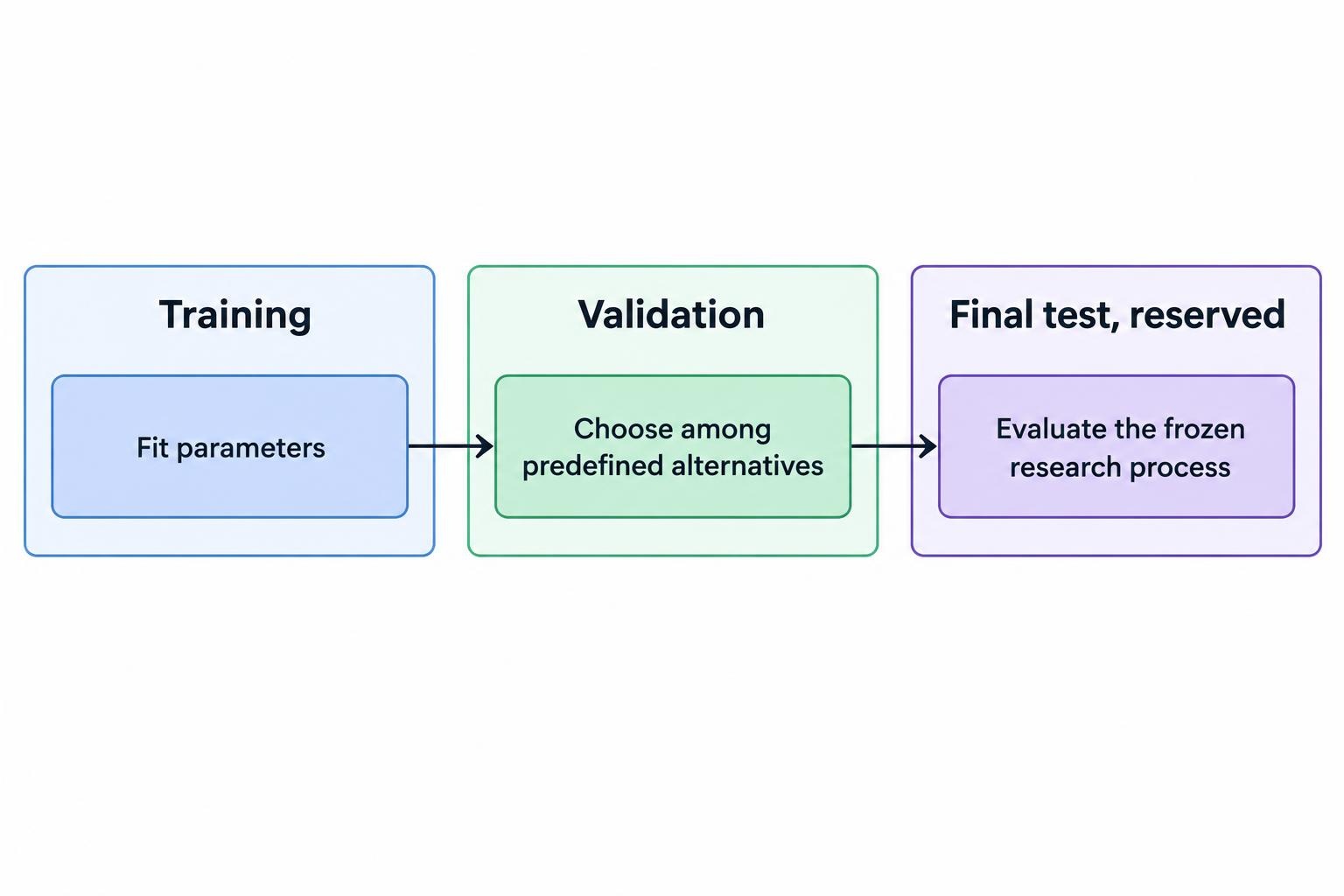
Suppose you develop rules using 2015–2020, select settings using 2021–2022 and reserve 2023–2025 for a final test. If you inspect the final period, change the strategy and rerun it, that period has become development data. Renaming it “out of sample” does not restore its independence.
There is no universal split ratio. Choose periods that provide enough observations for development and meaningful evaluation across relevant conditions. Years of minute bars do not necessarily provide years of independent evidence.
Use Walk-Forward Testing Without Repeatedly Tuning It
In walk-forward testing, fit or select the strategy using earlier data, evaluate the next period, then advance the windows. Choose the retraining schedule and rolling or expanding training window before comparing results.
Keep the stitched evaluation record separate from training results. If you repeatedly change the procedure after inspecting that record, you are selecting on it. Walk-forward testing is a research structure, not immunity from overfitting.
Purge Overlapping Outcomes Where Necessary
Chronological row boundaries can still leak future information when training labels extend beyond them. Suppose a training example predicts the next five trading days, but the test period begins before those five days have elapsed. Its outcome uses prices from the test period and would not yet be known at the training cutoff.
Purging removes training observations whose outcome intervals overlap the evaluation interval. In validation designs that also place training data after a test block, an embargo excludes a following interval to reduce contamination from nearby observations. These methods are covered in HKUST’s backtesting lecture materials.
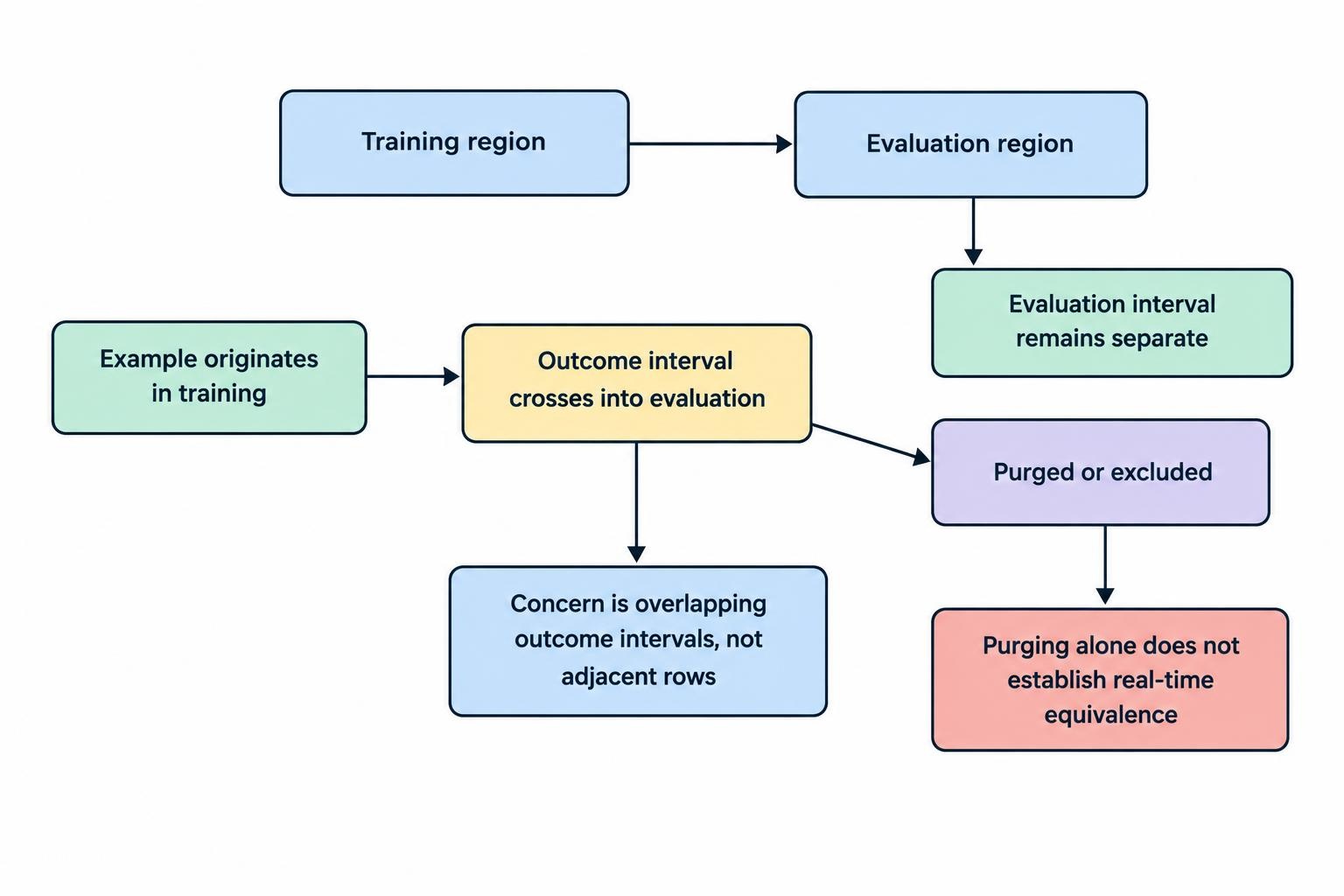
Choose exclusions from actual information intervals, label horizons and dependencies, not a percentage copied from another strategy. A fixed row gap may suit regularly spaced, fixed-horizon labels; irregular events or variable holding periods need interval-level checks. Purging does not make training on later history equivalent to a real-time deployment simulation.
Test Whether Performance Survives Reasonable Changes
Once the timing and validation boundaries are sound, examine fragility. Change one assumption at a time and retain every result. The aim is to challenge the proposed edge, not find a new winner.
Check neighboring parameter values. If a lookback of 20 performs acceptably, examine nearby settings rather than celebrating 20 as a magic number. A broad region of usable results is more reassuring than one isolated peak, though neither proves future profitability.
Test execution assumptions too. Increase estimated costs, delay entries, reduce assumed fills and examine capacity constraints. Record whether the strategy remains economically useful rather than whether its gross return stays positive.
Inspect performance by period, instrument and trade contribution. A strategy supported almost entirely by one asset or a handful of trades needs a clear explanation. Do not automatically remove those trades: genuine strategies can have concentrated payoffs. Report the dependence instead.
Keep position sizing fixed during these comparisons unless sizing is the stated subject of the test. Otherwise, exposure changes can disguise signal deterioration. Define those boundaries through explicit entry, exit and position-sizing rules.
Set a Release Gate Before Trading
Write acceptance conditions before opening the final evaluation results. Avoid a universal Sharpe ratio, trade count or sample length: the required evidence depends on trading frequency, dependence between outcomes, implementation costs and the breadth of the search.
A practical release gate should require:
- A reproducible dataset, strategy version and complete experiment log.
- Documented publication, receipt, signal and execution timing.
- Clean training boundaries for features, preprocessing and outcome labels.
- Acceptable evaluation results under predefined cost and sensitivity tests.
- A written explanation of concentrated returns and unresolved data weaknesses.
After freezing the strategy, paper trading before live deployment provides another check on signal timing and order handling. It does not establish achievable live fills, but it can expose differences between the research implementation and the running system.
The strongest safeguard is a process that allows a promising strategy to fail. Preserve disappointing results, disclose assumptions and stop treating every weak test as an invitation to add another filter. A backtest earns its place by surviving scrutiny, not by producing the prettiest chart.