Binary options payouts tell you what a winning contract returns. Trading costs tell you how much of that return you keep. Confusing the two can make an unattractive trade look profitable, especially when a platform displays a large percentage beside a small stake.
The useful comparison is not “Which contract advertises the highest payout?” It is “What can I gain, what can I lose, and what charges apply to each outcome?” A $100 winning trade that earns $80 does not offset a $100 losing trade. Add fees, and the gap grows.
This guide separates advertised payouts from net profit, explains how different payment structures work, and shows how to calculate costs before committing money. All numerical examples are hypothetical, not current platform offers or fee schedules.
What Does a Binary Options Payout Actually Mean?
A binary option settles against a stated condition. For a buyer holding a cash-or-nothing contract through expiry, the settlement is a predetermined cash amount if the condition is met, or zero if it is not. The word payout, however, can describe either the total money returned or just the profit on the stake.
Those are different numbers. Before comparing contracts, separate three amounts:
- Stake or purchase price: the money committed to acquire the position, excluding any separately charged fees.
- Gross cash returned: the amount credited when the position settles, before charges.
- Net profit or loss: cash returned minus the purchase cost and all applicable charges.
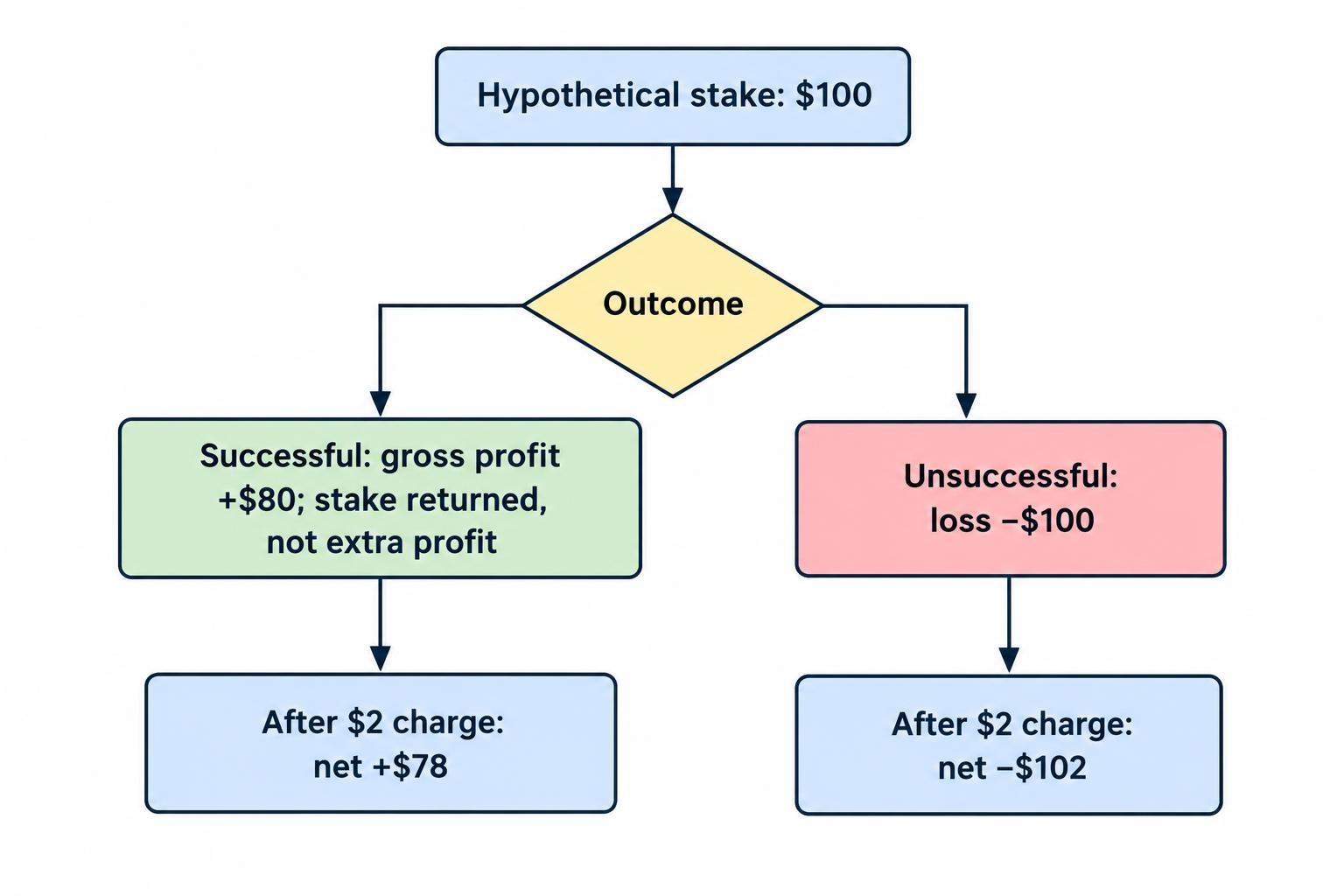
Suppose a contract requires a $100 stake and advertises an 80% profit payout. If successful, it returns the $100 stake plus $80 profit, making the gross cash returned $180. If unsuccessful, with no refund provision, it returns nothing and the loss is $100.
The distinction matters because a positive outcome does not necessarily pay enough to compensate for an equally frequent negative outcome. The SEC’s binary options investor warning identifies this payout imbalance as a reason advertised returns can mislead investors.
Percentage Payouts and Fixed Settlement Amounts
A percentage return on a stake
Under a quoted percentage structure, the contract states the profit payable on a successful stake. At an 80% profit payout, a $50 stake earns $40 before fees. At 70%, the same stake earns $35. The unsuccessful outcome can still cost the full $50.
Read the order confirmation rather than relying on a promotional banner. Establish whether “80% payout” means an 80% profit plus return of the stake, or a total payment calculated another way. If the wording is unclear, the economics are unclear.
A purchase price below a fixed settlement value
A different structure prices the contract against a fixed cash settlement. Consider a hypothetical contract that costs $42 and pays either $100 or zero at expiry. A successful purchase earns $58 before fees: $100 received minus $42 paid. An unsuccessful purchase loses $42.
The $100 settlement is not $100 of profit. The gross return on the purchase cost is $58 divided by $42, or approximately 138.1%. That large percentage does not establish that the trade offers good value; it must be weighed against the likelihood of receiving nothing.
These examples describe purchases held to expiry, not every possible position or early exit. The mechanics of expiry conditions and settlement belong in the separate guide to binary options pricing, expiry, and settlement.
Calculate Net Profit for Both Outcomes
Calculate the winning and losing results separately. A single “return” figure hides the difference between charges deducted on entry, charges applied only to successful settlements, and account costs paid later.
Net winning profit = gross cash returned − stake or purchase price − winning-outcome charges.
Net losing result = cash returned after an unsuccessful outcome − stake or purchase price − losing-outcome charges.
Take the $100 stake with an $80 winning profit. Assume a hypothetical $2 transaction charge applies whether the trade succeeds or fails. The winning result becomes $78, while the losing result becomes minus $102.
Across ten equal-sized trades, six wins and four losses produce $480 in winning profits and $400 in lost stakes before fees. That leaves $80. Ten charges of $2 reduce the result to $60. These figures illustrate arithmetic, not an expected trading performance.
Do not subtract the stake twice. If a statement already reports an $80 profit rather than the $180 total returned, subtracting another $100 would distort the result. Reconcile the transaction history with the actual account balance movement.
Trading Costs to Check Before Placing an Order
A claim of “zero commission” answers only one question. It does not tell you whether the payout terms are favorable, whether an early exit involves a spread, or whether moving money into and out of the account carries charges.
| Cost | What to establish | Effect on the result |
|---|---|---|
| Transaction commission | Whether it applies per order, contract, or completed transaction | Reduces profit and can increase the total loss |
| Settlement charge | Whether it applies to successful outcomes, all settlements, or neither | Changes the amount retained at expiry |
| Bid and ask spread | The executable buying and selling prices, where trading before expiry is available | Creates a cost when crossing the spread |
| Funding and withdrawal charges | Provider charges, payment method costs, and minimum fees | Reduces cash available outside the trading account |
| Currency conversion and account charges | Conversion rates, inactivity terms, subscriptions, and other applicable charges | Reduces the account’s net result even without another trade |
Not every contract or account has every charge listed here. Check which apply rather than adding imaginary costs or assuming they are absent. Record minimum charges and caps too: a flat fee can consume a larger share of a small position.
Compare costs in dollars as well as percentages. A $1 charge is 1% of a $100 stake but 10% of a $10 stake. Small stakes reduce the dollars exposed to a losing outcome; they do not automatically make the fee structure economical.
How Spreads and Early Exits Affect Returns
If a contract supports trading before expiry, the final settlement amount is not the same as the price available for an early sale. Selling closes the position at an executable market price, not at the amount you hope it will eventually pay.
Consider a hypothetical $100-settlement contract quoted at a $46 bid and $50 ask. Buying at $50 and immediately selling at an unchanged $46 bid would lose $4 before commissions. The underlying event need not change for that spread cost to appear.
If the bid later rises to $61 and you sell, the gross trading profit is $11: $61 received minus $50 paid. Deduct any entry and exit charges. Do not substitute the potential $100 expiry payment into the calculation; the position ended at the sale.
For a quoted early-close offer rather than an order book trade, compare the actual cash offered with the original stake and any charges. Do not assume an exit will be available simply because a demonstration screen displayed one. Review the contractual conditions before relying on it.
Why Winning More Than Half Your Trades May Not Be Enough
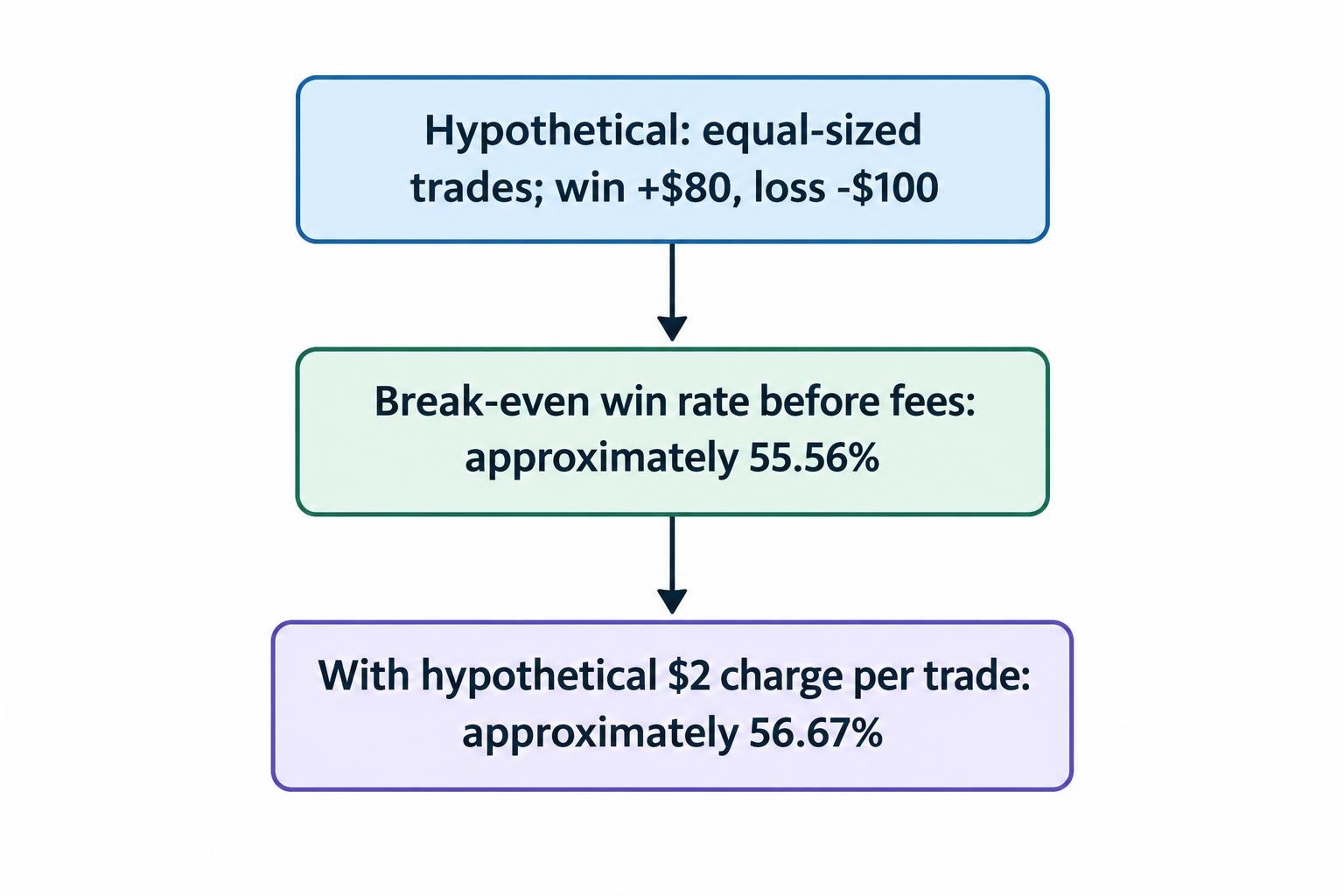
A win rate means little without the average amount won and lost. With an $80 winning profit and a $100 losing stake, five wins and five losses produce a $100 loss before fees. The successful trades earn $400; the unsuccessful trades lose $500.
Under those assumptions, the break-even win rate is approximately 55.56%. With the hypothetical $2 charge on every trade, it rises to approximately 56.67%. Both thresholds assume equal stakes, unchanged payouts, no refunds, and no other costs.
The full calculation, including other payout levels, is covered in calculating binary options break-even win rates. Here, the practical point is simpler: count dollars retained, not just green marks in a trading history.
A higher advertised payout does not automatically identify the better opportunity. If the probability of success differs between contracts, comparing payout percentages alone leaves out half the calculation. Nor does a past winning percentage establish the probability of future success.
Account Costs, Bonuses, and Withdrawal Conditions
Account costs require a separate calculation from individual trade results. Suppose a hypothetical account earns $120 after transaction charges, then incurs $15 in withdrawal and conversion costs. The cash profit retained is $105. If those charges were already included in the $120 figure, subtracting them again would be double counting.
Allocate recurring charges consistently when reviewing performance. A $30 monthly subscription spread across 30 trades represents $1 per trade for analytical purposes. It remains a $30 account expense even if you place no trades. Making extra trades to dilute that average does not remove the expense.
Bonuses need a different kind of scrutiny. The CFTC’s warning about off-exchange binary options describes bonus arrangements requiring a minimum amount of trading before withdrawals, as well as complaints involving hidden charges to return funds.
For a hypothetical $100 bonus requiring $3,000 in qualifying turnover, the comparison is not simply “$100 free.” Establish which trades count, whether the condition affects deposited funds, when it expires, and whether the bonus can be declined. Extra trading exposes more money to losses; a larger screen balance is not necessarily more withdrawable cash.
Treat unexpected demands for further deposits to release an existing balance as a warning, not as an ordinary cost to include in your profit forecast.
Check Legal Access Before Comparing Payouts
For a U.S. resident, a website accepting a deposit does not establish that it is authorized to offer the product. Verify the legal entity, its registration, and whether the offered activity is covered before sending money or identity documents.
The CFTC’s guidance on unregistered binary options platforms warns about unauthorized operations and stresses that registration checks can help identify them. Registration is not a guarantee against fraud, and it does not guarantee profitable trading.
Keep this check separate from the payout calculation. A mathematically attractive quoted return is worthless if the balance cannot be withdrawn or the displayed transactions are not genuine. The guide to checking binary options platform registration and availability covers that review without confusing it with fee comparisons.
Build a Cost Record Before Risking Money
Use a simple record containing the stake or purchase price, quoted winning return, unsuccessful-outcome payment, entry charges, settlement or exit charges, and final net result. Keep account costs in a separate ledger, then reconcile both records to deposits, withdrawals, and the ending balance.
Save the order confirmation and the applicable terms. If a quoted payout changes between opportunities, record the figure available for each trade. Applying one favorable payout percentage to every historical result can overstate what a strategy would have earned.
A practice account can help check your arithmetic and whether you have interpreted the display correctly. It cannot prove that a real withdrawal will be honored or that live trading conditions will match. Keep those distinctions clear when comparing binary options demo accounts and live trading.
Before placing an order, you should be able to state the maximum cash loss, the net winning profit, and every known charge in dollars. If any of those amounts remains unclear, stop at the calculation stage. A payout percentage is an offer term, not a profit forecast.