News alerts around an investment watchlist should answer one question: has anything changed that deserves a review of the investment case? A useful system brings relevant announcements to your attention without turning every headline into a reason to trade.
Start with the companies and funds you own, add investments you are actively researching, then define the events worth monitoring. Combine direct company announcements, regulatory filings and selected news searches. Give urgent developments a separate channel from routine coverage, and decide what happens after an alert arrives.
This approach supports using financial news for long term investing: information feeds a considered review rather than an automatic transaction. The aim is a manageable research queue, not a phone that vibrates whenever someone publishes an opinion.
Build the Watchlist Before Building the Alerts
A ticker list is not yet an alert plan. For each investment, record its full legal name, ticker, exchange, investor relations page and the reason it belongs on your list. Where names are ambiguous, include the business division, product or geography that matters to your research.
Separate holdings from candidates. A company representing a large share of your portfolio deserves a different review priority from a business you might investigate next year. You can keep both on one watchlist, but they should not compete for the same notification settings.
Add a short investment thesis and two or three developments that would challenge it. For a manufacturer, those might be weaker order intake, rising borrowing needs or the loss of a major customer. For a subscription business, you might monitor customer retention, pricing and cash generation.
These are monitoring choices, not universal investment rules. Their purpose is to make relevance explicit. Without them, an alert system has no reliable basis for distinguishing a consequential announcement from another interview with the chief executive.
Choose Sources by the Job They Perform
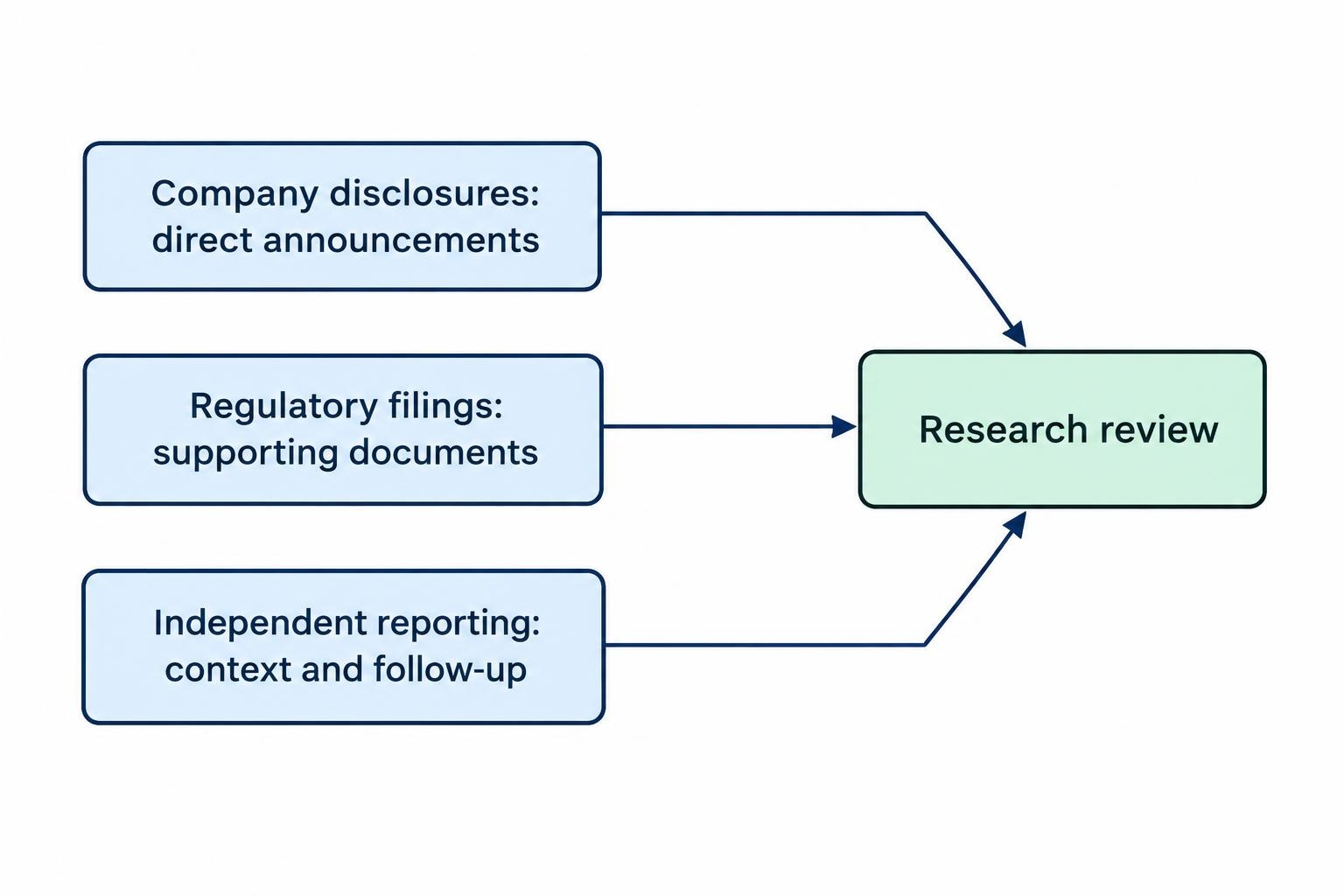
Use three source layers: company disclosures for direct announcements, regulatory filings for supporting documents, and independent reporting for context and follow-up. Avoid subscribing to several services that perform exactly the same job.
Start With Company Announcements
Visit each company’s investor relations section and check whether it offers email subscriptions. Where categories are available, select financial results, corporate announcements, filings and investor events that match your monitoring plan. Keep the announcement archive bookmarked even if you subscribe.
For a fund or ETF, look for the provider’s notices concerning the fund itself. Your alert plan might include changes to fees, investment objectives, distributions or closure proposals. Do not assume that monitoring a few large portfolio holdings covers the fund’s own announcements.
Add a Regulatory Filing Feed
For companies filing with the US Securities and Exchange Commission, EDGAR offers company filing subscriptions through feeds that can be filtered by filing type. The SEC’s EDGAR RSS instructions describe company and latest-filings subscriptions. Use a compatible feed reader, and check its refresh and notification settings rather than assuming every new filing produces an immediate email.
For investments outside the US, identify the relevant official disclosure channel and check its subscription options. Record which channel you expect to carry company announcements, and retain a direct route to search it manually.
Use News Searches to Fill Gaps
Use broader searches for customer developments, competitors, litigation coverage and industry reporting. Keep these separate from official disclosures so that a commentary article does not arrive with the same apparent importance as a company announcement.
A small source set is a sensible starting point. Add another feed only when you can name the gap it fills. More subscriptions can mean more administration rather than better coverage.
Write Search Alerts Around Events, Not Just Tickers
A search for a company name alone is a useful starting test, but it should not be the finished setup. Short tickers and common brand names need particular care. Pair them with the company’s full name or an identifying business term, and inspect the results before saving the alert.
Where your chosen service supports them, test quotation marks, alternative terms and exclusions. Search syntax differs between services, so treat a query as a draft until its preview returns relevant material.
Google’s alert setup instructions provide controls for notification frequency, source types, language, region, result volume and the receiving account. These settings let you separate a broad research digest from a narrower company search. They are not a promise that every relevant announcement will be found or delivered at publication time.
| Alert purpose | Illustrative search terms | Suggested handling |
|---|---|---|
| Results and outlook | Full company name with earnings, results, guidance or outlook | Review around the reporting date |
| Financing concerns | Full company name with refinancing, covenant, liquidity or default | Prompt verification against original documents |
| Business developments | Full company name with contract, acquisition, disposal or recall | Daily review, escalating where relevant |
| Industry research | Product category with demand, capacity, regulation or pricing | Weekly research digest |
The terms above are query ingredients, not copy-and-paste instructions for every platform. Create separate searches for different questions. If you exclude terms to remove irrelevant results, check that you have not also removed useful criticism or adverse coverage.
Give Each Alert a Review Priority
Decide how an alert should be handled before it arrives. A practical starting structure is prompt review, daily digest and scheduled research. “Prompt review” means checking the evidence sooner; it does not mean buying or selling sooner.
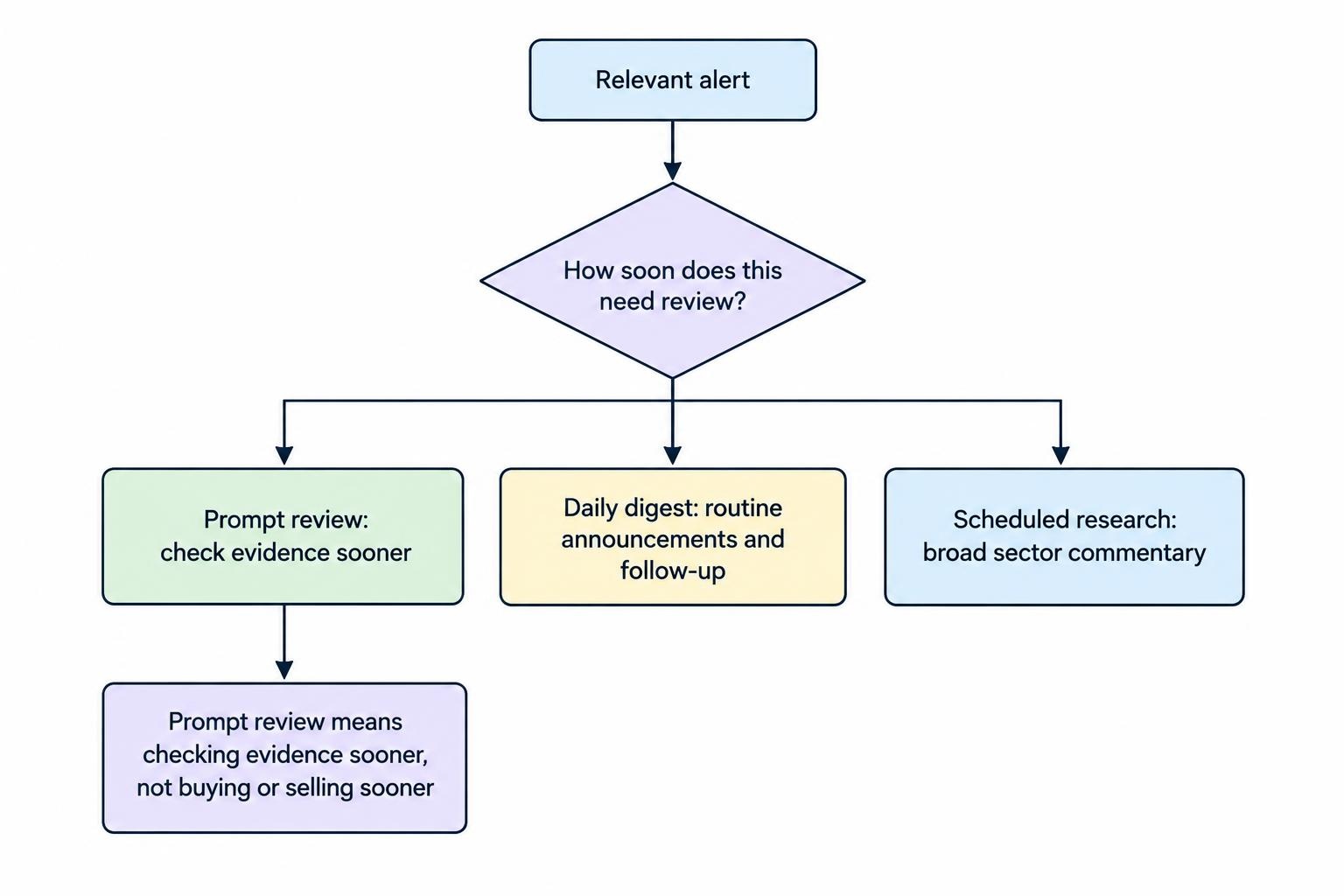
Reserve interruptions for developments that could challenge your thesis or require attention before a stated deadline. Put routine announcements and follow-up reporting into a daily folder. Keep broad sector commentary for a weekly reading session.
For US reporting companies, Form 8-K can contain information about events such as material agreements, bankruptcy, financial results and concerns about previously issued financial statements. The SEC’s guide to reading Form 8-K also explains why an earnings release may appear as an exhibit and why fuller financial statements can follow in periodic reports. Configure filing alerts as an invitation to inspect the relevant item and attachments, not as a verdict on the business.
Distinguish a risk alert from an opportunity alert. A verified financing problem in an existing holding may justify bringing forward your research. A favourable article about a watchlist candidate can usually wait for the next planned review.
Keep an Earnings Calendar Alongside the News Feed
Do not make search alerts your only reminder for scheduled events. Maintain a calendar of expected results dates and investor presentations, then confirm those dates against company announcements as they approach.
Set a preparation reminder before each event. Revisit the previous reporting period, write down the figures you want to check and note any unanswered questions. After publication, compare the new evidence with those expectations rather than letting the headline choose the subject.
Give each company a short monitoring card: the next expected event, two or three measures to review, and the documents needed to assess them. The broader process of reviewing earnings announcements against a long-term investment thesis should remain separate from configuring notifications.
Add another reminder if documents are still outstanding. An initial release, presentation and later report may form one research task, but your alert service may deliver them separately.
Remove Duplicates and Test What You Missed
Review the setup after the first two weeks. Use that period as a trial, not proof that the system is complete. Count which alerts were useful, which repeated an existing story and which concerned the wrong company.
Group coverage by event where possible. Keep one main entry for an announcement and attach later reporting only when it adds information. A rewritten headline should not reopen a completed research task.
Check for missing items as well as excess noise. Compare your received alerts with the company’s announcement archive and relevant official filing history for the same period. Record anything absent and investigate whether the cause was your query, source selection, delivery settings or inbox filtering.
Do not judge success by notification volume. A quieter feed is useful only if it still captures the events you intended to monitor. Keep a manual review schedule as a backstop.
Verify the Announcement Before Updating Your View
When an alert looks important, open the original document. Check the company identity, publication date, event date and reporting period. Distinguish a proposal from a completed transaction, and a management forecast from a reported result.
Read the relevant attachments, corrections and qualifications. Ask whether several articles contain independent reporting or repeat one announcement. For a more detailed verification process, use the checks in how to verify financial news sources.
Keep social posts in a separate, unverified queue. The SEC’s investor alert on social media stock scams warns against making investment decisions solely from social platforms or apps and describes false rumours and misleading promotions. A popular post is a reason to investigate a claim, not evidence that the claim is true.
Be just as disciplined with automated summaries. Require a link to the underlying document and verify any figure that would affect your assessment. If the original evidence cannot be located, leave the claim unresolved.
Work Through a Watchlist Example
Consider a hypothetical investor holding a manufacturer and researching a software company. The manufacturer’s thesis depends on steady customer demand and manageable debt. The software company remains a candidate because its valuation needs further work.
For the manufacturer, the investor sets up company announcement emails, a filing feed and searches covering its name alongside orders, refinancing and customer contracts. Official announcements enter a review folder; searches feed a daily digest. The investor assigns potential financing trouble a prompt-review label.
For the software candidate, the investor tracks results, pricing changes and major product announcements through a weekly research queue. There is no reason to interrupt work for every favourable mention of a company that is not yet ready for an investment decision.
Suppose a report says the manufacturer has lost a customer. The investor first locates the underlying announcement, checks whether the contract ended early or expired, and compares the disclosed impact with the existing thesis. The alert has done its job by identifying a question. The evidence still has to answer it.
Turn Alerts Into a Repeatable Review Process
For each relevant event, record the original document, what changed, which assumption it affects and what remains unknown. Choose a next step: no change, further research, an updated valuation or a portfolio review under your existing investment policy.
Keep that decision record short enough to maintain. A sentence such as “New contract announced; financial contribution undisclosed; revisit at next results” is more useful than an inbox full of unread coverage.
Once a month, remove obsolete searches, update company names and check that subscriptions still arrive. Review alerts after selling an investment too: either retain them for a stated research reason or switch them off.
A well-built watchlist alert system ends with a research decision, not a trading instruction. Its value is practical: relevant evidence reaches you, distractions stay contained, and each announcement has a clear place in your review process.