AI for financial information analysis uses machine learning and language models to turn news, company filings, earnings calls, and economic releases into material that analysts can search, compare, and review. The practical aim is to answer a defined question faster, without losing the evidence behind the answer.
That distinction matters. Extracting a company’s revised revenue guidance is an information task. Deciding whether its shares offer an attractive return is an investment judgment. An AI system should not slide from one to the other without making the assumptions visible.
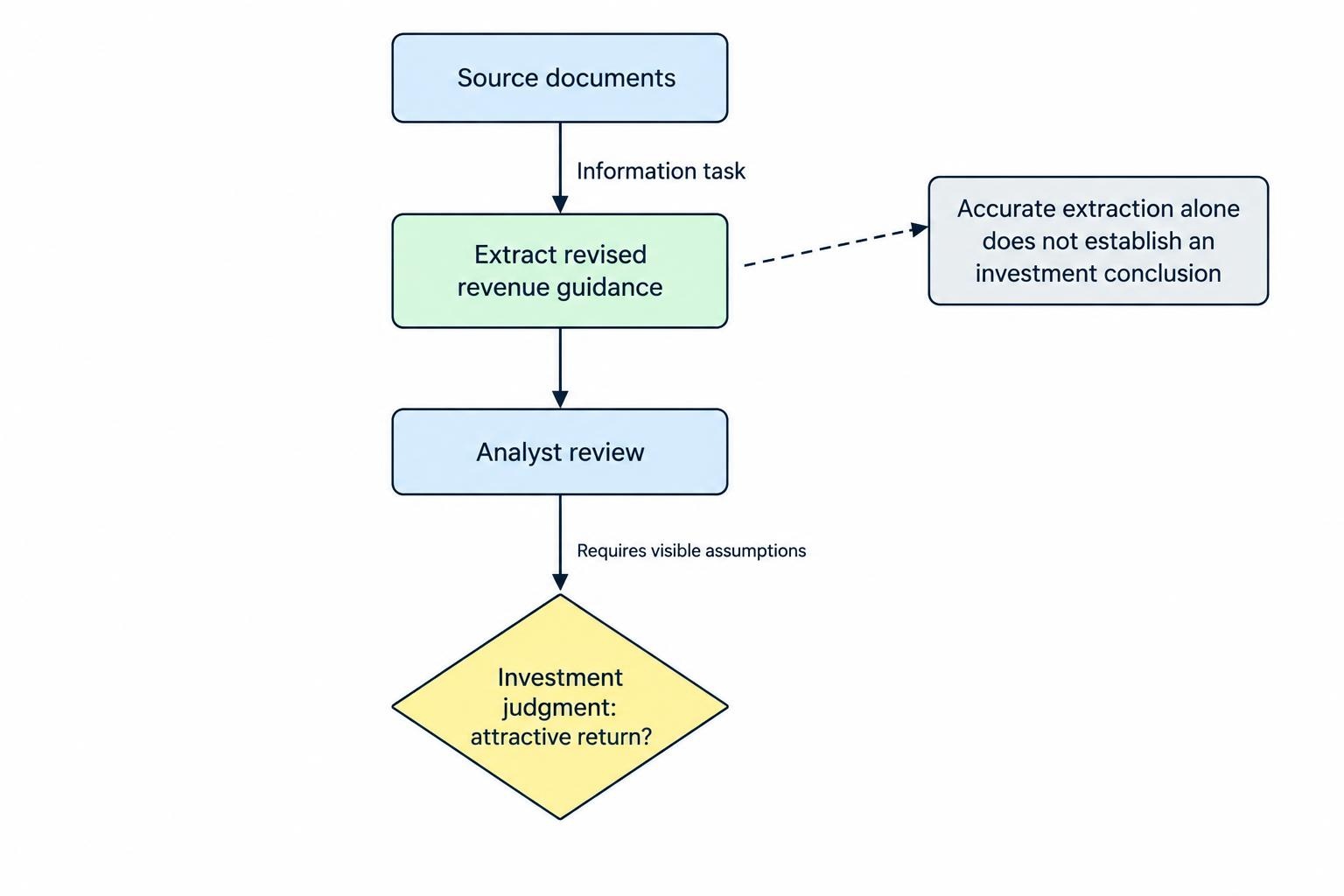
A useful setup therefore starts with source documents and ends with a reviewable research output, not an unexplained buy or sell instruction. This guide covers the methods, inputs, checks, and purchasing decisions that make that process workable.
What AI Should Do in Financial Research
Start with a narrow assignment. “Analyze this company” leaves too much room for interpretation. “Compare this quarter’s margin guidance with the previous release, preserve both ranges, and identify the stated reasons for any change” produces an answer that can be checked.
Separate information processing from forecasting. A model that accurately identifies a dividend announcement has completed an extraction task. It has not demonstrated that it can predict the next price move.
| Task | Useful output | Required check |
|---|---|---|
| Document extraction | Revenue, guidance, dates, and business segments | Match each field to its original passage or table |
| Summarization | A short account of reported developments | Check omissions, qualifications, and numerical accuracy |
| Document comparison | Changes in forecasts, disclosures, or management language | Compare equivalent periods and definitions |
| Sentiment classification | Positive, negative, or mixed language about a subject | Identify whose outlook is being classified |
| Research prioritization | A queue of events requiring human attention | Measure missed events as well as false alerts |
Choose the output before choosing the model. A fixed set of fields may call for a parser and validation rules. A comparison of management explanations may justify a language model. More elaborate software is not automatically a better research process.
How the Main Analysis Methods Fit Together
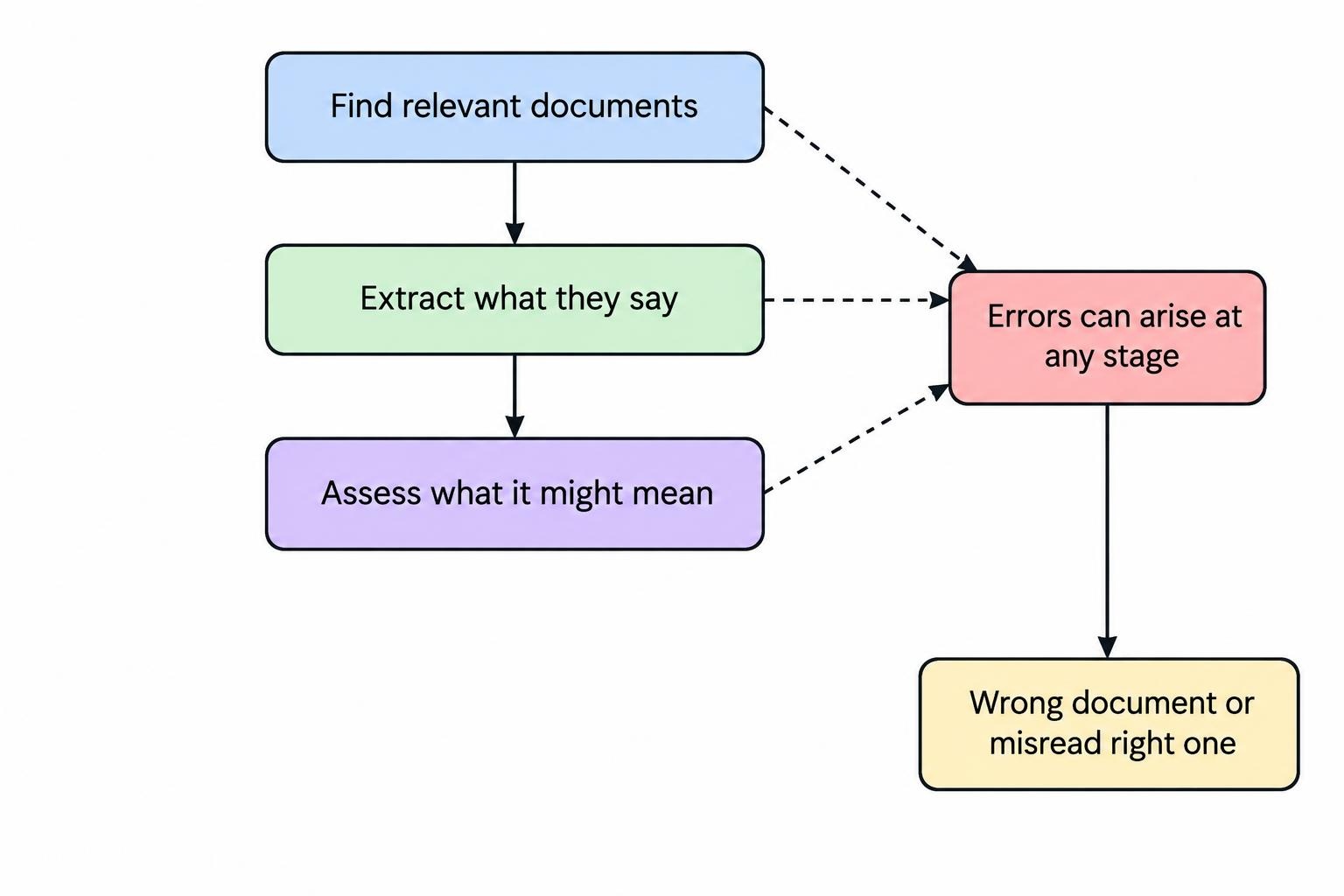
Think of the workflow as three separate jobs: find the relevant material, extract what it says, then assess what it might mean. Keeping these jobs separate makes errors easier to locate. A poor answer might come from retrieving the wrong document rather than misreading the right one.
Retrieval augmented generation, usually shortened to RAG, combines document retrieval with text generation. Instead of relying only on information stored during training, the system retrieves passages to inform its response. The underlying approach is set out in the original retrieval augmented generation research paper.
For financial research, configure retrieval around an approved collection of filings, releases, and transcripts. Require the answer to identify the documents and passages it used. Retrieval gives the system evidence to work with; treat the resulting answer as a draft that still needs verification.
Use conventional calculations for arithmetic. Let the language model identify the relevant figures, then pass validated values to a spreadsheet or calculation service. Preserve the inputs and formula beside the result. There is little benefit in making a language model improvise a percentage change.
Build the Process Around Reliable Financial Data
Define a source hierarchy before collecting documents. Use original company disclosures for reported company figures, official statistical releases for economic data, and original policy publications for central bank decisions. News coverage can provide context and competing interpretations, but keep those separate from the underlying announcement.
For US public company research, the SEC’s EDGAR API documentation describes access to company submission histories and extracted XBRL financial statement data. The documentation also flags differences in reporting dates and the scope of aggregated facts. A structured field still needs the right reporting context.
Preserve that context in every record: issuer identity, document type, publication time, reporting period, currency, units, and document version. Store when your system received the material too. Publication time and arrival time answer different questions.
Keep revisions separate from original releases. Otherwise, a later correction can silently replace what an analyst actually knew at the time. Also distinguish consolidated figures from segment results and quarterly amounts from year to date totals. A correct number attached to the wrong period is still a wrong answer.
Where AI Fits Across News, Earnings, and Sentiment
Financial news and event monitoring
Give a news analysis system a watchlist and an event definition. Suitable assignments include identifying guidance changes, management departures, financing announcements, or production interruptions. Ask it to extract the event, affected company, publication time, and unresolved questions rather than produce a generic summary.
Group repeated coverage of the same announcement before creating alerts. Ten articles repeating one press release should not become ten independent confirmations. The guide to extracting information from financial news with AI covers this workflow in more detail.
Earnings calls and company disclosures
For earnings analysis, structure the review around changes: what changed in the reported figures, what changed in guidance, and what changed in management’s explanation? Keep prepared remarks separate from analyst questions and management answers.
Ask for the passage supporting each claimed change. If management discusses demand without quantifying it, preserve that absence rather than supplying an estimate. The guide to using language models to analyze earnings calls develops the comparison process without treating confident language as evidence of stronger performance.
Financial sentiment analysis
Define the target before assigning a sentiment label. A statement can be positive about company revenue and negative about profit margins. A rise in borrowing costs can have different implications for a lender and a heavily indebted borrower.
Use separate labels for the subject, outlook, and stated reason. Avoid compressing an entire document into one score unless that score serves a tested purpose. Our guide to financial sentiment analysis and its limitations examines these distinctions across news and social media.
A Practical Workflow: Reviewing a Guidance Change
Consider a hypothetical manufacturer that revises annual revenue guidance from $4.8–$5.0 billion to $4.5–$4.7 billion. Management cites delayed customer orders and leaves its operating margin outlook unchanged.
A useful AI output would report the two ranges, identify the reporting period, preserve the margin statement, and retrieve the passage about order delays. It would not convert “delayed” into “cancelled” or describe the margin outlook as reduced.
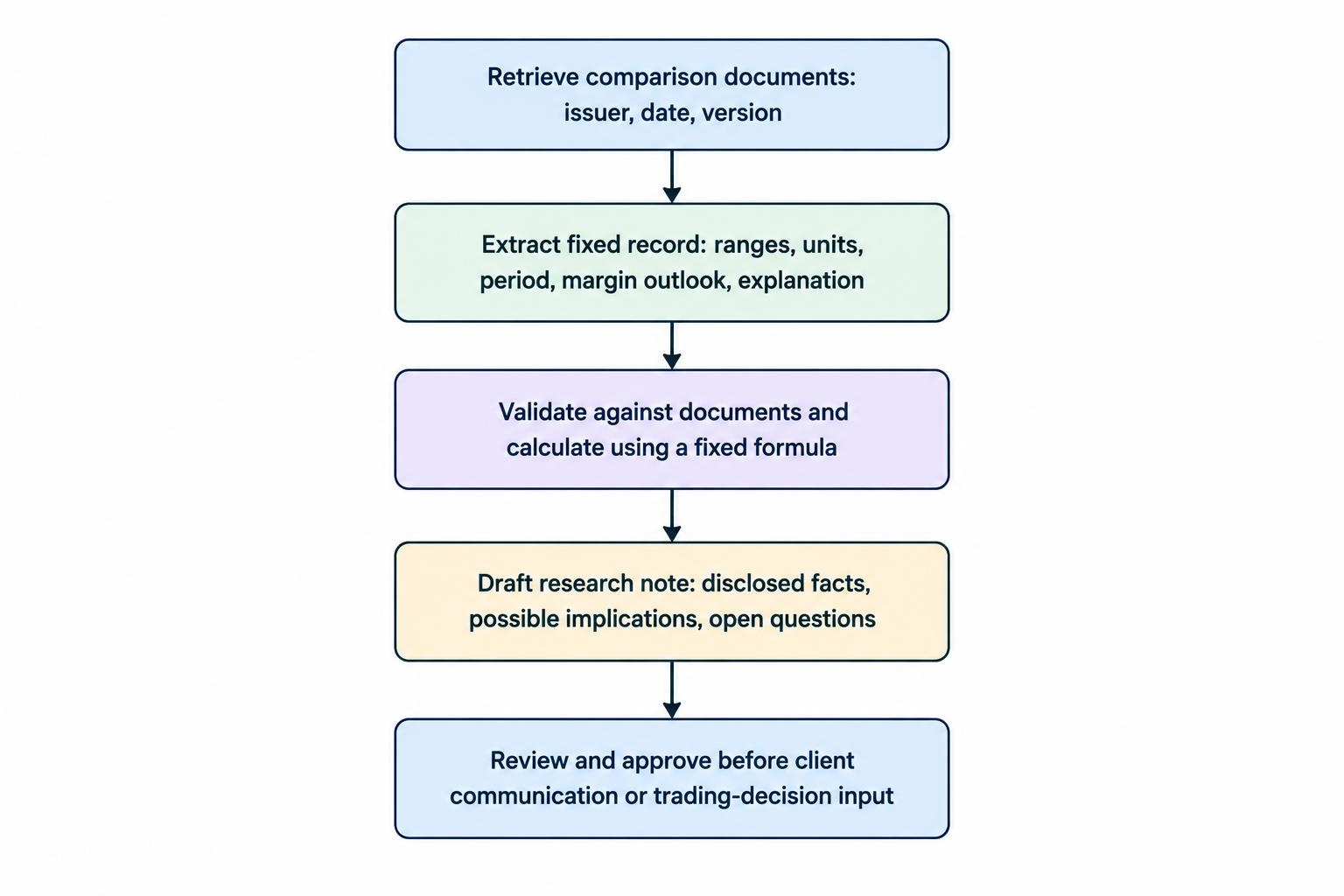
Build the review in five stages:
- Retrieve the comparison documents. Select the new announcement and the previous guidance release, checking issuer, date, and version.
- Extract a fixed record. Capture both ranges, units, forecast period, margin outlook, and management’s stated explanation.
- Validate and calculate. Compare the extracted values with the documents, then calculate the change using a fixed formula.
- Draft the research note. Separate disclosed facts from possible implications and questions that remain unanswered.
- Review before distribution. Require approval before the note becomes a client message or an input to a trading decision.
In this example, the revenue guidance midpoint falls from $4.9 billion to $4.6 billion, a reduction of approximately 6.1%. Label this as a calculated midpoint change, not a management quotation or an earnings forecast.
The interpretation should remain conditional. Delayed orders might move revenue into a later period, but the announcement alone does not establish when those orders will return. The research note should identify that uncertainty and ask whether management disclosed a revised delivery schedule.
A compact output should contain four blocks: reported change, supporting evidence, calculated comparison, and open questions. This gives the reviewer a short route back to the documents. A polished paragraph with no evidence trail is harder to challenge, however reassuring it sounds.
Check AI Outputs Before Using Them
Generative models can confidently produce false statements, invented citations, and explanations that appear to justify an incorrect answer. These risks are covered in the NIST Generative AI Risk Management Profile. Fluent writing should never serve as an accuracy test.
Review claims at field level. Confirm each figure, period, unit, quotation, and issuer against the original document. Then check the relationship between them. “Revenue increased, but guidance fell” must not become “revenue guidance increased” during compression.
Inspect omissions as carefully as additions. A summary that reports an increased forecast but drops the condition attached to it can distort the announcement without inventing a single number. Require uncertainty and qualifications to survive the summary.
Use an explicit “not stated” result when evidence is missing. Do not require the system to fill every field. A blank supported by the document is more useful than a guess dressed for a board meeting.
Make this a repeatable review procedure rather than an informal final read. The guide to checking AI summaries for errors and unsupported claims provides a closer look at evidence matching and correction.
Evaluate Research Quality Separately From Trading Results
Build a reviewed test set before rolling out the workflow. Include ordinary announcements, revisions, ambiguous language, missing figures, and documents containing several reporting periods. Record the expected answer and the passage that supports it.
Measure extraction accuracy, unsupported claims, missed events, false alerts, and review time separately. An average score can conceal a serious weakness. Getting company names right does not compensate for repeatedly reversing increases and decreases in guidance.
Set acceptance thresholds around the cost of an error. A reading queue can tolerate different mistakes from a system drafting client communications. Reject outputs with missing evidence rather than letting a high average score excuse them.
For any proposed trading application, keep a further evaluation boundary. Accurate extraction does not establish profitable execution. Historical testing should preserve the information available at each decision time and account for delays and trading costs. Use the guide to data leakage and overfitting in AI trading backtests before interpreting a historical result as a usable signal.
Retest after changes to the model, retrieval settings, prompts, or document parser. Save the configuration with each test run so that a later result can be compared with the version it replaces.
Control Access and Dependence on Providers
Keep the research system separate from order submission unless a separately approved process authorizes that connection. Give document collection components read access where possible, and keep account credentials out of prompts and uploaded research files.
AI adoption also creates risks beyond an individual incorrect summary. Provider concentration, market correlations, cyber risk, and weaknesses in model governance are among the vulnerabilities identified in the FSB report on AI and financial stability.
Translate those concerns into operating controls. Keep a manual route to original disclosures, define what happens when retrieval fails, and make stale data visible. A service outage should produce a clear failure notice, not yesterday’s answer presented as fresh analysis.
Treat external documents as research material, never as authority to change system permissions or handling rules. Assign ownership for correcting erroneous outputs and notifying anyone who received them.
Choose Tools by Evidence, Coverage, and Cost
Evaluate a proposed tool against your own documents and review process. Ask it to complete a small set of representative tasks, including cases with missing evidence. Compare the resulting records with your reviewed answers, not with the quality of the sales demonstration.
Ask how the provider handles source coverage, timestamps, document revisions, retention, access controls, and model updates. Provider dependencies deserve ongoing attention, not a one time procurement check; the FSB’s 2025 AI monitoring report includes a case study on third party dependencies and service provider concentration.
Calculate cost per reviewed output. Include data access, document processing, retrieval, model use, storage, and analyst correction time. A cheap summary is not cheap if someone must reconstruct its evidence from scratch.
Start with one bounded workflow, such as guidance comparisons for a defined watchlist. Expand only after it meets documented quality and operating requirements. The standard is practical: every material claim should lead back to evidence, every calculation should be reproducible, and every consequential decision should have an accountable owner.