Earnings announcements should test a long-term investment thesis, not replace it with a verdict on the latest quarter. The useful question is whether new results change the company’s capacity to earn profits, generate cash and fund growth over several years. Beating an analyst estimate is a different test.
A disciplined review connects each announcement to the reasons for owning the business: customer demand, pricing power, competitive position, financial strength and the price paid for those qualities. This is the company-level work within using financial news for long-term investing. The aim is to update assumptions when evidence changes, without treating every earnings headline as an instruction to trade.
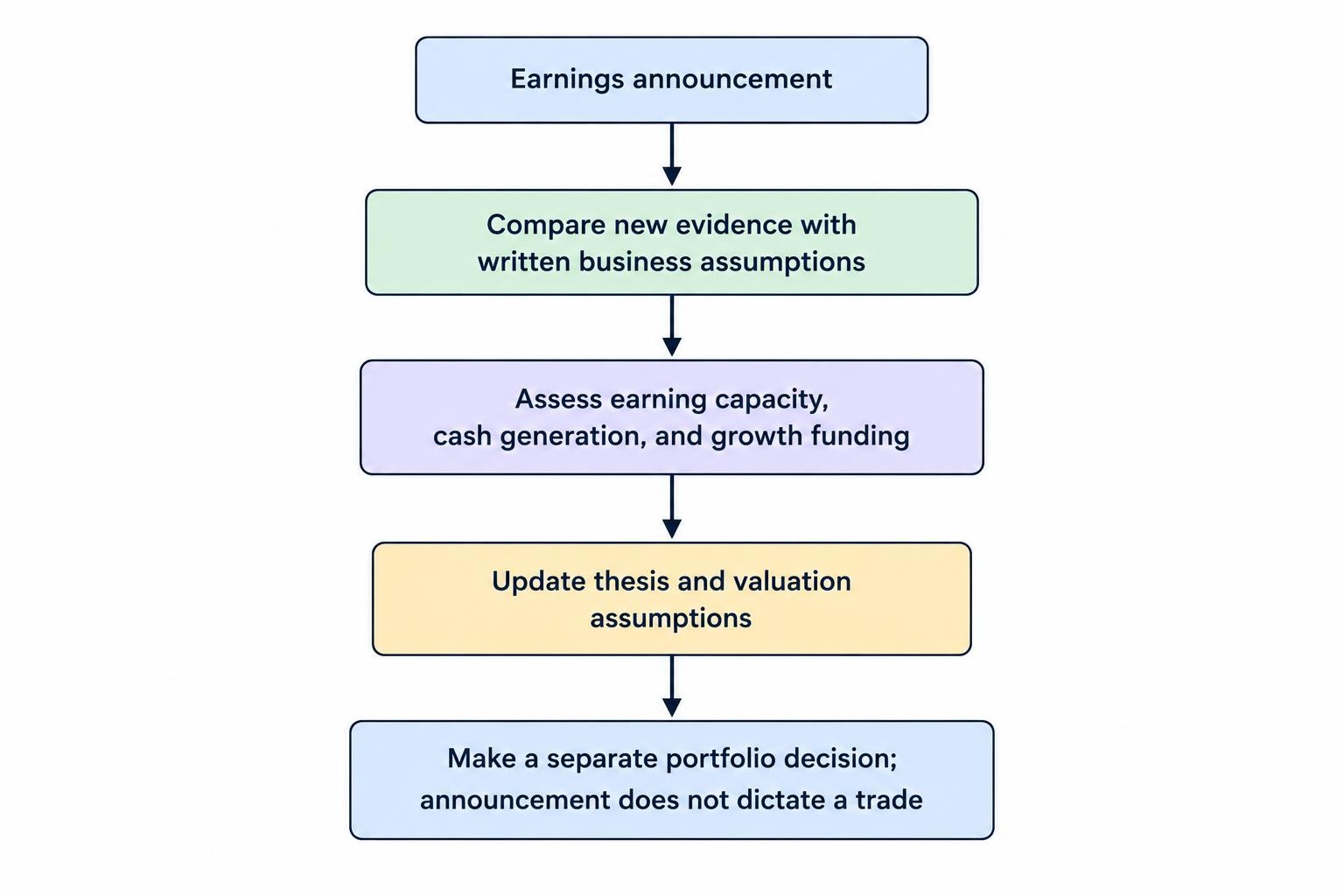
Write the Investment Thesis Before Earnings Arrive
An investment thesis is a testable explanation of why a business could produce attractive returns at its purchase price. “It is a good company” is not enough. Neither is “the shares used to trade higher.” A useful thesis identifies what must happen, over what period, and what would prove the argument wrong.
Consider a hypothetical industrial supplier. The investment case might depend on replacement demand supporting sales, service contracts lifting margins, and existing factories handling more production without a matching increase in capital spending. Each assumption creates a question for the next earnings review.
Write down the evidence that would weaken those assumptions too. Falling service renewals could challenge customer loyalty. Persistent discounting could challenge pricing power. Repeated factory expansion could challenge the expectation of modest reinvestment needs.
Keep the business case separate from the valuation case. A company can meet its operating targets while its shares offer an unattractive return at a much higher price. Conversely, a lower share price does not repair a business whose economics have deteriorated. Both parts need reviewing, but they should not be confused.
Use the Earnings Release as a Starting Point
For U.S. companies, an earnings release and the full periodic report are not interchangeable. Many companies publish results through a press release attached to Form 8-K. Those disclosures typically summarize financial statements that appear later in Form 10-Q or Form 10-K. The Investor.gov bulletin on earnings disclosures in Form 8-K sets out that distinction.
Start with the release to identify what changed. Then check the supporting financial tables, management commentary and relevant notes when available. If the full report has not appeared, record the unanswered questions rather than filling the gaps with assumptions.
Check the reporting period and measurement basis before comparing numbers. Fiscal quarters may not match calendar quarters. Revenue growth might be reported, adjusted for currency movements, or adjusted for acquisitions. A comparison only helps when both figures measure the same thing.
The annual and quarterly reports provide business risks, operating results and management’s discussion of performance. Use the Investor.gov guide to reading Forms 10-K and 10-Q to locate those disclosures. Read the sections relevant to the thesis, rather than giving every paragraph the same attention.
Connect Reported Metrics to Business Assumptions
A quarterly review becomes more useful when each metric answers an investment question. Revenue matters, but its meaning depends on the source of growth. Higher prices, more units sold and an acquired business can produce similar headline growth while supporting different long-term expectations.
| Thesis assumption | Evidence to review | Question for the investor |
|---|---|---|
| Demand can grow | Sales volumes, customer additions and organic revenue | Is the business selling more, or mainly charging more? |
| Customers accept higher prices | Pricing, retention and gross margin | Are price increases holding without damaging demand? |
| Growth should improve profitability | Segment profit and operating expenses | Does additional revenue leave more operating profit? |
| Profits can support reinvestment | Operating cash flow and capital spending | How much cash remains after business investment? |
| The balance sheet can withstand setbacks | Cash, borrowings and debt maturities | Could a weaker period force expensive financing? |
| Growth benefits each shareholder | Diluted share count and per-share results | Is ownership dilution absorbing the improvement? |
Choose measures that fit the company. For a subscription business, test renewal behavior and customer spending. For a manufacturer, examine volumes, production costs and factory investment. Avoid collecting metrics simply because they appear in the presentation. A longer spreadsheet is not automatically a better argument.
Preserve metric definitions alongside the figures. If management changes how it calculates a customer measure or stops publishing it, establish whether the old and new series remain comparable. Missing evidence is a reason to investigate, not permission to assume the trend continued.
Distinguish a Temporary Setback From Thesis Damage
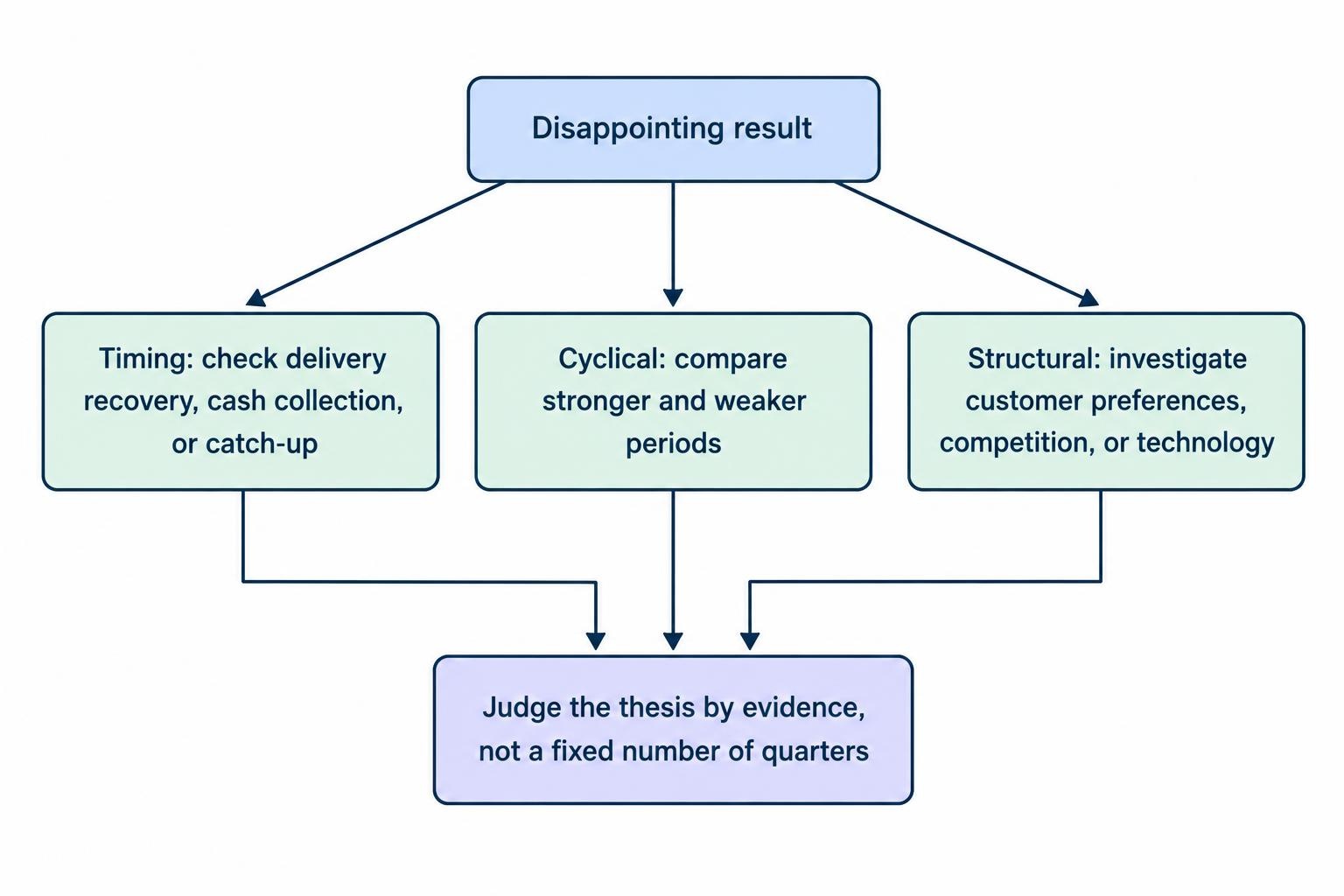
Classify a disappointing result by its cause, expected duration and effect on future economics. A delayed shipment and a permanently lost customer may both reduce quarterly revenue. They do not deserve the same response.
For a timing explanation, ask what evidence would confirm recovery. Has the customer accepted a revised delivery date? Did receivables turn into cash after the reporting period? Does the next update show the expected catch-up? Treat “temporary” as a claim to test, not a reassuring label.
For a cyclical explanation, examine the business across stronger and weaker conditions. Compare demand, inventory and profitability over several periods. For a structural explanation, investigate whether customer preferences, competition or technology have changed the company’s earning capacity.
There is no universal number of weak quarters that proves a thesis has failed. Several quarters may be needed to assess an investment program. One disclosure may be enough to invalidate an assumption about a major customer relationship. The importance of the evidence matters more than the calendar.
Check Earnings Quality, Not Just Earnings Growth
Separate Operating Improvement From Per-Share Arithmetic
Suppose a hypothetical company earns $100 million with 100 million weighted-average shares outstanding. Earnings per share are $1.00. If profit stays at $100 million while the share count falls to 90 million, earnings per share rise to about $1.11. The per-share improvement is real, but it is not evidence of higher operating profit.
Review net income, operating profit and diluted share count separately. Ask how repurchases were funded and whether they changed financial flexibility. Apply the same discipline to dilution: total company profit can grow without an equivalent improvement for each shareholder.
Examine the Adjustments
Adjusted results need inspection rather than automatic acceptance or rejection. Read the reconciliation and identify what management removed. The SEC staff interpretations on non-GAAP financial measures warn that excluding normal, recurring cash operating expenses can produce a misleading measure, and that inconsistent adjustments between periods can also mislead.
For the investment thesis, ask whether an excluded expense is likely to recur and whether it reflects the cost of running the business. A restructuring charge deserves closer attention when restructuring has become an annual appointment. Compare reported and adjusted results across several periods, not just the latest reconciliation.
Follow the Cash and the Balance Sheet
Profit and cash generation answer different questions. The cash flow statement separates operating, investing and financing activity, and reconciles net income with operating cash movements. Those relationships are covered in the SEC guide to financial statements and cash flows. Use that statement to test whether reported earnings support the funding assumptions in your thesis.
Investigate changes in receivables, inventory and supplier payments before judging a cash flow swing. Ask whether cash movements reflect seasonality, expansion, collection problems or payment timing. Compare equivalent periods and year-to-date figures where possible; do not treat one strong cash quarter as a permanent improvement.
Then examine investment requirements. If the thesis assumes growth without heavy additional spending, rising capital expenditure needs an explanation. Is management expanding capacity, replacing worn assets or spending more simply to maintain its position? If that distinction is not disclosed, acknowledge the uncertainty.
Check debt maturities and cash availability alongside the earnings outlook. Test whether the company could fund planned investment and meet obligations under a weaker operating scenario. A long investment horizon does not remove a near-term financing problem.
Read Guidance and the Earnings Call as Claims to Test
Management guidance is an input to the analysis, not a promise. Record changes in the forecast range and the assumptions behind them. An unchanged profit forecast may still contain a different business story if lower expected sales are offset by cost reductions or a lower tax assumption.
During the call, focus on questions that remain unresolved after reading the release. What caused the margin movement? Why did customer spending weaken? What must happen for the second-half forecast to hold? The dedicated guide to analyzing earnings calls with large language models covers a separate workflow for reviewing those discussions.
Judge answers by their content rather than their confidence. A useful answer identifies a driver, gives a measurable expectation and allows later verification. An evasive answer leaves the original question open. Management sounding comfortable is not, by itself, evidence that the investment case is comfortable.
Keep company developments separate from wider economic pressures. Where management cites borrowing costs, inflation or weaker consumer demand, compare those explanations with the framework for reviewing economic news in a long-term portfolio. Do not let a broad economic explanation excuse company-level problems without checking.
Update Valuation Without Overreacting to One Quarter
Translate new evidence into the assumptions used to value the business. If the announcement changes expected sales growth, sustainable margins, reinvestment needs or financial risk, revise those inputs explicitly. Avoid moving a valuation estimate simply because the market price moved first.
Use a range of outcomes rather than pretending the new information produces one precise answer. A downside case might assume slower customer growth and weaker margins. A central case might retain the existing operating plan with a delay. An upside case should require evidence, not just a more cheerful spreadsheet.
Distinguish a delay in cash generation from a permanent reduction in earning capacity. Both can affect value, but they change different assumptions. Keep a record of the previous valuation range and explain why the revised range differs.
A hypothetical fall in share price from $100 to $85 is not enough to establish better value. If your estimated business value also falls from $110 to $80, the lower quotation has not improved the relationship between price and value. The relevant comparison is the updated business assessment against the updated price.
Finish With a Written Thesis Update
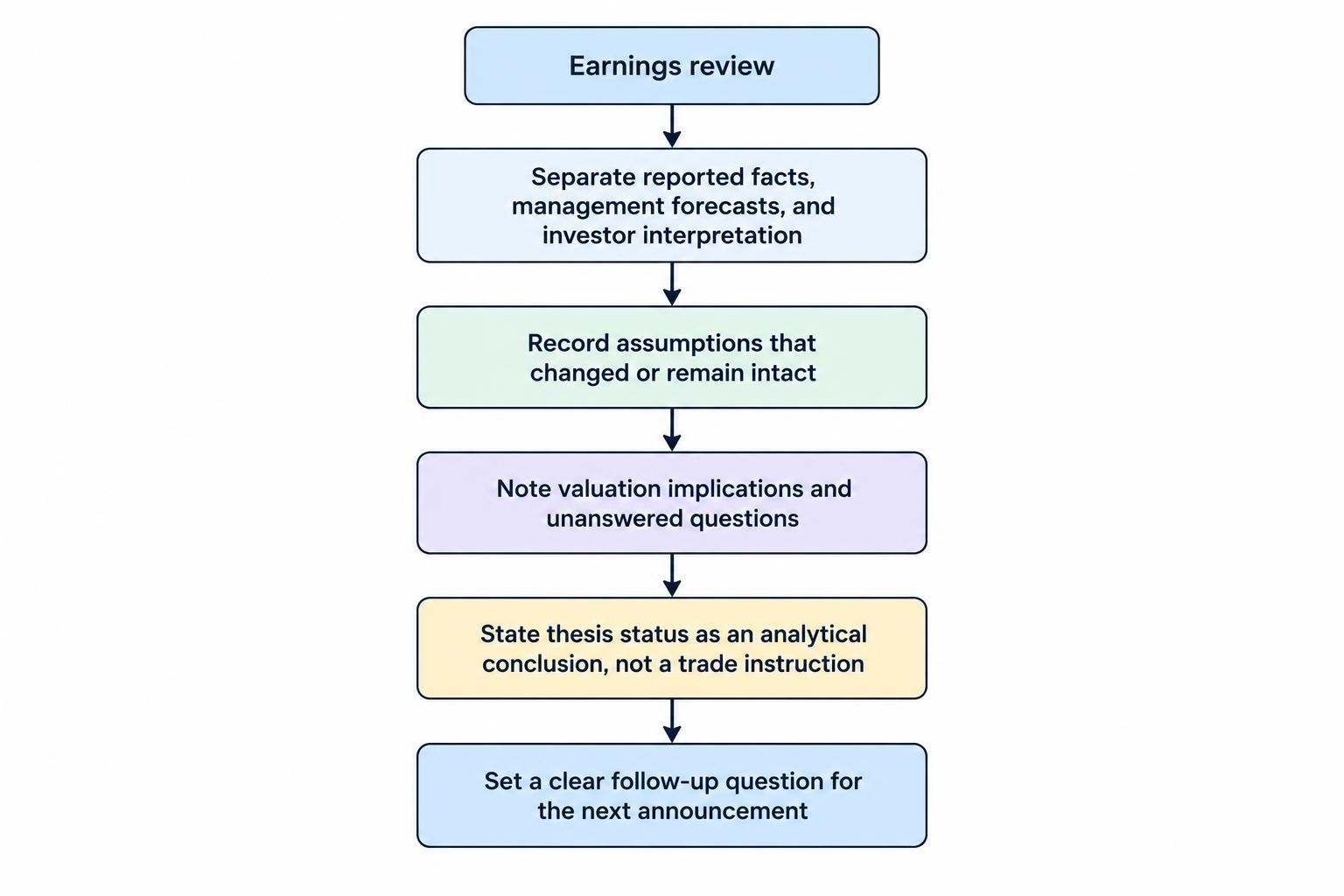
Close the review with a short decision record. State what changed, which assumptions remain intact, what evidence weakened them and which questions remain unanswered. Separate reported facts from management forecasts and your own interpretation.
If AI helped prepare the review, verify material figures and claims against the underlying documents. Preserve dates, units and the distinction between reported and adjusted results. Use the checklist for checking AI summaries for errors and unsupported claims before allowing a summary to influence a valuation change.
The written result might be “thesis intact, valuation unchanged,” “thesis intact, expected returns lower,” or “thesis weakened pending evidence.” None automatically determines a trade. Portfolio concentration, taxes, liquidity needs and alternative uses of capital still belong in the decision.
Set a clear follow-up question for the next announcement. That turns earnings season into a continuing test of the business case, rather than a fresh argument every three months. Long-term investing requires patience, but patience works better when it has conditions.