Automated trading systems use software to evaluate market conditions and submit or manage orders under predefined instructions. Those instructions can govern a single entry signal or an entire process, including position sizing, exits, exposure limits and responses to connection failures.
The practical benefit is consistency: software can apply the same process without waiting for someone to click a button. The danger is consistency too. A flawed rule can repeat faithfully until someone stops it. Automation changes how a strategy operates; it does not establish that the strategy deserves capital.
A useful assessment separates three questions: Does the trading idea have evidence behind it? Can the software execute it correctly? Can the operator detect and contain failures? Each needs its own testing.
What an Automated Trading System Actually Does
A complete system connects market information to trading decisions, then checks what happened after sending an order. A signal generator alone is not a complete automated trading operation. Neither is a script that submits orders but never reconciles them with the account.
Most designs can be divided into five functional parts:
| Component | Purpose | Question to resolve |
|---|---|---|
| Data input | Receives prices, volumes or other permitted information | Is the information current and usable? |
| Strategy logic | Evaluates entry and exit conditions | Are the rules precise enough to reproduce? |
| Risk controls | Checks proposed orders and account exposure | Should this order be allowed? |
| Execution management | Submits, modifies and cancels orders | What is the order’s confirmed status? |
| Monitoring and records | Tracks activity, exceptions and account state | Does actual behavior match intended behavior? |
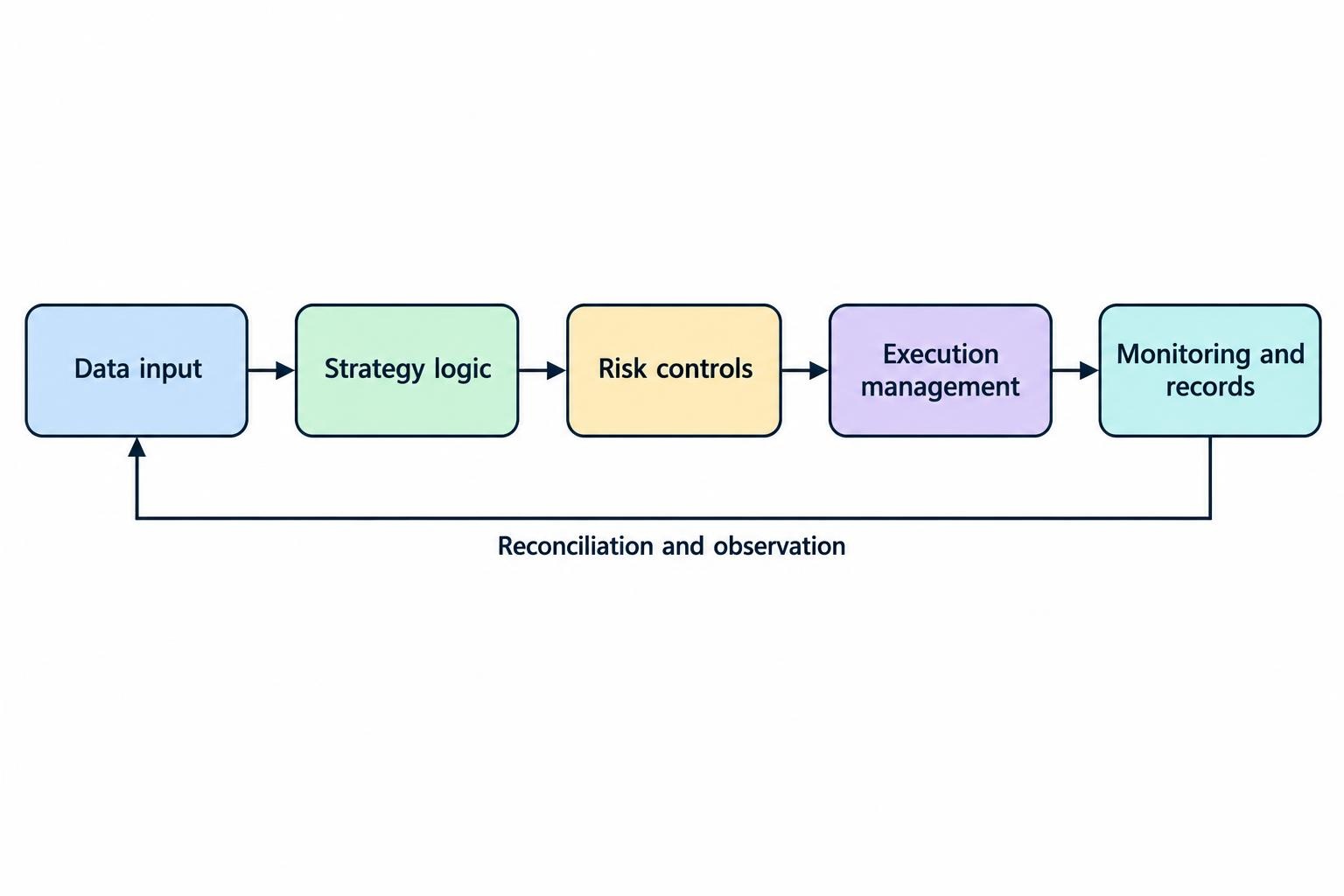
Start with a written strategy specification, not a platform purchase. Define the instrument, trading session, signal timing, sizing method and exit rules. The broader guide to trading systems covers this foundation; automation adds the requirement that every operational instruction must also be unambiguous.
A Simple Example
Consider a hypothetical system that buys after a completed price bar closes above a defined trading range. “Buy the breakout” leaves too much open. The specification must identify which bars form the range, whether the current bar counts, when the signal becomes valid and what order to submit.
It must also say what happens if the spread exceeds a threshold, an earlier order remains pending or the account already holds the maximum position. These are not secondary details. They determine what the system actually trades.
Levels of Automation
Automation is not an all or nothing choice. An alert system identifies a condition but leaves execution to a person. A partially automated workflow might prepare an order for approval, or manage an exit after a manual entry. A fully automated workflow can make and execute decisions within its configured permissions.
Choose the level that fits the task and available supervision. If the objective is to remove repetitive order entry, automating that step may be enough. There is no requirement to hand every decision to software simply because the platform offers the option.
Separate strategy automation from execution automation. A strategy decides whether to trade and how much exposure to take. An execution algorithm manages how an existing trading instruction reaches the market. Software that divides a large order into smaller orders does not necessarily choose the investment.
Choosing the Operating Setup
Before choosing software, map the proposed workflow from data arrival to confirmed position. Identify where the strategy runs, where credentials are stored, which service submits orders and how someone can intervene if the main interface stops responding.
For each candidate setup, verify supported instruments, order types, data access, testing tools, logs and account permissions. Also check whether automation depends on a running desktop application, a hosted service or a separate server. Treat those dependencies as operating requirements rather than small print.
For a custom application, the guide to trading APIs and platform integrations provides the next layer of detail. The integration must handle more than successful submissions: plan for rejections, delayed acknowledgments, partial fills and lost connections.
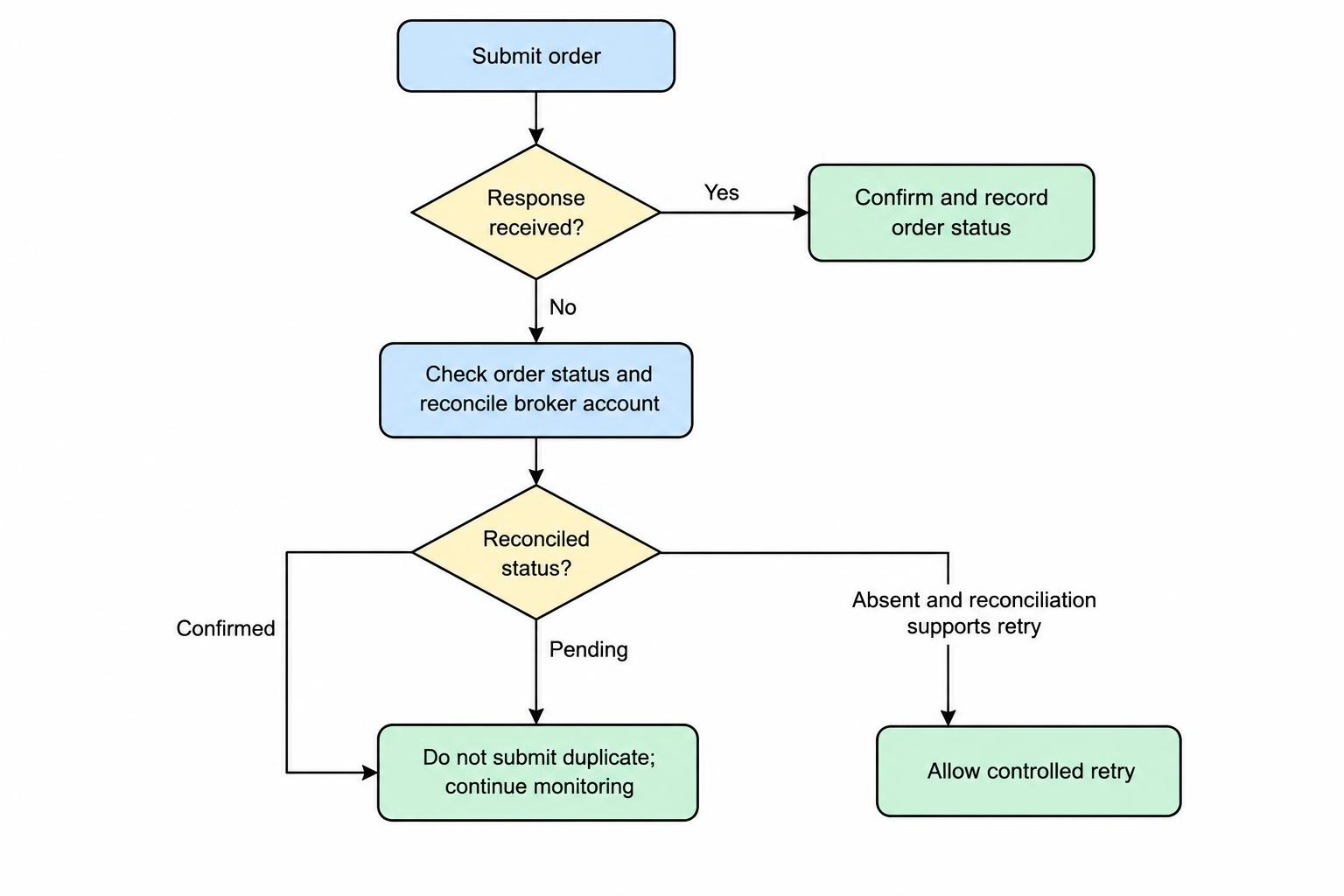
A timeout deserves particular attention. Suppose the application sends an order but receives no response. Do not design the system to assume that nothing happened and immediately submit another order. Require a status check and reconciliation process before any retry that could duplicate exposure.
Testing Before Live Trading
Use Backtesting to Challenge the Idea
A backtest applies strategy instructions to historical information under stated assumptions. Its value lies in exposing how the idea behaves: when it trades, where losses accumulate and how sensitive results are to costs or parameter changes.
Before interpreting returns, document the data period, instrument universe, execution assumptions and all costs included. Distinguish simulated results from actual trading records. The CFTC advisory on commodity trading systems warns against misleading performance presentations and emphasizes the weaknesses of hypothetical results.
Model the costs relevant to the proposed activity. These may include commissions, spreads, financing, borrowing charges and slippage. Keep recurring software and data expenses in the operating budget, even if the backtesting engine does not deduct them.
Make the assumptions inspectable. If a historical bar contains both a stop price and a profit target, how does the simulation determine which occurred first? If an order only partly fills, how does the remaining position behave? A smooth equity curve cannot answer those questions.
The detailed process for backtesting an automated trading strategy should establish these assumptions before comparing strategy variants. Preserve an untouched evaluation period and record what changed between tests.
Challenge Suspiciously Good Results
Ask whether the simulated trader had access only to information available at the decision time. Check publication timestamps, completed versus unfinished bars and the treatment of instruments that disappeared from the dataset.
Also inspect the search process. Testing many variations and displaying only the best result hides the failed experiments. Keep a research log and test whether modest changes to parameters or costs destroy the apparent advantage. The companion guide to overfitting and look-ahead bias addresses these research errors without turning this overview into a testing manual.
Test the Workflow Separately
Historical testing asks how a strategy behaves under a simulation. Paper trading lets you observe the running workflow without placing real capital at risk. Use it to check signal timing, order construction, alerts, account reconciliation and recovery procedures.
Do not treat a simulated fill as proof that a live order would receive the same treatment. Document the simulator’s assumptions and identify what it does not reproduce. A forward test should produce an operational record, not just another performance chart.
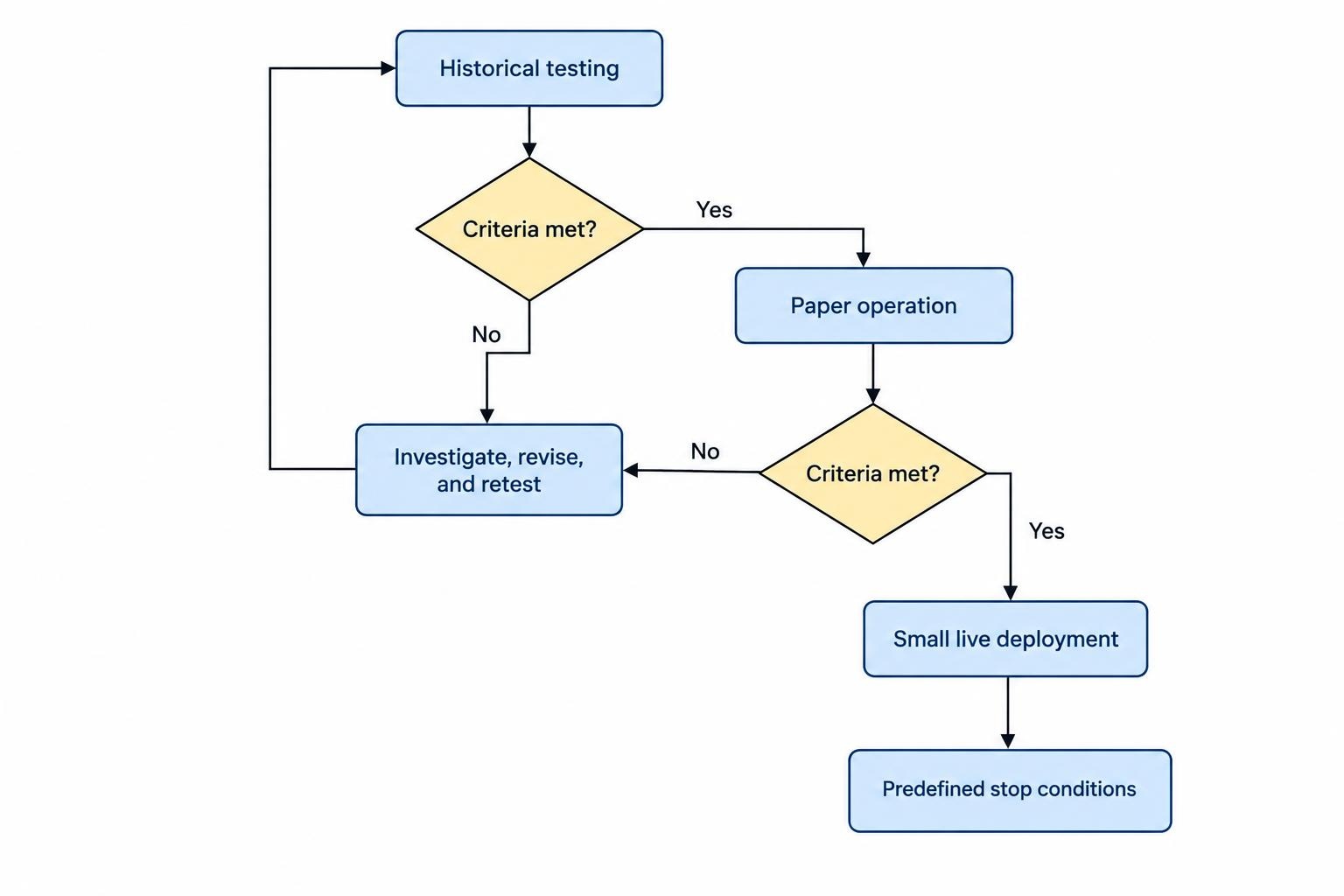
A staged transition should include historical testing, paper operation and a small live deployment with predefined stop conditions. The comparison of paper trading and live automated trading explains what to evaluate at each stage. Passing one stage should not automatically authorize a larger allocation.
Risk Controls Must Be Separate From Entry Logic
Design a risk check that can reject an order even when the strategy strongly favors it. Consider maximum order size, total exposure, permitted instruments, message frequency and acceptable data age. Define account exposure across strategies rather than assuming each bot operates in isolation.
There is an institutional precedent for blocking unsuitable orders before submission. For covered U.S. broker-dealers with market access, Rule 15c3-5 requires controls designed to prevent orders exceeding preset credit or capital thresholds and reject certain erroneous or duplicative orders. The SEC market access risk-control guidance describes those obligations. This is a broker-dealer rule, not a universal legal requirement for every retail trading script.
For your own design, specify the response to each breach. Blocking new entries, cancelling working orders and closing existing positions are different actions. Do not hide all three behind a button labelled “stop.”
Likewise, define how a daily loss threshold is measured. Does it include unrealized losses, transaction costs and positions opened earlier? Who may reset it? Treat the threshold as a trigger for action, not a promise that losses cannot exceed that amount.
Human Oversight and Failure Recovery
Assign responsibility before deployment. Someone must own strategy approval, software changes, alerts and incident response. If one person performs every role, document the checks anyway; a checklist remains useful when the developer and operator share a chair.
For FINRA member firms using algorithmic strategies, FINRA’s algorithmic trading supervision guidance addresses development, testing, deployment and continuing oversight. Its suggested practices include retrievable code versions, rapid disable mechanisms and small pilot deployments where feasible.
Turn those principles into an operating procedure. Record the approved software version and settings. Define who can change them, how changes are tested and how to return to the previous version. Avoid editing live strategy logic simply because the last few trades were uncomfortable.
Monitor operational health as well as profit and loss. A profitable day can still contain duplicate orders, missed exits or unexplained position differences. Review data freshness, order rejections, pending orders, connection status and discrepancies between local records and the broker account.
The guide to monitoring trading bots and detecting strategy failures develops this process further. For each alert, write an action and name a responsible operator. An alert that nobody owns is just background noise with a timestamp.
Assessing Commercial Bots and AI Claims
Evaluate a purchased bot as an operating system and a trading proposition separately. Request a clear description of its behavior, account permissions, loss controls and failure procedures. Ask whether performance records are historical simulations, demonstration accounts or independently verifiable live activity.
AI branding should not lower that standard. The CFTC warning about AI trading bot promotions identifies schemes using claims of extraordinary or guaranteed returns. Treat such promises as a reason to stop and investigate, not a shortcut around due diligence.
Automation does not require machine learning. A transparent rule set may be easier to inspect and troubleshoot than a model whose decisions are harder to explain. If a model is involved, request its intended inputs, update process, testing boundaries and response to missing or unusual data.
Calculate the full operating cost before buying. Include subscriptions, market data, hosting, maintenance and trading expenses. Reject a cost comparison that assumes the advertised return will arrive every month. Revenue is uncertain; subscription invoices tend to be more dependable.
Deciding Whether a System Is Ready
Set acceptance criteria before reviewing the final results. These should cover research quality, operational behavior and the amount of risk authorized for deployment.
- Strategy: Written rules, a documented rationale and tests that include realistic cost assumptions.
- Execution: Verified handling of rejected, partial, delayed and uncertain order states.
- Controls: Tested exposure checks, shutdown actions and recovery procedures.
- Oversight: Usable records, actionable alerts and an identified operator.
Keep a failed criterion visible rather than compensating for it with an attractive backtest. Strong simulated returns do not repair unreliable order handling, and tidy software does not establish a trading advantage.
The sound objective is not maximum automation. It is a repeatable process whose decisions, permissions and failure responses can be inspected. Automate only what you can define, test and supervise—and keep capital allocation separate from enthusiasm for the software.