Monitoring trading bots means checking more than whether the software is running or the account is profitable. A bot can stay connected while trading on stale prices, mishandling partial fills, or building exposure that its dashboard fails to show. It can also operate exactly as designed while the strategy behind it stops earning enough to cover costs.
The monitoring process must answer three questions: Is the system working correctly? Is it staying within its risk limits? Does the trading logic still justify committing capital? Those questions need separate measurements and different responses. A broken connection requires operational action; a losing week requires evidence before anyone rewrites the strategy.
For automated trading systems, monitoring should be part of the design, not a dashboard added after deployment. The aim is to detect faults early, contain exposure, and make decisions from records rather than a worrying equity curve.
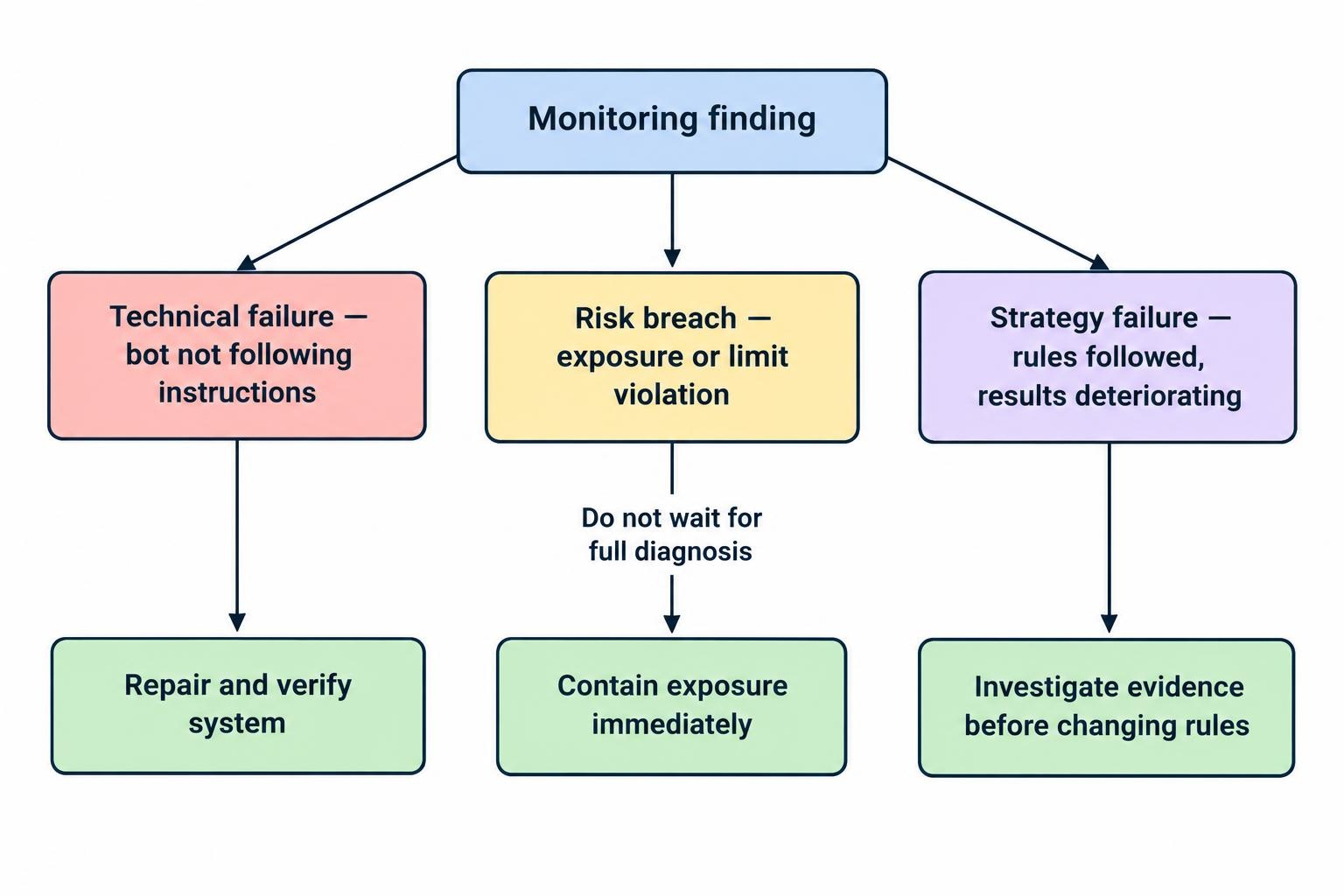
Separate Technical Failures From Strategy Failures
A technical failure occurs when the bot does not carry out its intended instructions. Examples include duplicate orders, incorrect position sizes, missing market updates, and an exit order that never reaches the broker. Profitability does not determine whether these are faults. A duplicate trade that happens to make money is still a defect.
A strategy failure is different. The bot follows its rules, but the relationship those rules depend on no longer produces acceptable results. A breakout system may encounter repeated reversals. A strategy built around small price discrepancies may lose its advantage after execution costs rise.
Keep a third category for risk breaches. Excess exposure, an unauthorized instrument, or a breached loss limit demands action whether the cause is software, market conditions, or human configuration. Do not wait for a complete diagnosis before containing a known breach.
Post-deployment controls should include alerts and reconciliation, not just software availability checks. These are among the practices set out in FINRA’s guidance on supervising algorithmic trading strategies, which addresses member firms rather than imposing a universal checklist on individual traders.
Build a Monitoring Baseline Before Going Live
Without a baseline, “unusual” becomes whatever feels uncomfortable that morning. Before deployment, document the strategy’s expected trade frequency, holding periods, exposure, execution costs, and loss distribution. Record the market conditions in which it was evaluated, including periods when it performed poorly.
Use evidence from backtesting an automated trading strategy, forward observation, and controlled live deployment. Keep these records separate: simulated fills and actual executions are not interchangeable. The baseline should reflect the deployed version, its instruments, and its intended operating hours.
Define warning levels and hard limits before losses occur. A warning starts an investigation; a hard limit triggers a predetermined restriction. Neither should move simply because the bot approaches it. Changes need a documented reason and fresh evaluation, not optimism with administrator access.
Monitor the Full Trading Chain
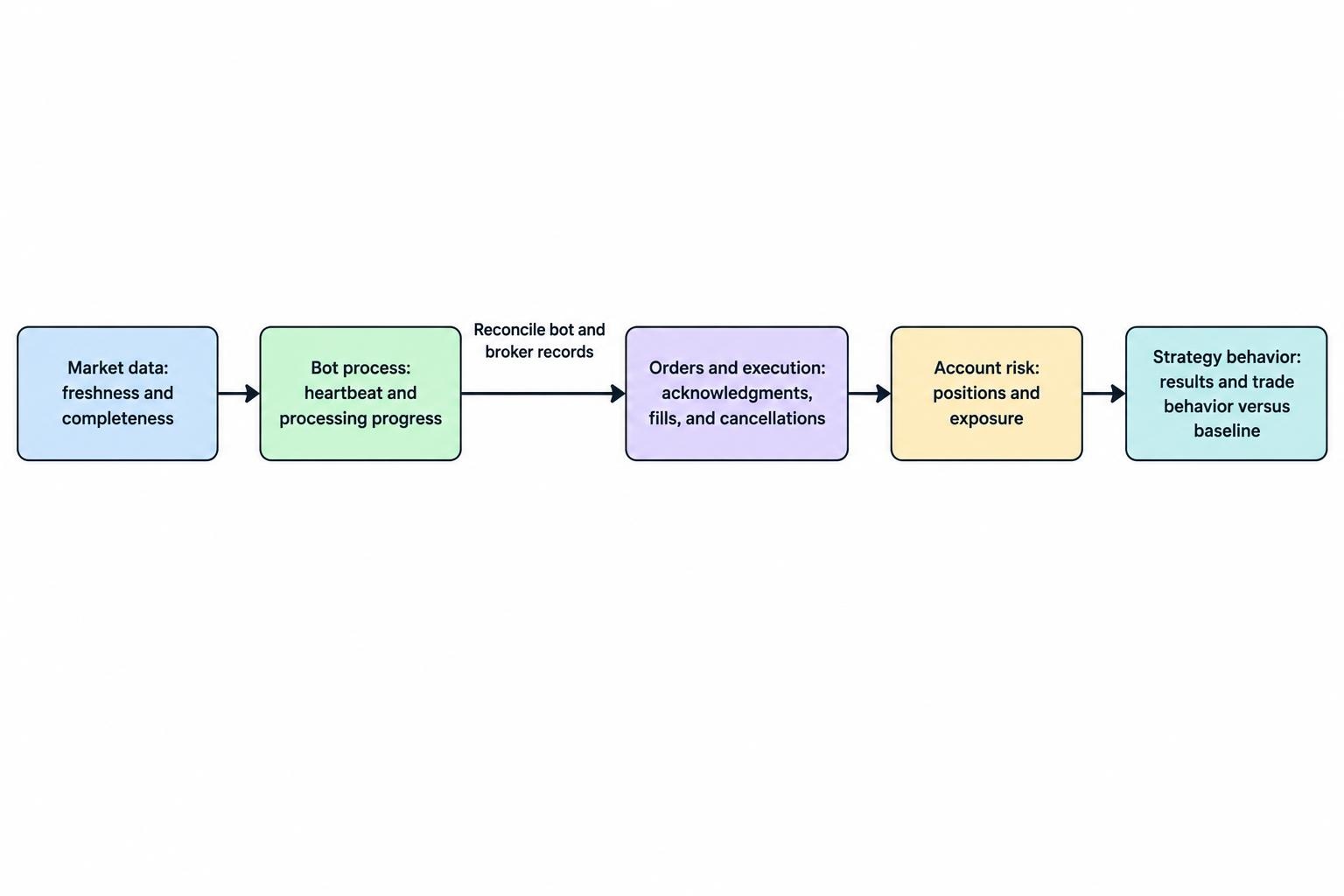
A useful dashboard follows the path from incoming data to account exposure. Track whether each stage receives valid inputs, produces expected outputs, and agrees with the next stage. The following is a practical monitoring framework, not a set of universal thresholds.
| Monitoring layer | Measurements to record | Problem to investigate |
|---|---|---|
| Market data | Update age, missing fields, sequence gaps, timestamp consistency | Signals calculated from stale or incomplete inputs |
| Bot process | Heartbeat, restarts, processing delays, active configuration | A process that appears alive but has stopped progressing |
| Orders and execution | Acknowledgments, rejections, partial fills, cancellation status, slippage | Instructions that differ from actual broker activity |
| Account risk | Positions, working orders, gross exposure, margin headroom, losses | Exposure beyond the approved operating limits |
| Strategy behavior | Net results, trade frequency, holding time, return distribution | Trading behavior that departs from the validated baseline |
Check Data Freshness, Not Just Connectivity
A connected data feed is not proof that usable prices are arriving. Record when the market event occurred and when the bot received it. Check clock synchronization, expected session hours, and whether the instrument is halted or simply inactive before treating silence as a fault.
Set freshness limits around the strategy’s decision horizon. A short horizon strategy may need to reject inputs that would remain usable for a daily system. When inputs become unreliable, define whether the bot blocks new entries, manages existing positions through a separate path, or requests human intervention.
Reconcile Orders and Positions
Compare the bot’s internal records with broker-reported working orders, executions, and positions. Perform this reconciliation at startup, after reconnecting, and during operation at a frequency suited to the strategy. Treat unexplained differences as exceptions requiring resolution.
An order timeout deserves particular care: the bot may not know whether the broker accepted the instruction. Do not blindly submit another order. Establish the original order’s status using its identifier and the available broker records. The response procedure belongs alongside broker API rate limits and connection error handling, rather than inside a generic retry loop.
Measure Execution Quality Separately From Signal Quality
Track execution against a defined benchmark, such as the available bid or ask when the order decision was made. Record order size, spread, execution delay, fill price, commissions, and other applicable charges. Use a consistent benchmark; changing it between reports makes comparisons unreliable.
Consider a hypothetical strategy expecting an average gross gain of eight basis points per completed trade. If its estimated total cost rises from three to seven basis points, the expected net gain falls from five to one. The signal has not necessarily changed, but there is much less room for error.
Break results down by instrument, session, order type, and size. Also examine fill rate alongside slippage: measuring only completed trades can hide missed opportunities or a change in which orders receive fills. A worsening account result may reflect weaker signals, higher costs, or both.
Distinguish a Normal Drawdown From Deterioration
A drawdown is a decline from an earlier equity peak. It describes the account’s path, not the cause of the decline. Even a strategy with positive expected returns can experience losing sequences. Equally, staying inside a historical drawdown does not prove the strategy remains sound.
Compare live behavior with a range of plausible outcomes rather than the single worst historical episode. Review trade-level returns, average wins and losses, holding periods, turnover, and exposure alongside net profit. Use consistent position sizing, or express results relative to the risk taken, so that a size change does not masquerade as a strategy change.
A preselected resampling or scenario analysis can help assess plausible losing sequences. Preserve relevant dependence between observations: treating correlated trades as independent can make the expected range look too narrow. Historical estimates also remain estimates, not loss guarantees.
A fall in win rate alone is weak evidence. A strategy may win less often but earn more from each winner. Concern becomes stronger when several related measures deteriorate together, such as lower net returns, longer recovery periods, and rising costs under comparable conditions. Evaluate shared exposures across bots too; several strategy names do not necessarily mean several independent risks.
Detect Changes in Strategy Behavior
Look beyond whether trades make money. Compare how often signals appear, which instruments generate them, how long positions remain open, and how frequently risk filters reject entries. An unexplained jump in trading activity can reveal an implementation problem before the loss report does.
For machine learning bots, separate changes in input data from changes in predictive usefulness. A different distribution of volatility or volume does not, by itself, prove the model is worse. Measure both input changes and realized outcomes when those outcomes become available. The NIST AI Risk Management Framework measurement playbook recommends comparing production behavior with testing metrics and assessing outputs against newly collected ground truth.
Avoid automatic retraining whenever an alert fires. First check data integrity, feature calculations, execution, and configuration. Retraining on faulty inputs can replace a diagnosable problem with a new model and less clarity about what happened.
Make Alerts Actionable
Organize alerts by the response they require. Informational messages record routine events. Warnings request investigation within a defined period. Critical alerts trigger an immediate restriction or escalation. Every actionable alert should identify the affected bot, account, condition, time, and current exposure.
Assign an owner and a backup response route. Require acknowledgment for critical events, and escalate if nobody responds. Group repeated notifications from the same incident without hiding a worsening condition. A hundred emails are not a response plan.
The distinction matters. During Knight Capital’s August 1, 2012 trading incident, an internal system generated 97 automated emails identifying an error before the market opened, but the firm did not act on them that day. The SEC’s findings on Knight Capital’s control failures show why generating messages and organizing an effective response are separate tasks.
Define When the Bot Must Stop
Set hard boundaries for order size, position exposure, message rate, and losses. Define the accounting basis for each limit, including whether it includes unrealized losses, fees, and working orders. Test those definitions against partial fills and activity from other systems using the same account.
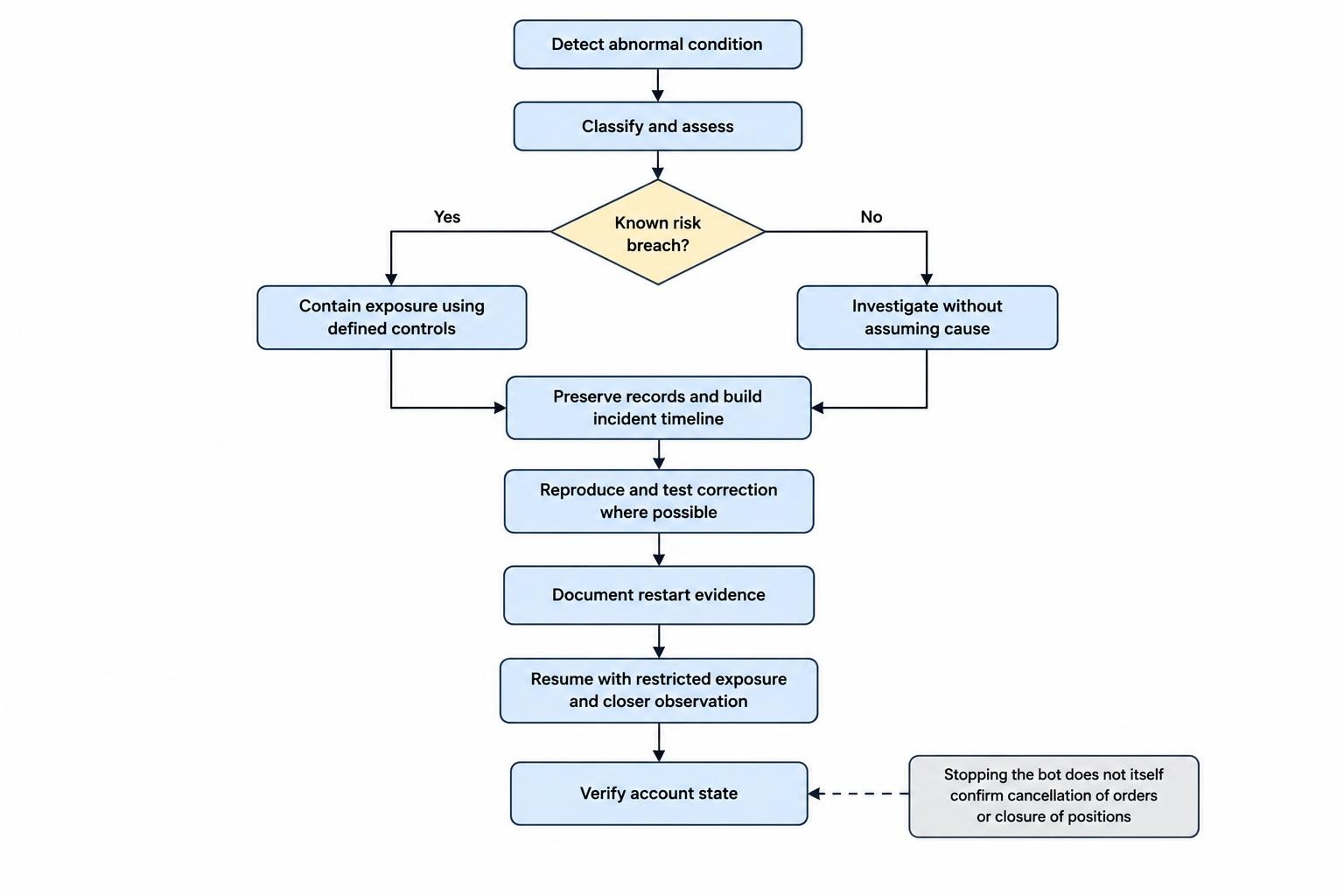
Separate three actions: blocking new entries, cancelling working orders, and closing positions. They are not interchangeable. Stopping the bot process does not establish that orders have been cancelled or positions closed. Verify the resulting account state rather than assuming the shutdown command achieved it.
Controls should prevent prohibited instructions where possible, rather than rely on detecting damage afterward. For US broker-dealers subject to the market access rule, the SEC’s market access risk-control guidance states that applicable automated pre-trade controls must reject orders exceeding relevant limits before routing; submitting and immediately attempting to cancel them is not sufficient.
Document the shutdown sequence, available control paths, and authority to restart. Detailed trading kill switch and emergency shutdown procedures should cover what happens when the normal bot connection is unavailable. A shutdown procedure also needs a plan for supervising any remaining exposure.
Investigate Incidents Before Restarting
Preserve logs, market timestamps, order identifiers, configuration, and software version before making changes. Build a timeline from the first abnormal input or action through detection and containment. Identify whether the fault began in data, signal generation, sizing, routing, or reconciliation.
Then reproduce the failure in a separate test environment where possible. Test the correction and nearby failure cases, including delayed responses, partial fills, reconnects, and duplicate notifications. Record what changed, why it addresses the cause, and what evidence supports restarting.
Resume with restricted exposure and closer observation. For suspected strategy deterioration, document the economic reason for any rule change and evaluate it on data not used to select that change. Do not keep editing parameters until the recent losing period looks profitable.
Use a Review Schedule That Matches the Risk
During active trading, prioritize data freshness, order state, exposure, and hard limits. After each session, reconcile activity and review exceptions, costs, and losses. At scheduled longer intervals, assess strategy behavior against its baseline and review whether alert thresholds still serve their intended purpose.
Monitor the monitoring system as well. Test notification delivery, missing-heartbeat detection, access to emergency controls, and the availability of the responsible person. Where practical, observe the trading process from a separate service so that one failure does not silence both the bot and its alarm.
A trading bot does not need constant human interference. It needs clear operating boundaries, trustworthy records, and a response process that works under pressure. The standard is not whether the dashboard stays green. It is whether an abnormal condition leads to a controlled, verifiable action.