Entry rules define when a trade qualifies. Exit rules define when to close it. Position-sizing rules define how much to trade. These decisions belong together: an entry price means little without an exit plan, and neither tells you the account exposure until you calculate the quantity.
A useful rule produces a decision from information available at the time. “Buy a strong breakout” leaves room for interpretation. “Buy after a completed daily close above the previous 20 sessions’ highest high” gives you something you can record, test and follow.
This guide focuses on turning those decisions into a written specification. For the wider process of choosing a market, setting objectives and assembling the strategy, start with building a rules-based trading system. The examples below illustrate rule design, not profitable strategies or recommended risk levels.
Define the Setup Before the Entry Trigger
A setup makes a trade eligible; a trigger authorizes the order. Keeping them separate prevents a promising chart from becoming an automatic instruction to buy.
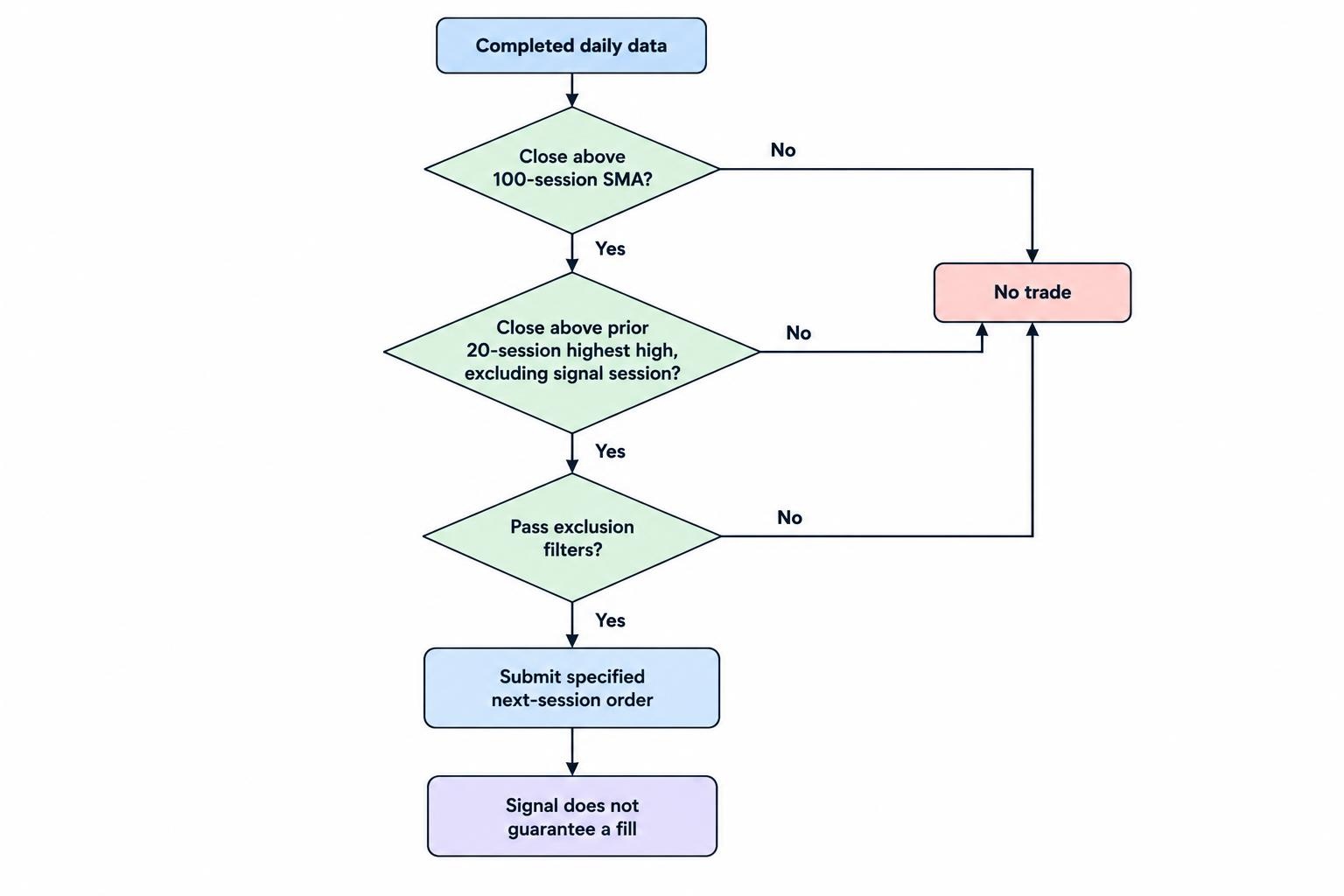
For a hypothetical stock strategy, the setup might require the latest completed daily close to sit above its 100-session simple moving average. The trigger might require that close to exceed the highest high of the preceding 20 completed sessions, excluding the signal session itself.
That wording settles several questions. The strategy uses daily bars, waits for the close and does not accidentally include the signal bar in its comparison. It still needs a named data feed, a definition of the trading session and a decision about adjusted prices.
Specify When and How the Order Is Submitted
A signal is not a fill. State whether the order goes in during the signal bar, at the next session’s opening auction or after another condition occurs. If the signal requires a completed closing price, do not assume you could also have traded at that same close without a workable execution method.
Choose the order type deliberately. For stocks, a market order does not guarantee the execution price; a limit order sets a price boundary but may remain unfilled. The SEC’s explanation of stock order types sets out these distinctions. “Enter at $50” is incomplete until the rule explains what happens if the next available price is $51.
Also define order expiry, partial fills and repeat signals. One workable instruction is: submit one buy limit order for the next regular session, cancel any unfilled balance at session end, and ignore further entry signals while a position remains open. Another strategy may need different instructions, but it needs instructions.
Write the Reasons Not to Trade
Entry filters should be observable, not emotional. “Skip uncertain markets” cannot be applied consistently. “Do not open a position if the quoted spread exceeds the stated threshold” can.
Other exclusions might cover scheduled earnings, stale prices, missing data or an existing position in the same instrument. Define the threshold, calendar or data check each exclusion uses. When several instruments qualify but capital is insufficient, specify the ranking method and tie-breaker before the signals arrive.
Define Exit Rules Before Committing Capital
An exit plan needs to cover losses, gains and trades that go nowhere. Decide which conditions close the whole position, which reduce it and which take priority when more than one condition applies. Writing the loss exit and profit-taking plan before entry is also part of CME Group’s trade-plan framework.
Place the Initial Stop Around Trade Invalidation
The initial stop should express where the trade premise fails, using a method you can repeat. Possible methods include a price level below a defined swing low, a fixed percentage from entry or a multiple of a stated volatility measure.
For a swing-based rule, define a swing. For a volatility-based rule, name the calculation, lookback period and multiplier. “Below nearby support” remains discretionary unless the method identifies that support.
Do not move the stop closer simply to fit a desired quantity. Establish the exit level first, then calculate how many units fit the risk budget. Otherwise, the account balance starts making claims about where market prices ought to turn.
A stop is not a guaranteed loss ceiling. For stocks, a triggered stop order becomes a market order and can execute away from its trigger price. A stop-limit order controls the acceptable execution price but may not execute at all. These risks, including differences in trigger standards, are covered in the SEC bulletin on stop, stop-limit and trailing stop orders. Size with that uncertainty in mind.
Choose a Profit Exit and a Time Exit
A fixed target can be expressed as a multiple of initial risk. If entry is $50 and the initial stop is $48, the price risk is $2 per share. A target at twice that distance is $54. Traders often call this a 2R target, where R represents the initial planned risk.
A trailing exit uses another rule to follow a favorable move. If you calculate the trail yourself, specify its reference price, distance and update schedule. Also state whether it can only tighten. Moving a stop to entry is not automatically financial break-even after costs.
A time exit closes the position after a defined holding period or deadline. For example: exit at the close of the tenth session after entry if neither the stop nor target has closed the position. State whether the entry session counts as session one.
If taking partial profits, define the fraction, rounding method and treatment of the remaining position. “Sell some when it looks stretched” is a judgment call, not a rule.
Calculate Position Size From the Risk Budget
Position size converts the distance to the planned exit into account exposure. The starting inputs are the amount you are prepared to risk and the stop location, rather than the largest order your buying power permits. This relationship is the basis of CME Group’s position-sizing lesson.
For a straightforward share trade, use:
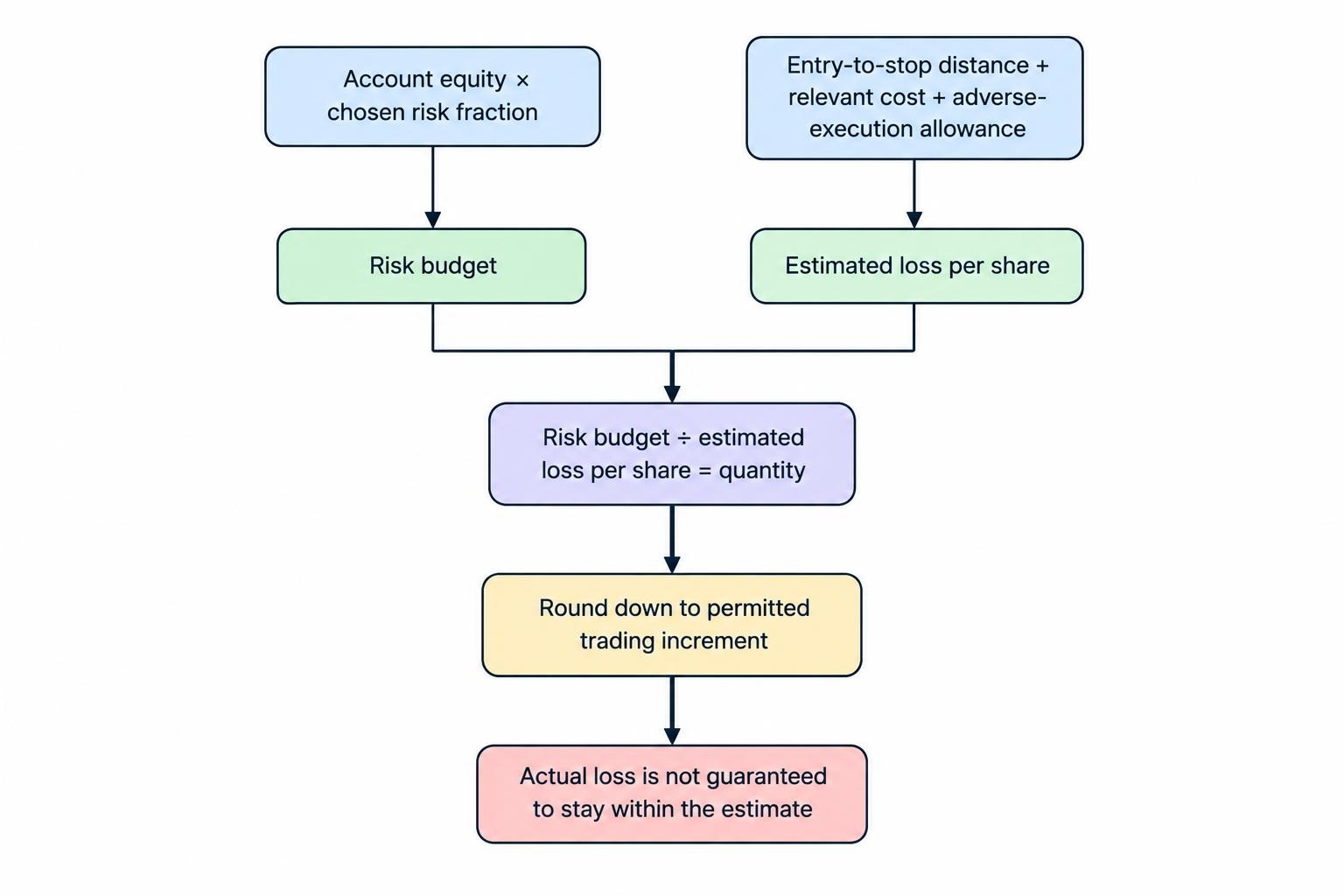
Risk budget = account equity × chosen risk fraction
Quantity = risk budget ÷ estimated loss per share
Estimated loss per share should include the entry-to-stop distance plus an allowance for relevant transaction costs and adverse execution. Round the result down to a permitted trading increment. For a product with a contract multiplier, calculate the monetary loss per contract before dividing.
Worked Example: A Hypothetical Stock Position
Assume account equity of $25,000 and an illustrative risk fraction of 0.5%. The planned risk budget is $125. This percentage demonstrates the arithmetic; it is not a universal safe level.
| Input | Illustrative value |
|---|---|
| Planned entry price | $50.00 |
| Initial stop price | $48.00 |
| Entry-to-stop distance | $2.00 per share |
| Assumed round-trip costs and adverse execution allowance | $0.10 per share |
| Estimated loss per share | $2.10 |
| Calculated whole-share quantity | 59 shares |
| Estimated loss under those assumptions | $123.90 |
| Position value at planned entry | $2,950 |
The calculation is $125 ÷ $2.10 = 59.52, rounded down to 59 shares. Buying 60 shares would exceed the stated budget under these assumptions.
The $2,950 position value and $123.90 estimated stop loss measure different things. Neither makes $123.90 a guaranteed maximum loss. The allowance is an estimate, not insurance against a gap or failed exit.
If there are fixed order fees, subtract those from the risk budget before dividing by the variable loss per unit. If the entry fills at a different price, follow a written adjustment procedure rather than leaving the original calculation untouched.
Add Exposure Limits Beyond the Individual Trade
A small planned loss on each position does not settle how much total exposure the account should carry. Several trades may depend on the same market move. A portfolio of different ticker symbols can still be one crowded bet.
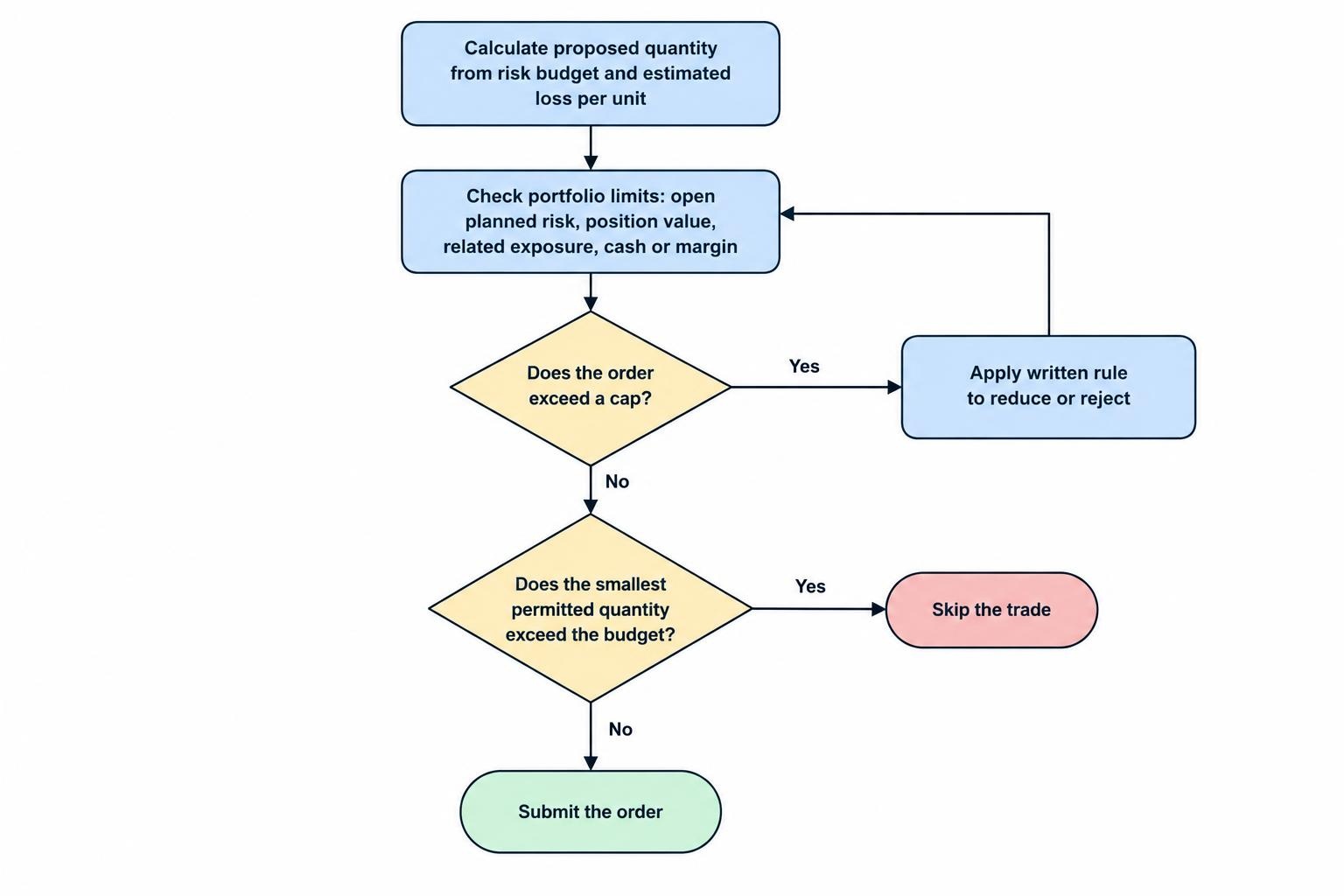
Set separate limits for total open planned risk, position value, related instruments and available cash or margin. These act as ceilings after the initial sizing calculation. The submitted quantity should satisfy every applicable ceiling, not just the stop-based formula.
For example, a hypothetical system could cap the sum of initial stop-based risk across open positions at 2% of current equity, with a lower cap for one sector. Those are design choices to evaluate, not recommended thresholds. Stop-based totals also leave gap exposure unresolved.
Turn these restrictions into pre-trade checks for order size and position exposure. If a proposed order breaches a cap, the rules should say whether to reduce it or reject it. If the smallest permitted quantity already exceeds the budget, skip the trade.
Also state how equity is measured. Fixed dollar risk and a fixed percentage of current equity are different policies. Choose when to refresh the balance and how to handle unrealized gains and losses. Do not switch methods mid-drawdown because one produces a larger order.
Combine the Rules Into One Trade Specification
A complete specification should let another person reach the same decision using the same inputs. The following compact example joins the pieces together without claiming an investment edge.
- Eligibility: A named stock’s completed regular-session close must exceed its 100-session simple moving average.
- Signal: That close must exceed the highest high of the preceding 20 completed sessions.
- Entry: Submit a next-session buy limit order at the signal close; cancel any unfilled balance at session end.
- Loss exit: Set the initial stop 2% below the entry limit. Do not widen it after entry.
- Profit and time exits: Target twice the initial entry-limit-to-stop distance, or close at the tenth session’s close, counting entry as session one.
- Size: Use the stated equity snapshot and risk fraction, include cost assumptions, round down and apply all exposure caps.
- Re-entry: Require a new qualifying signal after the position closes; do not immediately recycle the old signal.
This example still needs execution instructions for partial fills, protective-order placement and cancellation of leftover exit orders. It also needs a response if protection cannot be confirmed. The safe specification is not “the platform will probably handle it.”
Test Ambiguous Cases Before Trading the Rules
Review awkward cases deliberately: the market opens beyond the stop, only part of an entry fills, a trading session is missing, or a daily bar touches both the target and stop.
That last case deserves care. A daily high and low may show that both levels traded without revealing which came first. Do not automatically credit the profitable exit. Use suitable finer-resolution data or document a conservative assumption. Keep the broader testing process separate through backtesting an automated trading strategy.
Check that every input existed at the decision time. A closing-price signal cannot authorize an earlier trade. A volatility calculation must not use future bars. Test the written rules as they stood, including rejected trades and unfilled orders, rather than reconstructing the trades that look attractive afterward.
Review Rule Quality Separately From Trade Outcomes
A losing trade can follow the rules perfectly. A profitable trade can break them. Record both execution compliance and financial results so that one does not disguise the other.
Useful records include the rule version, signal timestamp, intended and filled prices, initial stop, quantity calculation, exit reason and costs. A trading journal and performance-tracking process should make deviations visible without requiring a detective investigation.
Revise the specification at scheduled reviews, not while negotiating with an open loss. Give each revision a version number and effective date. The practical goal is a repeatable decision process: enter only when the conditions qualify, exit when the written condition occurs, and trade only the quantity the account constraints permit.