Financial sentiment analysis measures the tone of financial news, company statements and investor commentary. It turns text into labels or scores that help analysts track optimism, concern and changes in expectations across companies, sectors or markets.
The useful question is not simply whether a headline sounds positive. It is positive for whom, compared with what expectations, and over which period? A report about falling oil prices could favor an airline and hurt an oil producer. A cheerful earnings announcement could still disappoint investors expecting stronger results.
Used within a broader process for AI financial information analysis, sentiment can help prioritize research and flag changes worth investigating. It should not turn every positive adjective into a buy order. Measuring language and forecasting returns are different jobs.
What Financial Sentiment Analysis Measures
A basic sentiment classifier assigns text to positive, negative or neutral categories. More detailed systems can assess uncertainty, distinguish statements about past results from future expectations, or score the tone directed at each company mentioned.
Define the task before choosing a model. Three questions that sound similar can require different labels:
- Language tone: Does the writer express optimism or concern?
- Business implications: Does the statement describe favorable or unfavorable conditions for the company?
- Expected market reaction: Does the information suggest a price response over a defined period?
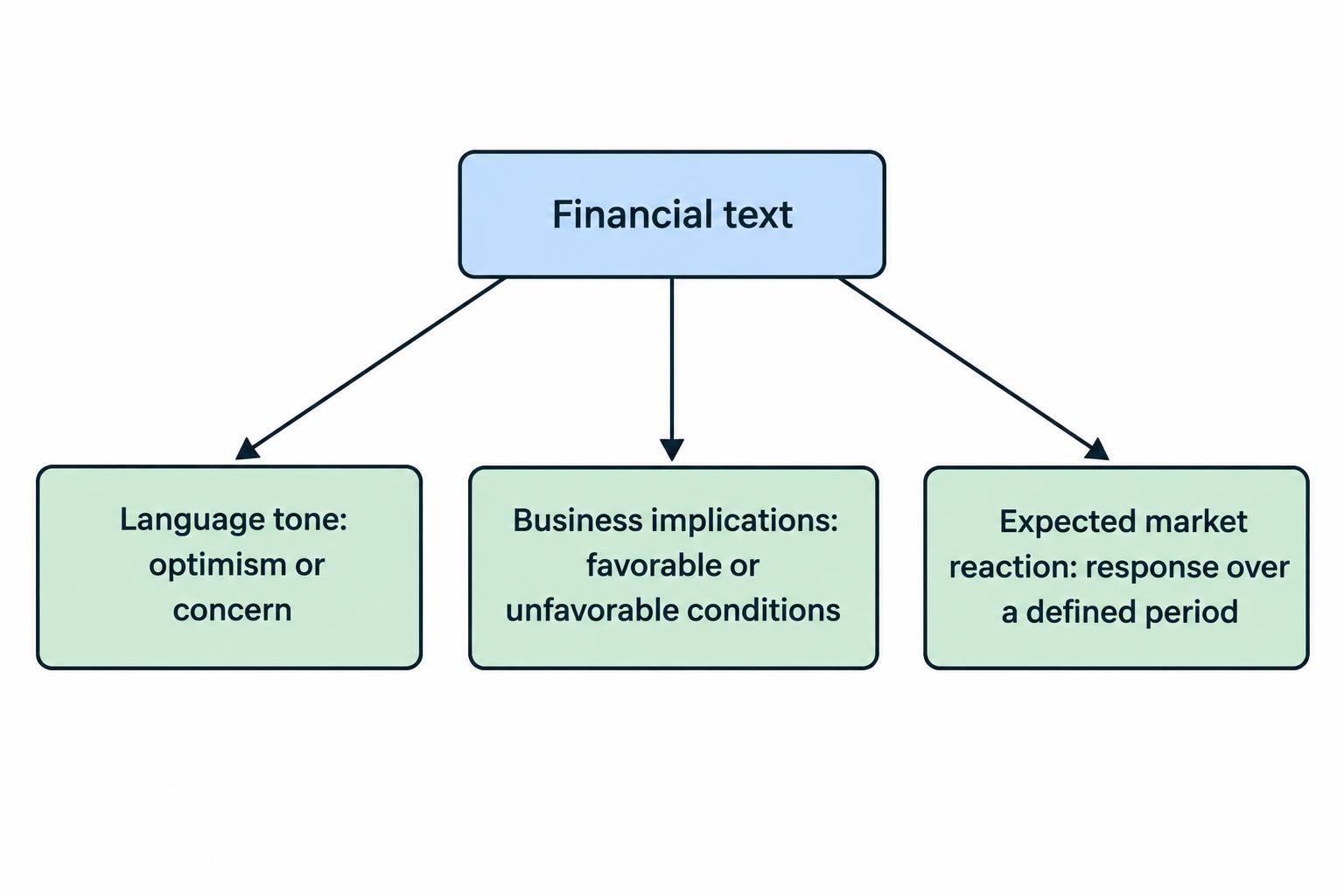
Consider the hypothetical sentence, “Management remains confident despite a sharp decline in orders.” Its language includes optimism, but its business content includes deterioration. A useful system should retain that distinction rather than allow “confident” to cancel out falling demand.
Neutral also needs a clear definition. It can mean factual reporting without a directional implication. It should not automatically mean that the model is confused. Give uncertain or ambiguous cases a separate review status so that missing context does not disappear inside a neutral label.
News Sentiment Versus Social Media Sentiment
News analysis and social media analysis should answer different research questions. Use news to examine reported developments and their framing. Use social commentary to examine what sampled participants are discussing and how they express their views. Neither should stand in for the other.
| Input | Useful research question | Main processing check |
|---|---|---|
| Financial news | Has coverage of a company or event changed tone? | Separate original reporting from repeated stories |
| Company announcements | Has management changed its language about demand, costs or outlook? | Compare statements with disclosed figures and previous wording |
| Social media posts | Has discussion become more optimistic, pessimistic or divided? | Check author concentration, repetition and relevance |
| Investor forums | Which arguments are attracting attention within this community? | Do not treat one community as the entire market |
Keep the original channels visible even if a dashboard offers a combined score. A rise in positive news coverage alongside increasingly negative social commentary is a research question, not a calculation error to smooth away.
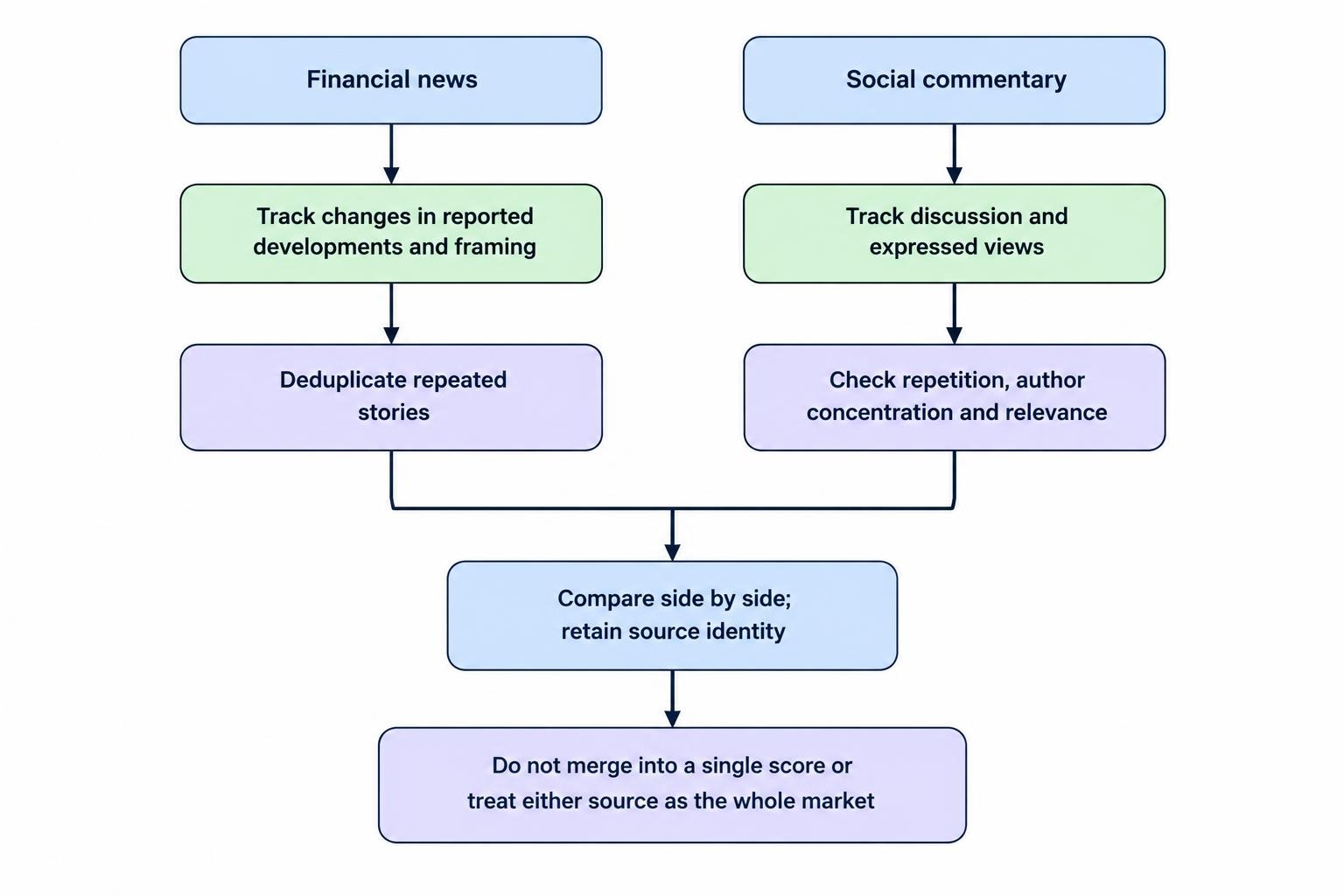
Coverage also needs context. Ten favorable posts from ten independent contributors are not equivalent to ten reposts of one message. Likewise, several publications carrying the same announcement do not provide several independent confirmations.
The SEC and FINRA bulletin on social sentiment investing tools identifies stale information, misleading content and hidden agendas as risks. That makes publication age and content provenance part of the analysis, rather than housekeeping to address later.
How Sentiment Models Analyze Financial Language
Financial dictionaries and word counts
A dictionary approach matches words or phrases against predefined categories. Its appeal is inspectability: an analyst can examine which terms contributed to a score and challenge the rules behind it.
However, word counts need rules for context. “Losses increased” and “losses narrowed” both contain “losses,” yet describe different developments. Negation matters too. “Demand is not weakening” should not receive the same interpretation as “demand is weakening.” Use these examples as basic acceptance tests before trusting an aggregate score.
Financial language models
Models trained or adapted for financial text offer another approach. The original FinBERT financial sentiment research reported improved performance on two financial sentiment datasets compared with the methods evaluated in that study. Those results support evaluating domain adaptation; they do not establish that every model bearing the FinBERT name will perform well on every feed.
Test a candidate model against the material it will actually receive. A classifier evaluated on formal news sentences still needs separate checks before handling slang, abbreviations, sarcasm or multilingual discussion. Treat each input channel as a validation task, not a box already ticked.
Large language models
For a large language model workflow, request a structured result: the target company, sentiment label, relevant passage, time horizon and any unresolved ambiguity. Ask it to distinguish statements in the text from its own interpretation.
An explanation is useful only when it matches the evidence. Require the system to identify the exact passage supporting its label, and review whether the passage supports the conclusion. Fluent reasoning is not a substitute for a traceable classification.
Assign Sentiment to the Right Company
Document sentiment can hide opposing implications. Consider this hypothetical headline: “Northbridge wins supply contract as Eastport loses its largest customer.” One label for the whole headline would discard the distinction between the two businesses.
Entity level classification addresses this problem by associating sentiment with named organizations or assets. The FinEntity research on entity level financial sentiment provides a dataset that labels financial entities and their associated positive, neutral or negative sentiment within news text.
In a practical workflow, resolve the company identity before assigning the label. Match names, subsidiaries and ticker symbols carefully. A short ticker can also be an ordinary word, and an article mentioning a company does not necessarily express an opinion about its shares.
Preserve attribution as well. A journalist reporting a short seller’s criticism is not necessarily endorsing it. Store who made the statement, who it concerns and whether it is an allegation, forecast or reported result. Those distinctions help prevent a quoted opinion from becoming an apparently established fact.
Build Scores That Remain Interpretable
A simple illustrative score subtracts the model’s negative class probability from its positive class probability. If the outputs are 0.70 positive, 0.20 neutral and 0.10 negative, that calculation produces 0.60.
That number describes a classification output. It is not a 60% expected return, nor does it establish a 70% chance that the asset will rise. Do not translate sentiment probabilities into market probabilities without a separately tested forecasting model.
When aggregating documents, retain more than the average. Show the number of independent items, the time window, source mix and distribution of labels. An average near zero could represent mostly neutral reporting or fierce disagreement between positive and negative commentary.
Compare changes against a relevant baseline. A company with consistently upbeat promotional language should not automatically outrank a restrained company reporting improving conditions. Track whether tone has changed relative to its own history, then inspect the underlying developments.
Build those checks into the financial news extraction workflow. Keep event facts, sentiment and interpretation as separate fields so an analyst can inspect each without reverse engineering a single opaque score.
Why Positive Sentiment Does Not Guarantee Rising Prices
Sentiment is not the same as surprise. In a hypothetical earnings release, revenue could rise 12% while falling short of an expected 18% increase. The language may sound favorable in isolation, yet the result disappoints against the comparison investors were using.
Timing creates another distinction. If commentary celebrates a price increase that already happened, its positive tone may describe the move rather than anticipate another one. A trading test must establish when the information became available and when an order could realistically have followed.
Research on which news moves stock prices finds a stronger relationship between information and price changes when news is identified by relevance, type and tone. That is evidence for studying financial text carefully, not proof that a positive sentiment threshold produces a profitable strategy.
Define the proposed use accordingly. A sentiment alert might prompt an analyst to review changing demand commentary, investigate disagreement or check whether a new event affects an existing thesis. Those uses do not require the score to act as an automatic trade instruction.
Limitations That Deserve Explicit Controls
Repetition, promotion and manufactured enthusiasm
A sentiment classifier measures the language it receives. Without additional checks, persuasive promotion can enter the dataset alongside independent analysis. Positive tone alone does not establish truthfulness or independence.
The SEC alert on social media stock tip scams describes misleading promotions and rumors used to influence share prices. It also warns against making investment decisions solely from social platforms or apps.
As a processing control, group near identical posts, show how much discussion comes from the most active accounts, and flag abrupt bursts of repeated wording. These checks should trigger investigation, not automatic accusations. Repetition alone does not prove manipulation.
Sarcasm, mixed messages and missing context
Include difficult examples in the review set. “Brilliant, another profit warning” tests sarcasm. “Margins improved, but only because investment was postponed” tests whether the model retains the qualification.
Allow an unresolved result when context is missing. A headline fragment may not contain enough information to identify the affected company or interpret the claim. Forcing every fragment into a confident label makes a dashboard tidier, not more reliable.
Changing coverage and unavailable data
Treat changes in the input feed as possible breaks in the series. If a provider adds a forum or stops supplying one language, investigate whether a score movement reflects new coverage rather than changed opinion.
Missing observations also need their own status. No relevant posts in a period is not neutral sentiment. It means the system has no observation under its collection rules.
Validate the Classifier and the Trading Hypothesis Separately
Begin with a manually reviewed sample from the intended news and social feeds. Write labeling instructions before scoring it, including rules for mixed sentiment, quoted opinions and uncertain cases. Review disagreements to clarify the task rather than assuming every disputed label is a model failure.
Assess errors by category. Positive labels may be reliable while negative labels perform poorly, or neutral examples may dominate the dataset. Examine precision and recall for each class, alongside the actual passages the model misclassified.
Then test the proposed decision process separately. Classification quality asks whether the model labels language correctly. Trading evaluation asks whether using those labels improves a defined process after delays, costs and risk constraints.
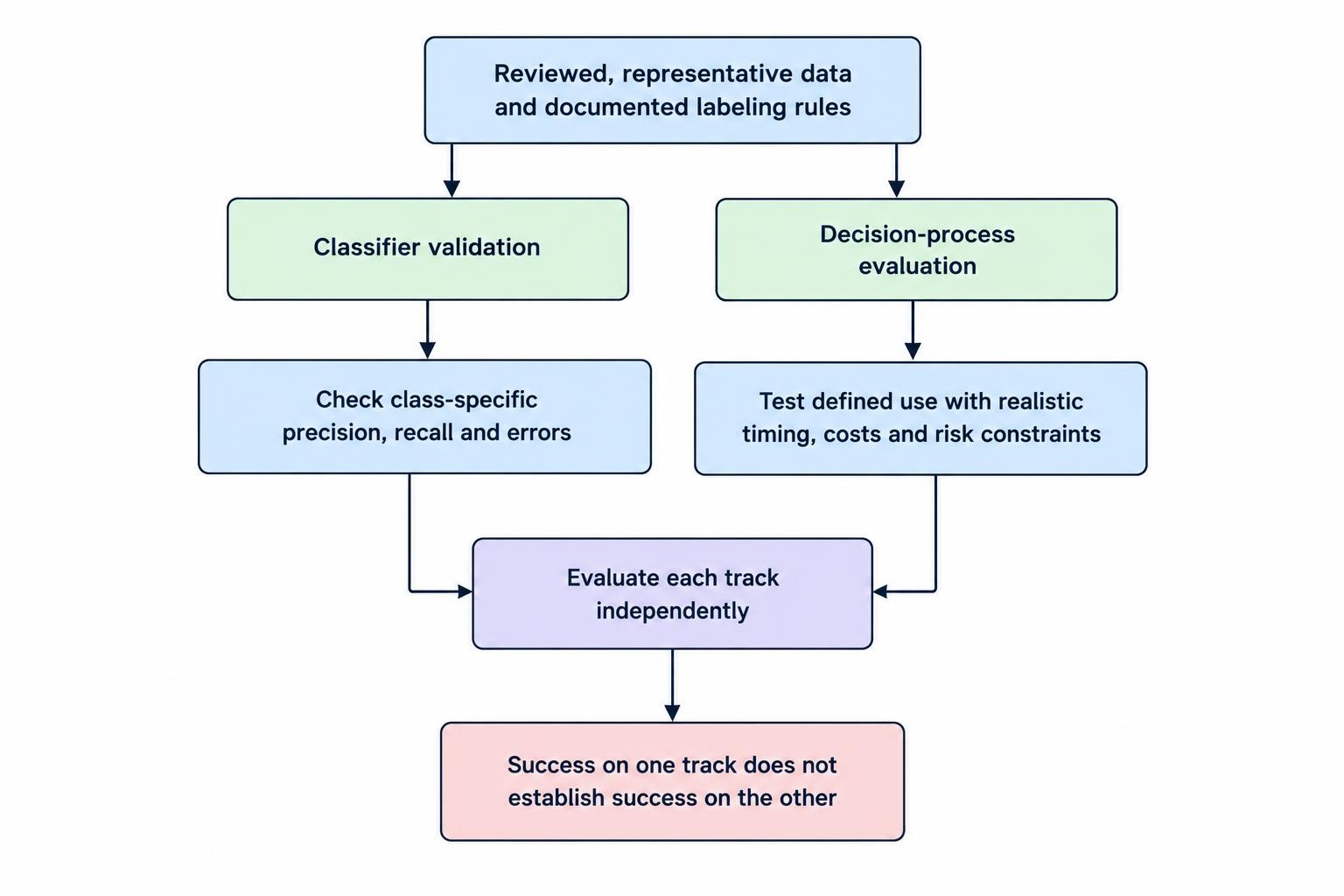
Preserve the information available at each historical decision point. Do not substitute a later article revision, collect posts written after the outcome, or randomly split duplicates of the same story across training and testing. The guide to avoiding overfitting and look-ahead bias covers the broader testing problems behind these mistakes.
Before deployment, require each alert to retain its original text, target entity, timestamps, model version and reason for escalation. Set review rules for contradictory evidence, missing context and unusual posting activity.
The practical standard is simple: a sentiment score should make the evidence easier to inspect. If an analyst cannot tell what changed, whose view was measured and why the label was assigned, the number is not ready to influence a financial decision.