Discretionary trading uses human judgment to decide whether and how to trade. Systematic trading applies predefined rules to make those decisions. The difference is not whether someone clicks a button or runs software. It is how much freedom the trader has to change the decision when an opportunity appears.
A discretionary trader can follow a structured plan. A systematic trader can place every order manually. Both approaches need a reason to expect profits after costs, sensible risk limits, and evidence that the process works beyond a few memorable trades.
The useful question is not which approach sounds more sophisticated. It is which decisions should remain open to judgment, which should follow fixed rules, and how you will measure the result.
What Is the Difference Between Discretionary and Systematic Trading?
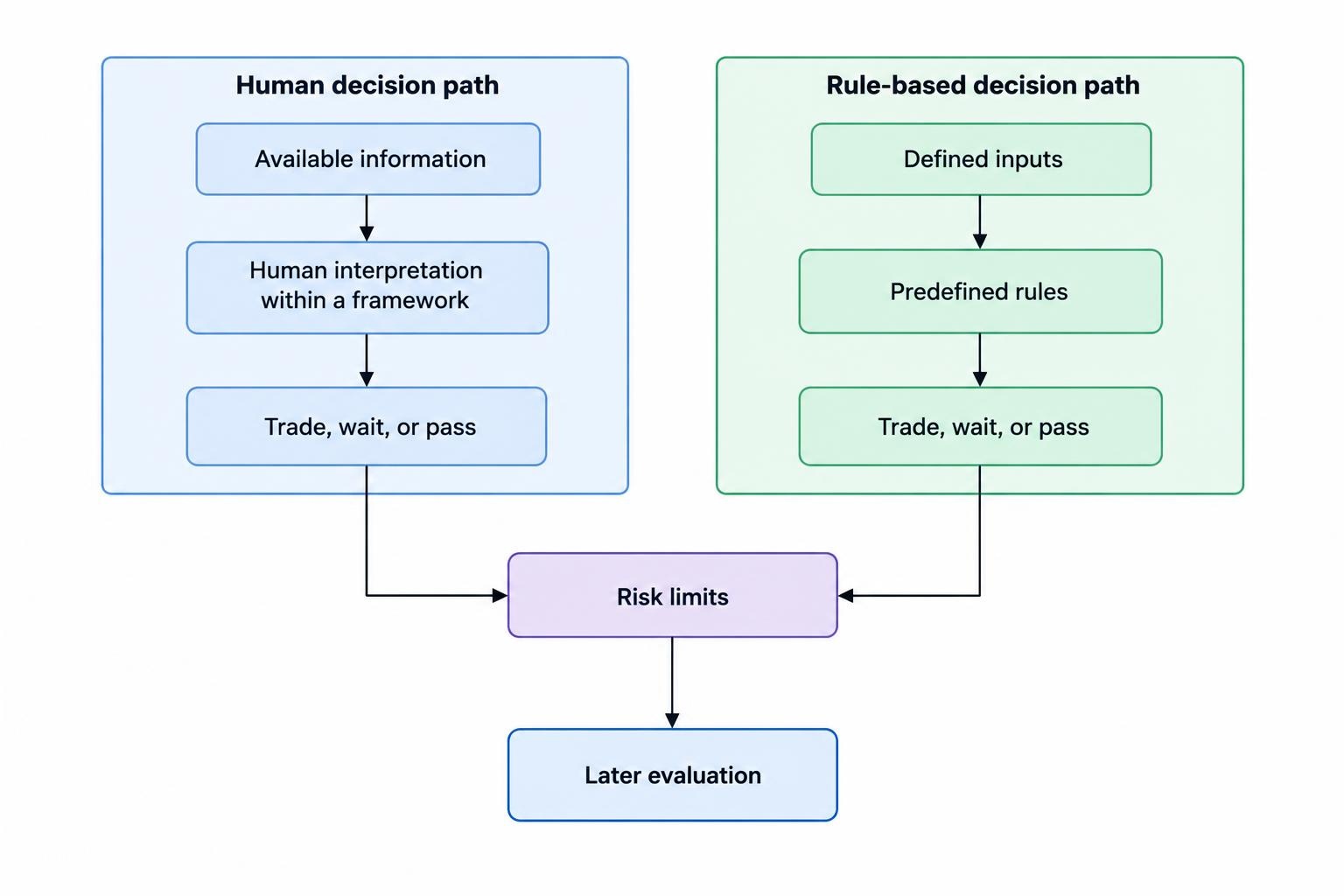
In discretionary trading, the trader interprets available information and chooses an action within a broader framework. Two opportunities with similar chart patterns may receive different treatment because the trader judges their context differently.
In systematic trading, an established process maps inputs to actions. Given the same inputs, strategy version, and account conditions, the process should produce the same decision. Rules can use prices, company fundamentals, economic releases, or other measurable information.
Both sit within the broader subject of trading systems and their operating principles. Neither label tells you whether a strategy is profitable, cautious, short term, or suitable for your circumstances.
| Decision area | Discretionary trading | Systematic trading |
|---|---|---|
| Trade selection | The trader interprets conditions and selects opportunities. | Defined criteria determine which opportunities qualify. |
| Handling context | Judgment can change the decision immediately. | Context matters when the rules represent it. |
| Consistency | Depends on the trader applying a stable decision framework. | Depends on consistent inputs and correct rule implementation. |
| Testing | Requires recorded decisions made without knowing subsequent outcomes. | Can support repeatable historical testing when suitable data exists. |
| Main failure risk | Unrecorded changes, emotional decisions, and hindsight explanations. | Weak assumptions, overfitting, data errors, and implementation failures. |
| Execution | Can be manual or use automated order tools. | Can be manual, partly automated, or fully automated. |
How Discretionary Trading Works
A discretionary trader usually starts with a framework: the markets they follow, the opportunities they want, and the conditions that would invalidate a trade. Judgment operates inside that framework rather than replacing it.
Consider a hypothetical trader watching a stock after an earnings announcement. Revenue exceeds expectations, but management reduces its profit outlook. The stock initially rises. The trader decides not to buy because the weaker outlook matters more to their thesis than the headline revenue figure.
That decision uses interpretation. Another trader could review the same release and reach a different view. The disagreement does not automatically make either process careless; it makes the reasoning something that needs recording and evaluation.
Where judgment can help
Discretion permits a trader to consider information that their existing numerical rules do not capture well. An unusual announcement, an ambiguous management comment, or uncertainty about a data release might justify further review rather than an immediate order.
The tradeoff is accountability. “The context looked wrong” is difficult to evaluate unless the trader records what looked wrong before the outcome becomes known. Useful discretion leaves a trail: the evidence considered, the decision made, and the conditions that would have changed it.
Where discretion can fail
The same freedom that permits interpretation also permits inconsistency. A trader might reject a valid setup after several losses, then accept a weaker one because they want to recover. The strategy changes, but the trader may still describe it as the same method.
Behavioral risk is not just a trading cliché. The SEC-hosted report on investor behavior identifies patterns such as excessive trading, holding losing investments too long, and reacting to performance in ways that can undermine results. A discretionary process should make these deviations visible rather than treating every decision as informed intuition.
How Systematic Trading Works
A systematic strategy defines its decision process before the next opportunity occurs. A simple example might buy a stock when its closing price exceeds the highest closing price of the previous 20 sessions, provided trading volume meets a stated threshold. Exit and position sizing rules would also need defining.
Those details matter. Does the strategy act at the closing auction or during the following session? What happens if the stock opens above the intended entry? Does the volume calculation include the current session? A rule that looks precise in conversation may still leave several trading decisions unanswered.
A usable specification should let another person reproduce the intended decisions without asking what the original trader “really meant.” The rules need not be simple, but they must be sufficiently clear to apply.
Repeatability is the main advantage
Repeatable decisions make comparison easier. You can investigate whether losses came from the strategy, transaction costs, bad data, or departures from the rules. You can also apply the same process across a larger set of opportunities without interpreting every setup from scratch.
Start with a written decision process before choosing software. The guide to building a rules-based trading system covers that separate task. Automation should implement a defined method, not conceal an unfinished one.
Rules can be consistently wrong
A system does not need to panic to lose money. It can follow an unprofitable rule perfectly. It can also trade on stale prices, apply an incorrect adjustment, or keep operating after the assumptions behind its strategy stop being useful.
Human judgment has not disappeared. It has moved into research, data selection, rule design, risk budgets, and decisions about when to revise or retire the strategy. Systematic trading restricts judgment at the point of execution; it does not remove responsibility.
Systematic Does Not Mean Automated
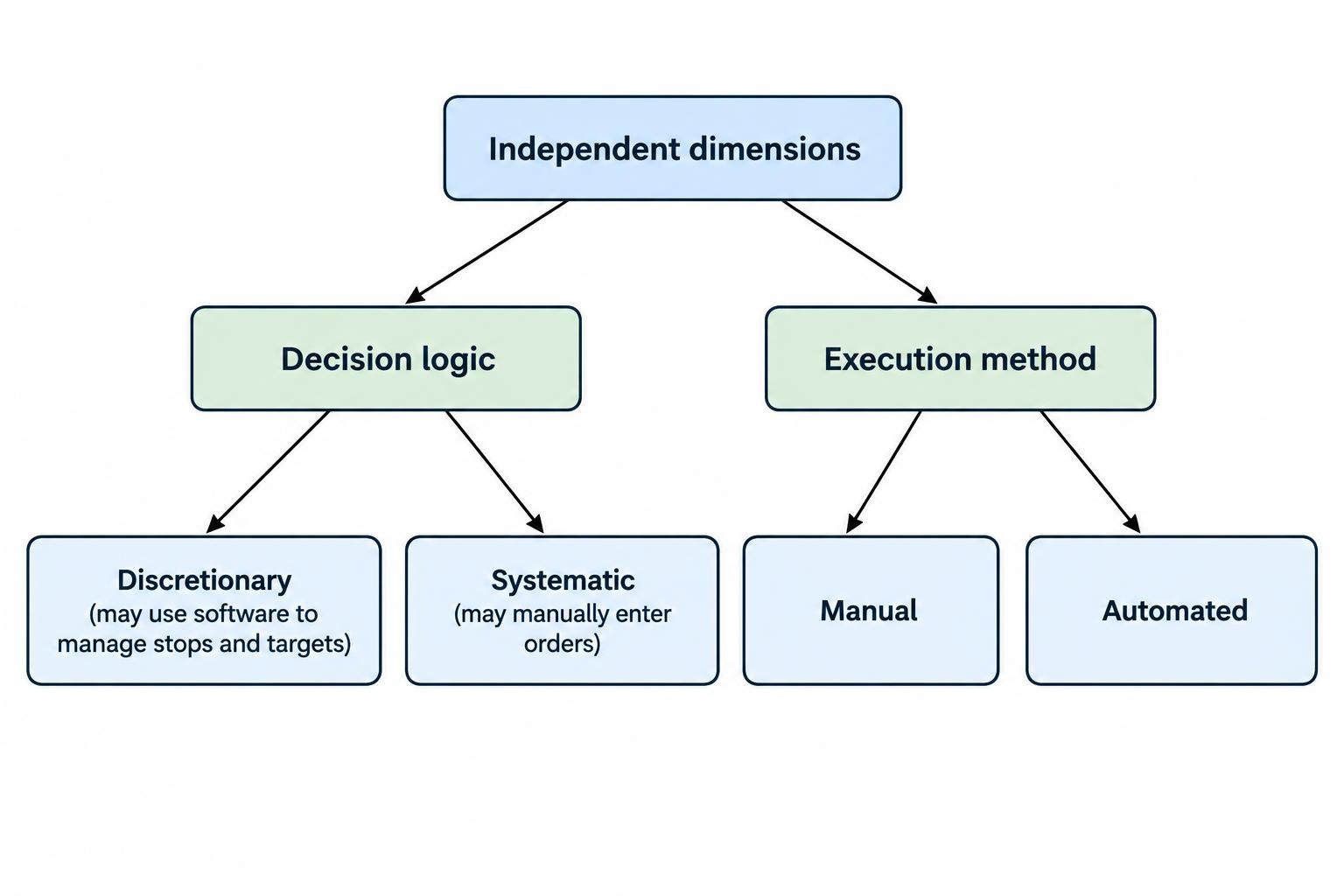
Systematic describes decision logic. Automated describes how a task happens. Keeping those ideas separate prevents an expensive category error.
A trader who checks a fixed end-of-day checklist and manually enters every qualifying order is trading systematically. A discretionary trader who chooses an entry and then uses software to manage a stop and profit target has automated part of execution without making trade selection systematic.
Automation also creates operating work. Someone must check order status, reconcile positions, detect connection failures, and control changes. FINRA’s guidance on algorithmic trading controls addresses testing, change management, monitoring, and mechanisms for disabling algorithms at member firms. These are institutional practices, not a blanket legal checklist for individual traders, but they illustrate why automated execution requires supervision.
Compare the Same Opportunity Under Both Approaches
Suppose a liquid stock breaks above a recent trading range after earnings. Both traders see the same price move, but their decision processes differ.
The discretionary trader reviews the announcement, sector performance, and the quality of the breakout. They might enter, wait for a pullback, or pass because the earnings reaction appears inconsistent with the business outlook.
The systematic trader checks the defined conditions. If the breakout, volume, volatility, and event filters qualify, the strategy takes the prescribed action. If earnings days are excluded by an existing rule, it does not trade.
Neither decision establishes superiority. If the stock rallies, the rejected trade does not prove discretion was foolish. If it falls, the systematic entry does not prove rules are useless. One outcome cannot settle a comparison between processes.
The revealing question comes later: did discretionary choices improve results across a meaningful set of comparable opportunities, after costs and differences in risk?
Which Approach Is More Profitable?
The label alone cannot answer that question. Compare actual methods, not an idealized human trader against a poorly designed algorithm, or a polished backtest against an inconsistent beginner.
A fair comparison needs similar markets, holding periods, capital constraints, and risk exposure. It should include commissions, spreads, slippage, financing where relevant, and ongoing data or software expenses. A higher return achieved through much larger exposure is not automatically a better result.
Historical results also need careful labeling. The CFTC’s guidance on evaluating performance disclosures distinguishes actual trading results from hypothetical results and highlights the need to disclose simulation limitations. Treat a backtest as evidence about a model under stated assumptions, not as a live account with the inconvenient parts removed.
Compare expectancy, drawdown, and implementation
Win rate is an incomplete measure. A method that wins frequently can still lose money if its losing trades are much larger than its winners. Assess average gains, average losses, costs, and the frequency of each outcome.
Also examine drawdown, the decline from a previous equity peak, and how long recovery takes. A process that you repeatedly abandon during its expected losing periods is not workable in its present form, even if its research results look attractive.
For discretion, separate the planned opportunity from the trader’s intervention. For systematic trading, separate the intended orders from actual fills. These distinctions help identify whether the weakness sits in the idea, the decision process, or execution.
Testing Discretionary and Systematic Decisions Fairly
Systematic rules lend themselves to repeatable testing, but the researcher can still influence the result through repeated changes. Trying many variations and keeping only the winner can produce a strategy that describes the past better than it anticipates unseen conditions.
Preserve data that did not influence development, use realistic trading assumptions, and record strategy revisions. The testing details belong in backtesting an automated trading strategy; the comparison here is about the quality of evidence each approach needs.
Discretion needs an equivalent discipline. Reviewing old charts while seeing what happened next does not test decision-making fairly. Instead, use forward observation or replay that conceals later prices. Record entries, rejected opportunities, exits, and reasons before revealing the outcome.
There is no universal trade count that proves a method works. Closely related trades may provide less independent evidence than their number suggests. Seek observations across different conditions and avoid declaring success after one unusually favorable period.
Can You Combine Discretionary and Systematic Trading?
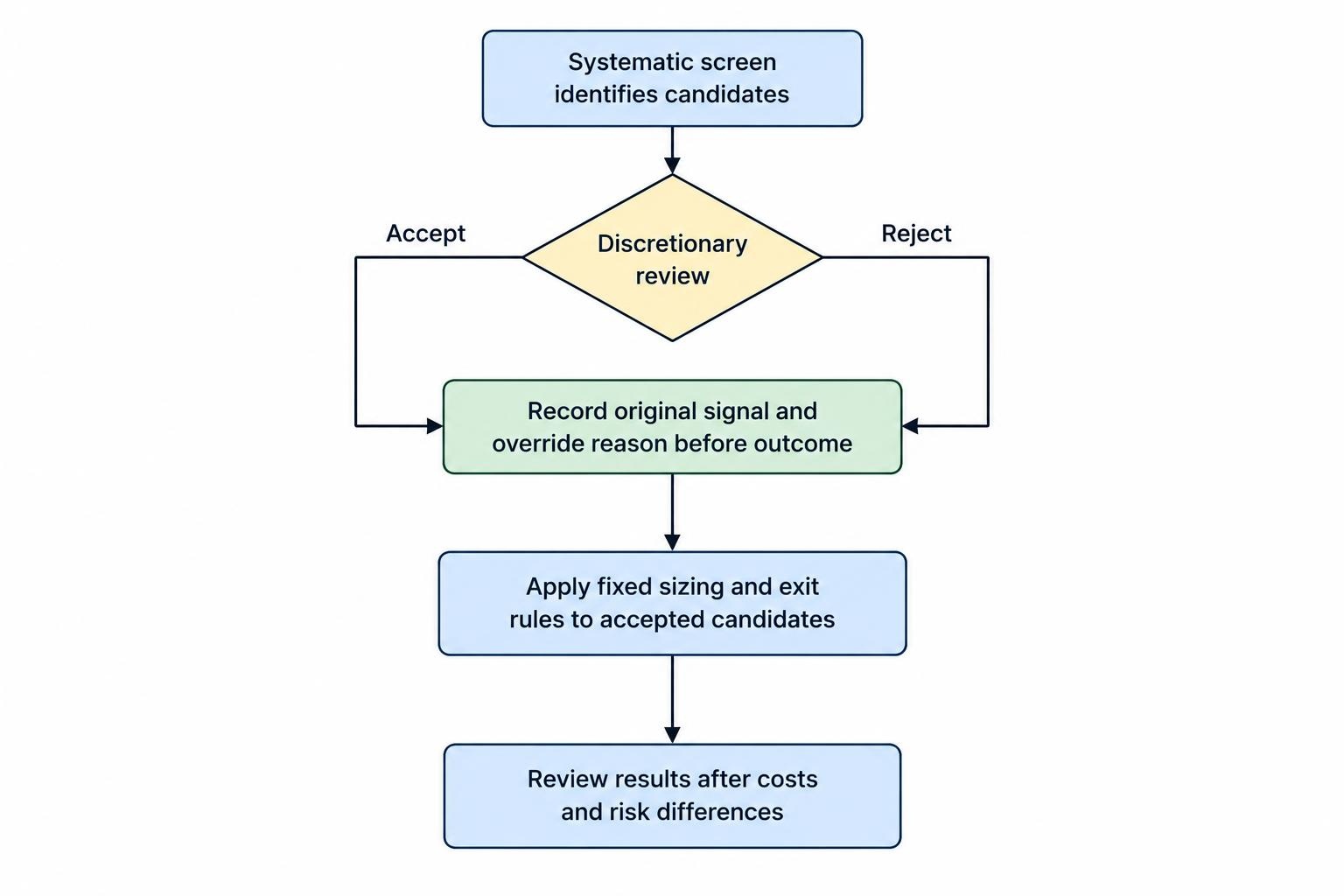
Yes, but define the boundary. A hybrid approach might use systematic screening to identify candidates, discretionary analysis to accept or reject them, and fixed rules to control position size and exits.
The danger is an unrestricted override. If every uncomfortable signal becomes an exception, the tested strategy and the traded strategy are different methods.
A more accountable hybrid process should:
- State which decisions permit judgment and which remain fixed.
- Record the reason for each override before its outcome is known.
- Keep the original signal alongside the discretionary decision.
- Review whether overrides improve results after costs and risk differences.
Distinguish safety intervention from a market opinion. Stopping new orders because account positions cannot be reconciled is operational risk control. Skipping a valid signal because it “feels late” is a strategy change. They should not share the same label in the records.
Choosing an Approach You Can Evaluate and Maintain
Choose around the work you can perform reliably, not the identity you prefer. Calling yourself systematic will not make incomplete rules precise. Calling yourself discretionary will not turn impulse into analysis.
A discretionary approach may fit work that requires interpreting announcements and resolving ambiguous information, provided you can document decisions consistently. A systematic approach may fit repeatable hypotheses and measurable inputs, provided you can maintain the research, data, and operating process.
Time commitment depends on the method. A manually operated daily system may need less screen time than discretionary intraday trading. A fully automated strategy may require substantial maintenance. Count preparation, monitoring, review, and troubleshooting—not just time spent entering orders.
Use trading journals and performance tracking to test whether your chosen process survives contact with actual decisions. Review rule adherence separately from profit. A winning trade can break the plan, and a losing trade can follow it correctly.
The strongest distinction is accountability. Discretionary trading should make judgment reviewable. Systematic trading should make rules reproducible. A hybrid should do both. Choose the process whose decisions you can explain before the trade and evaluate honestly afterward; neither approach guarantees a profit.