Swing trading aims to participate in market movements that develop over several sessions, commonly holding positions for days or weeks. The trader needs a process for identifying candidates, selecting an entry, sizing exposure and deciding when the original reason for the position no longer holds. You can learn more about what you need to succeed in swing trading by visiting SwingTrading.com.
Artificial intelligence can assist parts of that process by organising information, finding patterns or producing estimates from data. Its role depends on the task and the system being used. An application that summarises a company release performs different work from a model estimating future returns. Neither automatically places trades. Understanding those distinctions makes it possible to assess whether a tool reduces useful work, changes the trading decision or simply adds another opinion to an already crowded research routine.
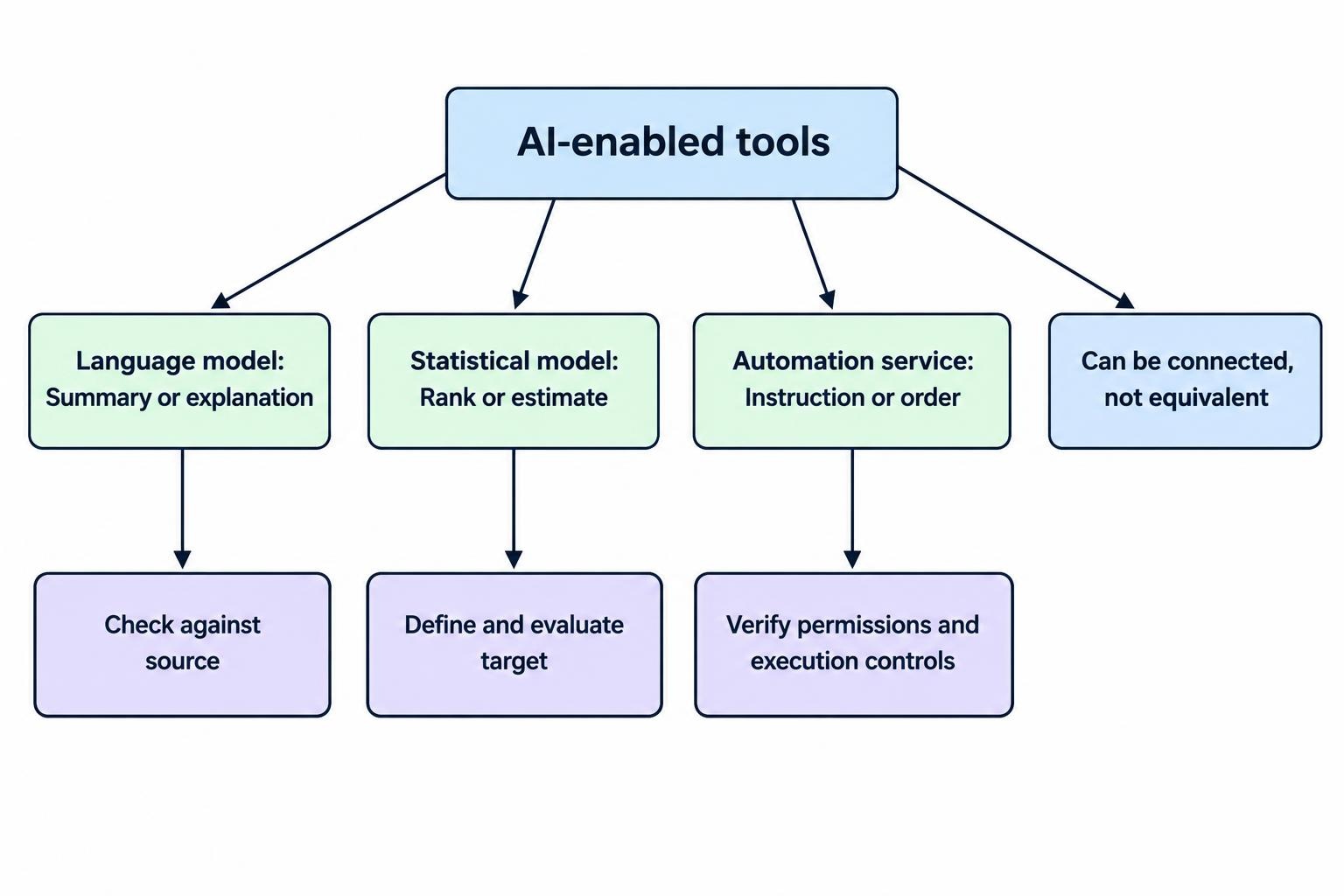
The term AI covers systems with different capabilities and failure modes. A language model can produce summaries, draft code and turn a written idea into a proposed set of rules. A statistical model can rank instruments or estimate an outcome from defined inputs. An automation service can act on an instruction, whether or not the decision behind it uses AI. These functions can be connected, but the connection introduces further assumptions about data, interpretation and execution. A trader should identify the exact output being purchased or built. A fluent explanation, a numerical score and an accepted broker order are different forms of evidence. Treating them as interchangeable can make an apparently simple service difficult to evaluate when its results differ from the advertised description.
Swing trading leaves more time for checking an output than a strategy reacting within seconds, which can make AI assisted research practical. A trader reviewing markets after the close can verify a summary, inspect a candidate and prepare an instruction for the next session. That time also creates a clear standard for the tool: its contribution should improve the quality or efficiency of the review without obscuring the source evidence. A system that produces many candidates but requires extensive correction may save little work. The relevant benefit could be fewer missed events, more consistent screening or better records rather than a higher forecast accuracy. Those outcomes need to be measured separately so that a useful research assistant is not mistaken for a proven trading strategy.
Research and screening with AI
Start with documents and questions that can be checked
A language model can help extract information from an earnings release, company filing or central bank statement supplied to it. The task should define what to extract and retain a route back to the original passage. A trader might ask which forecasts changed, which reporting period a figure covers and what management identified as the cause. Those are more testable requests than asking whether the document is bullish. Inaccurate summaries can reverse a comparison, confuse annual and quarterly figures or omit a qualification. The original source therefore remains part of the workflow. The tool adds value when it makes the evidence easier to inspect, rather than when a polished paragraph becomes a substitute for checking what the issuer actually published.
For US listed companies, the SEC’s guidance on accessing EDGAR data explains access to filings and structured company information. This is a US reporting source, not a worldwide database covering every instrument. It illustrates how research can begin with an identifiable document instead of a generated claim about a company. Other markets require the relevant issuer or exchange reporting source. Record the publication date and the period described, especially when several releases use similar titles. A statement published after the intended trade cannot support the earlier decision. Keeping those dates with the extracted figures helps both current research and later attempts to test whether the same process would have worked historically.
Use screening to narrow the work
A screening model can rank a defined universe by observations such as price strength, volatility, liquidity and recent changes in reported information. Its value depends on what happens after that ranking. A score may help decide which instruments deserve detailed review without being a direct instruction to buy them. The trader needs to know the input dates, calculation schedule and eligible universe. Otherwise, a candidate can appear attractive because its information is stale or because the ranking excludes inconvenient alternatives. A useful screen also explains why an instrument was included in terms that can be checked. That explanation need not reveal every mathematical operation, but it should make clear which observations drove the result and which relevant factors the system did not assess.
The universe must be suitable for the intended account and holding period. A model can rank a thinly traded share highly while ignoring the difficulty of entering or leaving it at the assumed price. It may identify an instrument that the account cannot trade or a contract whose financing makes the intended holding period expensive. Basic eligibility rules should therefore be applied independently of a prediction score. Liquidity measures, available history, contract definitions and scheduled events all affect whether a candidate can be evaluated sensibly. Screening a wider universe is not automatically an improvement if the additional results cannot be traded under comparable conditions. The model should reduce the work of finding suitable candidates rather than pass operational problems into the final trading decision.
Sentiment analysis adds another category of observation. A model may classify language in news or social media as positive, negative or uncertain, but that classification is different from measuring an unanticipated change in value. Optimistic language can repeat an event already reflected in the price. Social posts can be duplicated, coordinated or unrelated to the correct company. The US FINRA and SEC bulletin on social sentiment tools highlights risks from inaccurate or misleading inputs. For a swing trader, sentiment is more useful when its source, timing and relevance can be inspected alongside other evidence. A rising score alone does not explain what the market had expected or why the observed language should change the proposed trade.
From an AI signal to a trade plan
Define the outcome being predicted
A model cannot be evaluated properly until its target is clear. Predicting whether a share closes higher in five sessions differs from predicting whether a position reaches a profit target before a stop. The second depends on the path prices take as well as the final observation. A model trained on one outcome should not be marketed or used as though it has established the other. The holding period also affects interpretation. An estimate for the next trading session does not automatically support a position held for two weeks. Before reviewing accuracy, state the proposed entry time, exit logic and price observations needed to calculate the result. Those definitions connect the statistical task to a transaction that could actually have been carried out.
A numerical confidence score also needs a definition. A ranking score of 80 does not necessarily mean an 80% probability of success. Even an output intended as a probability needs evaluation against later outcomes to establish how well it is calibrated. In a group of comparable predictions labelled 60%, the observed frequency should be assessed across enough independent decisions rather than inferred from one trade. The financial result still depends on gains, losses and costs. A model can predict direction correctly more often than not and lose money if its unsuccessful positions are larger or more expensive. A useful service explains what the score measures and preserves the predictions so that its meaning can be checked after the outcome is known.
Keep the plan separate from the explanation
A trade plan needs an entry condition, quantity, exit logic and a reason for remaining in the position. AI can help organise those fields, but they should not be improvised into a persuasive story after a candidate has been selected. The trader needs to distinguish a prediction from the evidence offered to explain it. A language model may produce a plausible rationale that does not reflect the statistical model’s actual calculation. The explanation should therefore be tested against sources and observed inputs. Recording the original plan also prevents a later narrative from quietly changing the trade’s purpose. If an earnings event or price movement invalidates the stated reason, a newly generated paragraph should not automatically override the exit process defined before entry.
A hypothetical position illustrates why planning cannot stop at an attractive forecast. Buying 100 shares at $50 creates a $5,000 position. A planned exit at $48 describes a $200 price loss before costs if execution occurs at that level. It does not guarantee the loss will be capped there, because the market can reopen or trade beyond the trigger. An AI estimate that the share will rise does not alter that exposure. The quantity should be checked using deterministic calculations and the contract’s actual terms. Where account currency, leverage or a derivative changes the calculation, those conversions also need verification. Generated arithmetic can support an explanation, but the accepted order should depend on a calculation whose inputs and result can be checked directly.
Data and backtesting
Reconstruct what was available at the time
Historical testing must use information available before each simulated decision. A company figure is not available merely because it describes an earlier quarter; its publication date matters. Economic statistics can also be revised after release. A historical database containing the latest revised values may not represent what a trader saw at the time. The same issue arises when an end of day observation is used to justify an entry at that day’s closing price without allowing for when the calculation became available. These mistakes give the model information it would not have possessed. The test then measures an impossible process. Preserve data timestamps and define a feasible execution schedule before interpreting a reported return as evidence about a usable strategy.
Language models create another historical testing problem. A model trained after the period being examined may contain information about later events, company outcomes or market episodes. Asking it to act as though it is living in an earlier year does not establish that later knowledge has been excluded. Restricting supplied documents can improve a research experiment, but a prompt alone is not evidence that the model has forgotten what it learned elsewhere. Historical text analysis therefore needs a careful account of the model version, available context and possible contamination. A forward record, collected as new information arrives and before outcomes are known, provides a different kind of evidence. It avoids relying entirely on a present day model’s supposed reconstruction of an earlier decision environment.
Keep training and evaluation in chronological order
Market observations have an order, and nearby examples can share information. A random split that trains a model on later data while testing it on earlier data can misrepresent how the system would be used. The official scikit-learn documentation for time series splitting explains this chronological issue. A trading evaluation should also consider overlapping outcome periods. If a target uses the following ten sessions, examples close to a test boundary may share future observations. The required separation depends on the features and target, so a generic chronological split does not solve every leakage problem. The practical objective is to prevent training, parameter selection or data preparation from using information belonging to the evaluation period.
Data preparation needs to follow the same discipline. Scaling, choosing variables or filling missing values using the complete history can introduce information from later observations before training even starts. The model may then appear more stable than a live process would be. The tradable universe also needs a historical definition. Testing only companies still listed today can omit failures or delistings that a trader would have encountered. Corporate actions and price adjustments require care so that returns are calculated consistently without assuming information unavailable at entry. These issues can matter more than the choice between two model types. A complicated algorithm does not repair a dataset whose construction has already made the test easier than the real trading task.
Compare with a simpler method and include costs
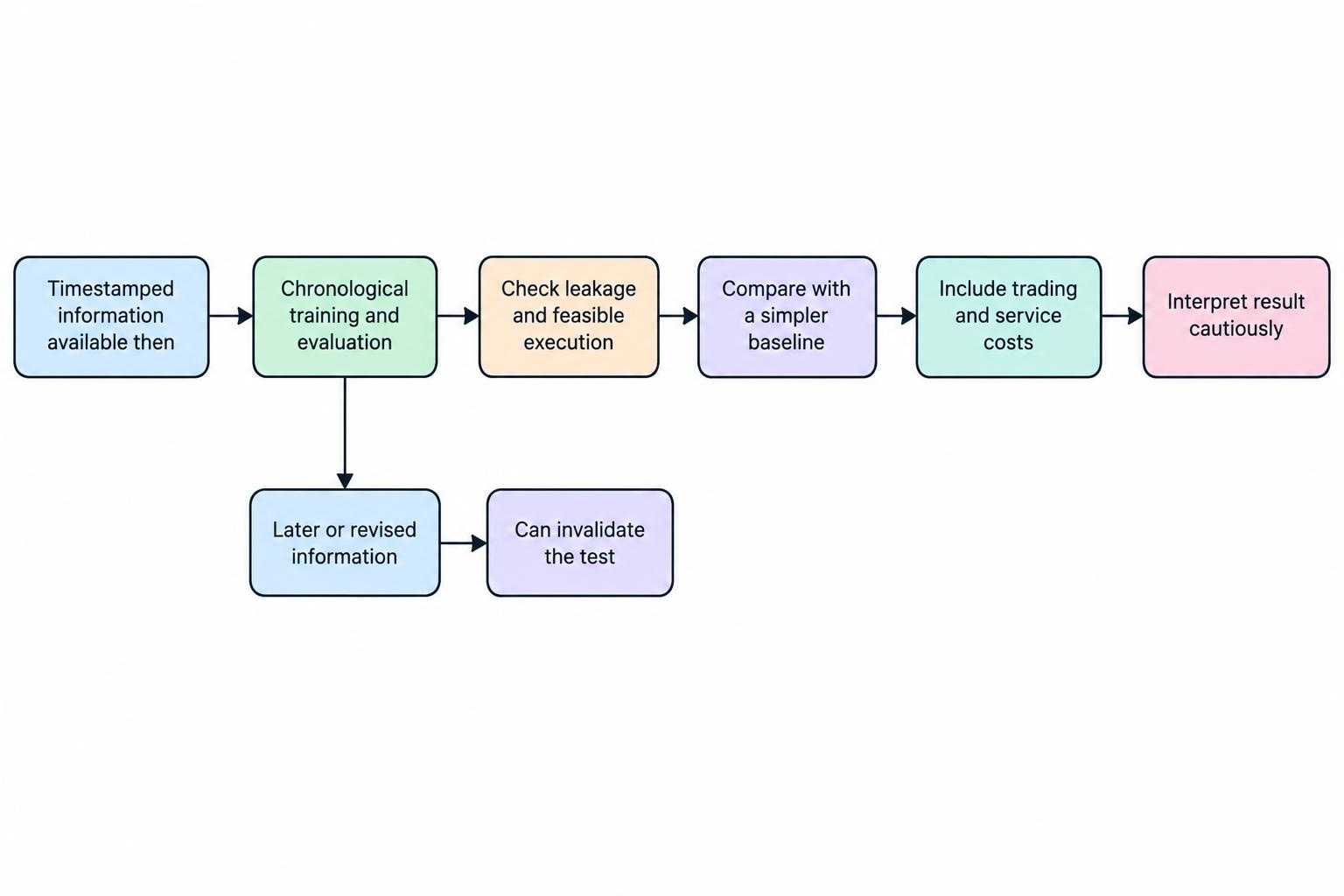
An AI strategy should be compared with a reasonable alternative using the same universe, dates and cost assumptions. That alternative might be a simple trend rule or a market exposure appropriate to the question. If most gains came from holding a rising market, the model’s contribution needs to be separated from that exposure. The comparison should also account for capital usage, turnover and risk rather than focus only on the largest final balance. More complex models can require additional data, subscriptions and maintenance. A modest improvement in a historical result may not justify those demands. The test should establish what changes when the AI component is added and whether that change remains meaningful after the complete process is made realistic.
Costs can remove an apparent advantage. Suppose a hypothetical method makes 40 completed trades with an average gross gain of $15, producing $600 before costs. Average trading costs of $8 per completed trade would consume $320, leaving $280 before subscriptions or other expenses. A further $300 service charge for that same evaluation period would make the combined result negative. The illustration does not forecast a return; it shows why software and transaction expenses belong in the same assessment. Slippage, financing and borrowing costs may also matter depending on the instrument. Test results should use plausible quantities and execution assumptions rather than apply a percentage return to an account that could not obtain the assumed prices or position sizes in practice.
Repeated experimentation also affects the evidence. If many targets, inputs and settings are tried, the strongest historical result may reflect selection rather than a durable pattern. Keep a record of those attempts and reserve observations for a final evaluation that does not guide further tuning. A process that repeatedly adjusts itself after seeing the test result no longer has an untouched test. Historical tools can make experimentation efficient, but that efficiency increases the need for a clear boundary between development and evaluation. MetaTrader 5’s Strategy Tester documentation illustrates software for testing trading programs. Running a model through such a tool still requires the trader to establish sound data, realistic execution and an evaluation design appropriate to the strategy being examined.
Portfolio risk and execution
A candidate score is not a position limit
Several highly ranked candidates can share one underlying risk. A group of technology shares may respond to the same earnings expectations, while different currency pairs can repeat exposure to one currency. A model ranking each instrument separately may fail to recognise that the account is making one concentrated decision through several positions. Portfolio controls should therefore operate independently of individual prediction scores. The trader needs a view of total committed capital, related exposures and the consequences of several positions moving adversely together. A system producing more candidates does not create diversification automatically. Its value depends partly on whether the account can choose among them without allowing the ranking process to expand exposure beyond the financial limits established for the method.
Swing positions also remain exposed between review sessions and across market closures. Earnings releases, policy decisions and other announcements can change prices before the trader can respond. An ordinary stop is not a guarantee against that gap risk. AI may help identify scheduled events or summarise new documents, but it cannot ensure that every unexpected event is detected or that an exit can occur at the planned level. The process needs a rule for what is held through known events and how changes are reviewed. That rule should remain intelligible when the model output is unavailable. A trading plan depending on a continuous stream of generated reassurance is difficult to assess and harder to follow consistently during adverse conditions.
Give an automated service only the authority it needs
Research assistance and broker access should be treated separately. A summarisation service does not need permission to withdraw funds, and a journal may need transaction history without authority to place orders. If a system submits instructions, establish its quantity limits, permitted instruments and response to a restart or rejected request. It should recognise positions already present and avoid duplicating them. Broker records must be reconciled with the service’s own log, particularly after a connection failure. Turning off new entries may leave existing positions open or pending orders active. The user needs to know how to regain control through an independent authorised route. A successful demonstration of the model’s predictions does not establish that these operating controls behave correctly when an account is under pressure.
Evaluating AI services and live results
Assess the provider as well as the model
Commercial claims should identify what is actually supplied, the instruments covered and how performance was measured. A backtest, a simulated forward record and a funded account history are different forms of evidence. Screenshots of selected winners do not show losing periods, subscriptions or capital added to the account. Ask whether reported returns include open losses and whether the described method matches the service currently being sold. A program advertised as free may depend on referred account openings or trading volume, creating a commercial incentive that deserves disclosure. The AI label adds no independent evidence about the provider’s identity, finances or account handling. Those questions need checking even if the product’s research functions appear useful during an initial trial.
In US investor protection material, the joint SEC, NASAA and FINRA alert on AI and investment fraud warns about unrealistic AI trading claims and unreliable generated information. The CFTC’s advisory on AI trading bots likewise addresses promises of unreasonably high or guaranteed returns. These are US sources, rather than statements of worldwide licensing requirements. Readers elsewhere need the relevant local rules and supervisory records when assessing a service. The general evidential point is that a technology claim does not establish an investment result. A promise that losses have been eliminated is not a substitute for complete performance records, a clear method and independently verified business details.
Measure the contribution through a forward trial
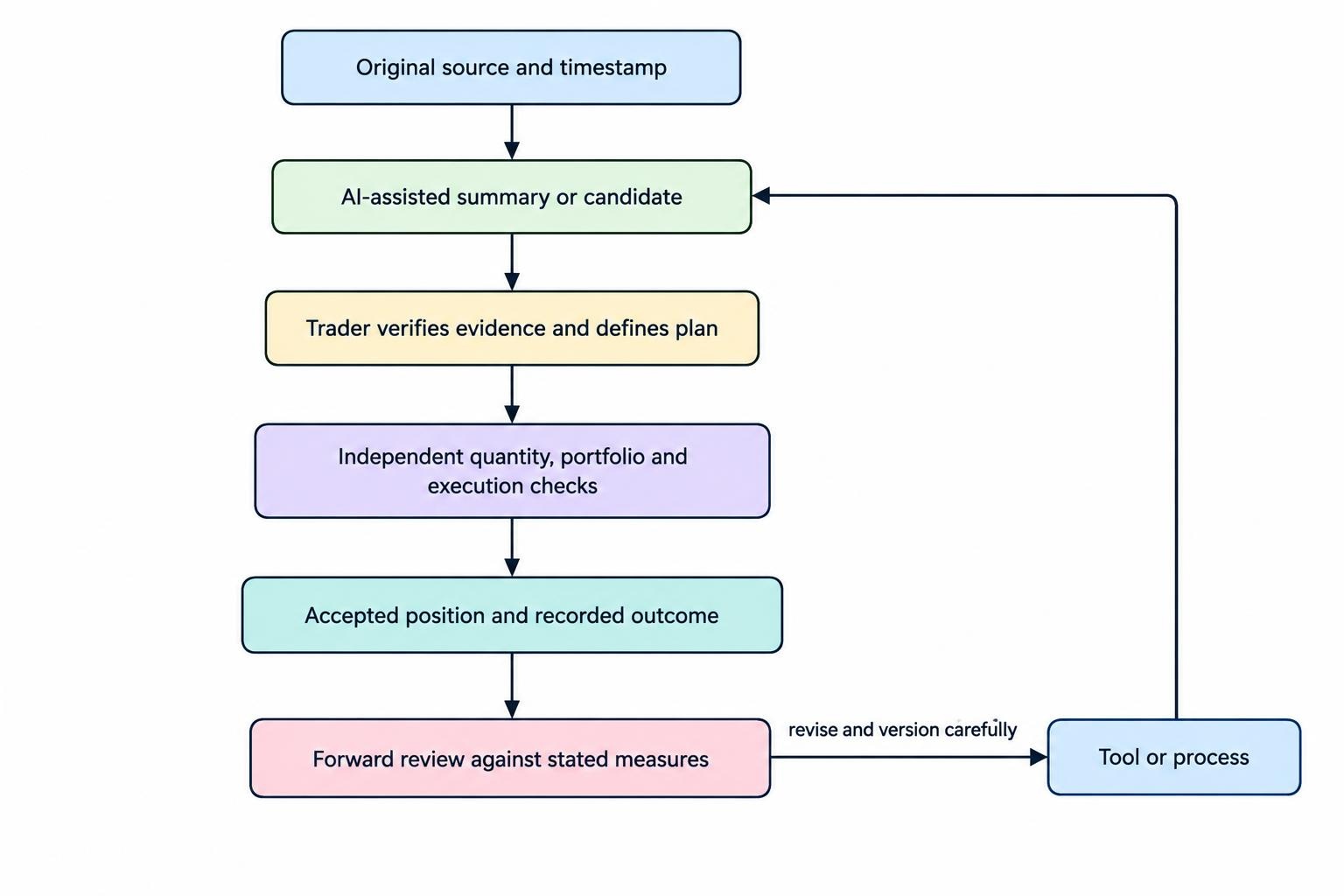
A forward trial should record the tool’s outputs before the outcomes are known. Preserve the date, source data, model or service version, proposed action and the trader’s eventual decision. Also record rejected candidates so that later review does not focus only on selected successes. A useful research trial can measure time saved, factual corrections required and relevant events missed, while a signal trial needs financial results under realistic execution assumptions. Those are separate measures. Keep the rules stable long enough to obtain interpretable observations, without treating a short favourable period as proof. Changes should be versioned and explained so that a later reviewer can distinguish an improved process from a different strategy whose earlier results have been carried forward inappropriately.
The appropriate role for AI is the one supported by that evidence. A document assistant may earn its place by reducing repetitive reading while keeping sources visible. A ranking model needs a stronger demonstration that its ordering improves decisions under the intended costs and constraints. An automated service must meet those standards and also handle live instructions reliably. Swing trading provides time to check information, but that time is useful only if the process actually includes verification. The final setup should preserve a clear path from source observations to the trade plan, accepted position and recorded outcome. AI contributes when it improves a defined part of that chain without concealing the assumptions or transferring responsibility to an output the trader cannot evaluate.