FIX, short for Financial Information eXchange, is a messaging standard that lets trading systems exchange structured information about orders, executions and other financial activity. It gives independently built systems a shared vocabulary, so an order management system and a broker’s gateway can communicate without inventing a new message format for every connection.
The FIX Trading Community’s application protocol specification defines the business meaning of those messages. FIX is not a trading platform, a strategy or a promise of faster execution. Its practical value is more straightforward: it makes trading instructions and responses interpretable across system boundaries.
For anyone planning a connection, the real work starts after “we support FIX.” Both parties still need to agree on supported messages, required fields, session behavior and recovery procedures. Sharing a language does not mean agreeing on every detail.
Where FIX Fits in a Trading System
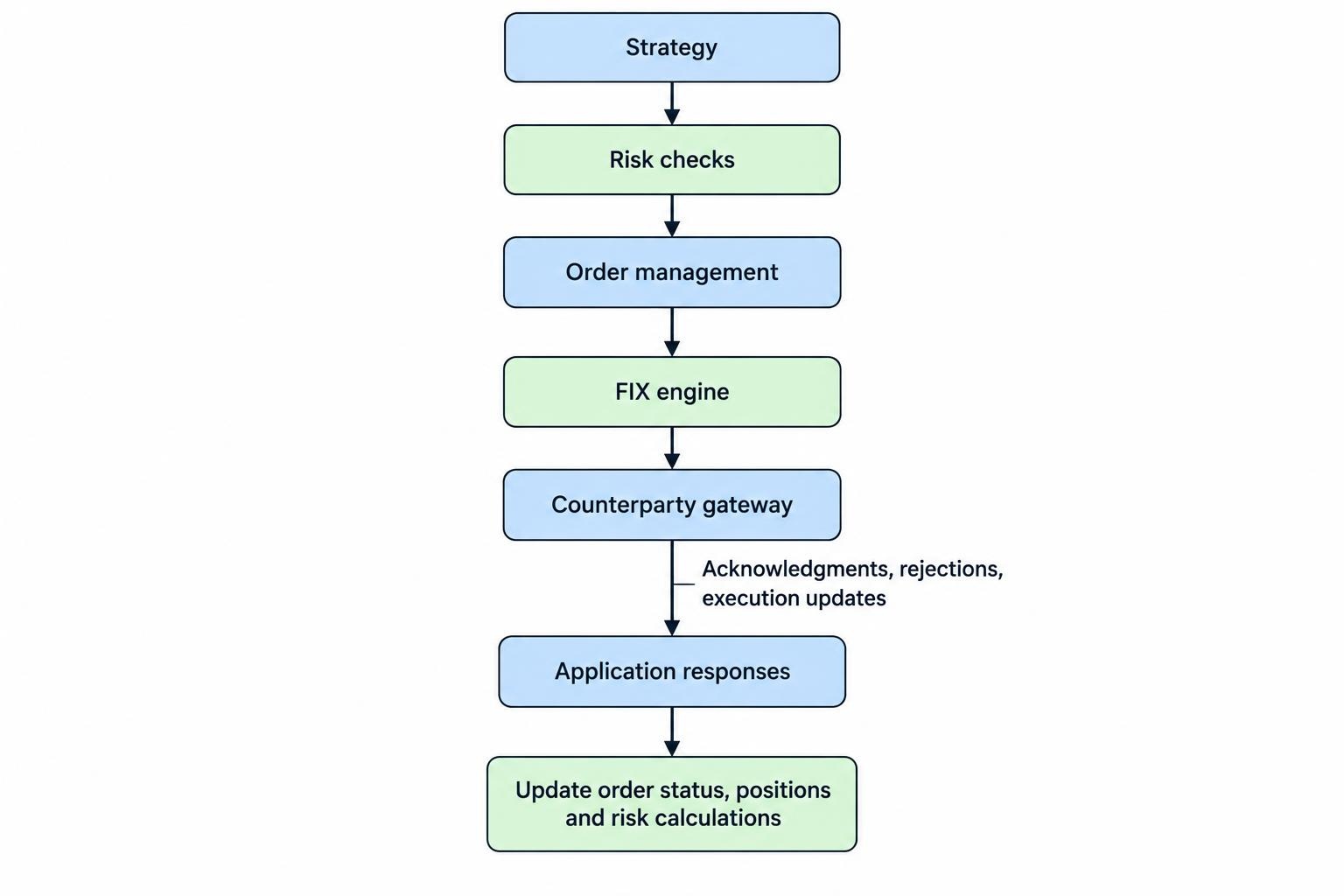
Consider a strategy that decides to buy shares. The strategy produces an instruction, an order management system checks it, and a connectivity component translates it into the format accepted by the receiving broker or venue. Responses then travel back into the application, where they update order status, positions and risk calculations.
A useful conceptual path is: strategy, risk checks, order management, FIX engine, counterparty gateway. The return path carries acknowledgments, rejections and execution updates. Keep those responsibilities separate when designing the system. The component that maintains a connection should not also decide whether an unexpected position is acceptable.
FIX belongs within the broader subject of trading APIs and platform integrations. Choosing a connection method starts with the receiving service’s capabilities, not a preference for a particular acronym. A well implemented interface that supports the required workflow is more useful than an impressive protocol name attached to an incomplete integration.
Business Messages and Session Management
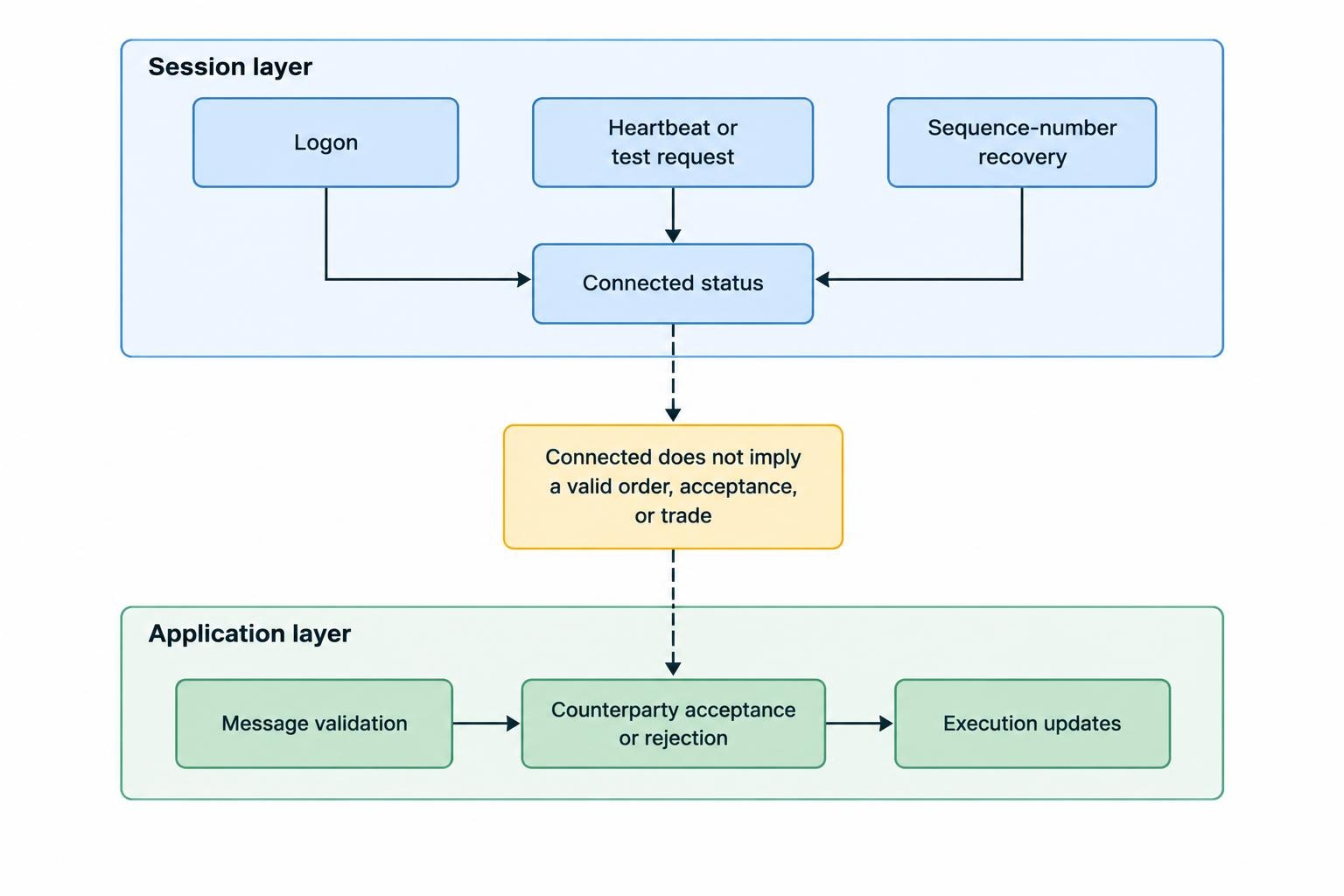
A conventional FIX integration has two related jobs. The application layer expresses business actions, such as submitting an order or reporting a trade. The session layer manages the exchange of messages between the two endpoints.
That distinction matters during troubleshooting. A successful connection does not prove that an order is valid. A valid order message does not prove that the receiving firm accepted the order. And acceptance does not mean the order has traded.
The Session Layer
The FIX session layer technical standard defines logon, heartbeat, logout and message recovery behavior. Each direction has its own sequence numbers. A session can continue across successive network connections, rather than starting afresh whenever a socket disconnects.
The initiator establishes the connection and sends the initial Logon message. The acceptor receives that request. Heartbeats and test requests help detect an unresponsive peer; sequence numbers help identify missing messages. These mechanisms support communication reliability, not proof of a business outcome.
For operations, keep connection status and trading status separate. A dashboard showing “connected” should not imply that order submissions are being accepted or execution updates are reaching the position service.
The Application Layer
Application handling should answer different questions: Which order does this update concern? What changed? Has the application already processed it? Does the new state agree with the quantities recorded locally?
Design those checks explicitly. A message can pass structural validation yet still require investigation because it refers to an unknown order or conflicts with the application’s current records. Treat parsing, business validation and state updates as separate stages, with clear error handling between them.
How to Read a FIX Message
Traditional FIX tagvalue messages consist of numeric field identifiers followed by values. A fragment such as 35=D identifies a New Order Single message. Fields are separated by the Start of Heading control character, often displayed as a vertical bar in readable logs.
Tagvalue is one possible syntax for FIX messages, formally specified in ISO 3531-1:2022 on FIX tagvalue encoding. Business meaning and encoding are separate concerns: the instruction being communicated is not the same thing as its byte representation.
Read a message in layers rather than trying to memorize every tag. Start with the message type and session identifiers, then examine the order identifiers and business fields. The following fields provide a useful starting point.
| Tag | Field | Purpose |
|---|---|---|
| 35 | MsgType | Identifies the kind of message. |
| 34 | MsgSeqNum | Identifies the message’s position in its session direction. |
| 49 / 56 | SenderCompID / TargetCompID | Identify the sending and receiving session participants. |
| 11 | ClOrdID | Client assigned order identifier. |
| 54 | Side | Expresses the transaction side, such as buy or sell. |
| 38 / 44 | OrderQty / Price | Express order quantity and price where applicable. |
This is a reading aid, not a complete order specification. Do not assemble production messages from a handful of familiar tags. Instrument identification, account details, order instructions and conditional requirements must match the receiving service’s documentation.
Be particularly careful with units. Before sending an order, establish what quantity represents, how price is expressed and which identifier names the instrument. A correctly formatted message containing the wrong economic instruction is still the wrong order.
Following an Order Without Confusing Messages With Trades
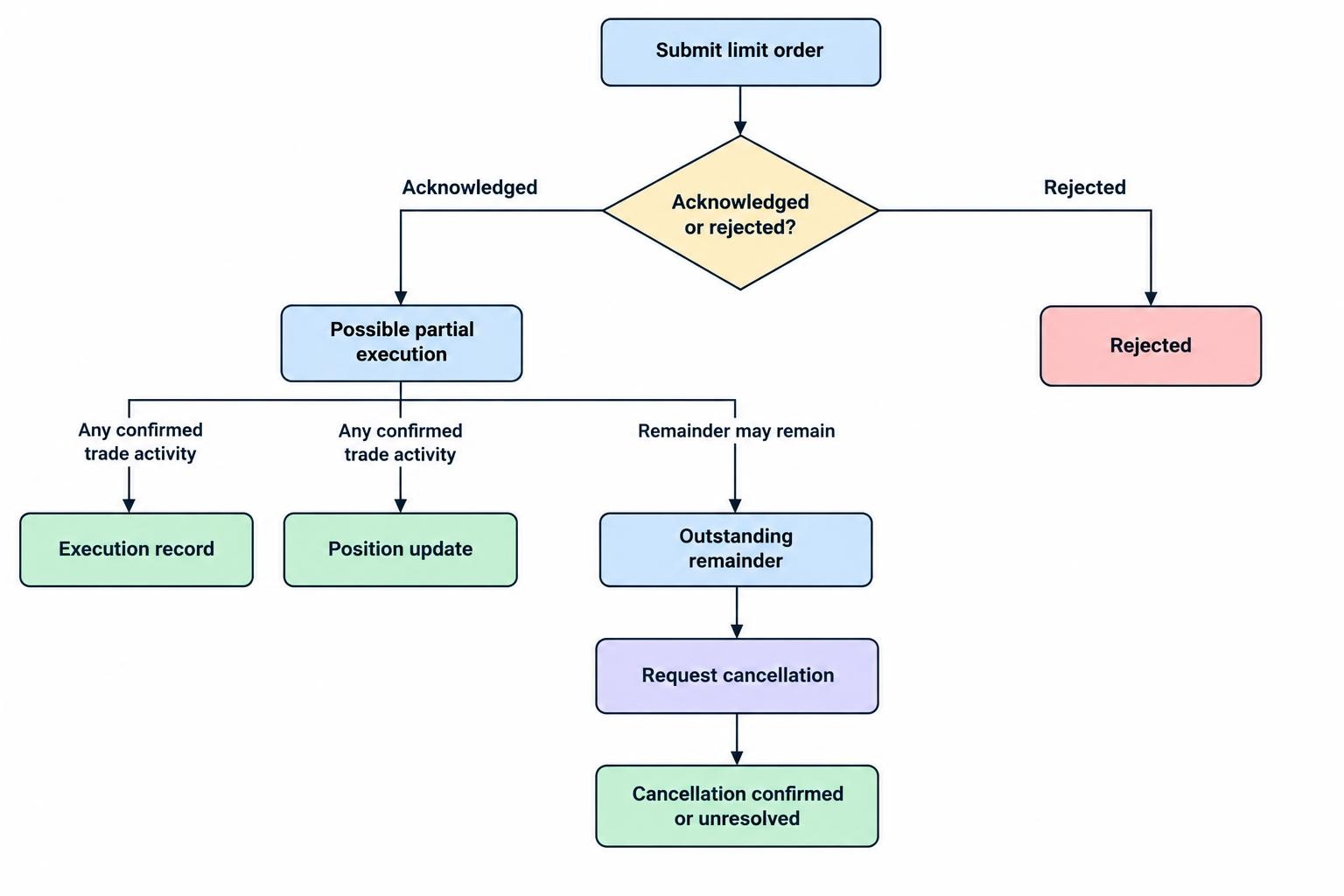
Suppose a system submits an illustrative limit order to buy 1,000 shares at $25.00. The application should distinguish submission, acceptance, execution and cancellation rather than treating them as one event.
If 300 shares trade, the position increases by 300 shares, while the unfilled portion may remain exposed to further execution. If the system then requests cancellation, it should not immediately assume that the remaining order has disappeared. The request and its confirmed outcome are different events.
Execution Reports can communicate more than completed trades, including order acknowledgments and status changes. The detailed treatment of these messages belongs in the guide to FIX order messages, execution reports and trade status. At the integration level, the requirement is to preserve those distinctions throughout the application.
Use separate records for orders and executions. Update positions from confirmed trade activity, not from the presence of an acknowledgment. Keep unresolved requests visible so that a timeout does not silently turn into an assumption.
Why Counterparty Specifications Matter
FIX provides common definitions, but a connection uses an agreed implementation of them. Before development, obtain the counterparty’s rules of engagement: its message specification, connectivity details, supported workflows and operating procedures.
A concrete example is the Cboe Titanium U.S. Equities FIX specification. It documents a subset of FIX 4.2, implementation differences and formal certification before production order entry. Its Execution Report definitions distinguish acknowledgments, fills, cancellations and other events.
The lesson is not to copy an exchange’s settings into another connection. It is to resolve implementation differences before they become production incidents. Two services advertising the same FIX version may not offer the same order types, identifier rules or recovery options.
Build a field mapping document that records required and conditional fields, accepted values, units and rejection handling. Include the session profile and application version where relevant. A version label alone is not a complete compatibility statement.
FIX Engines and Your Application’s Responsibilities
A FIX engine handles protocol mechanics so the application does not need to implement every session rule from scratch. The integration still needs configuration, message mapping, storage decisions and business logic.
The QuickFIX/C++ configuration reference, for example, includes session identities, schedules, validation settings, message stores and logging options. Those are operational decisions, not just installation details. Review them against the counterparty’s requirements instead of accepting defaults without inspection.
Keep a clear boundary between engine callbacks and application processing. Receiving a message should trigger controlled handling, with failures recorded and recoverable. Avoid designs where an exception in an unrelated service leaves the trading application uncertain whether an execution reached its position records.
Before selecting an engine, assess maintainability as well as functionality. Ask who will apply updates, review configuration changes, investigate sequence problems and support incidents outside normal development hours. Free software does not make operational ownership free.
Recovery Is More Than Reconnecting
Plan for a connection failure while orders are active. The difficult question is not simply whether the system can reconnect, but what happened during the interruption.
Use a written recovery procedure that separates restoring communication from restoring confidence in order state. After reconnection, reconcile unresolved submissions, cancellation requests and executions before releasing new activity that depends on them.
A hypothetical failure illustrates the risk. The application sends an order, loses its connection before receiving a response and then submits another order with a fresh identifier. If the first instruction was accepted, the second may create additional exposure. Retrying is not automatically harmless.
Agree on recovery behavior with the counterparty and test it. Do not use sequence resets as a convenient way to clear an unexplained mismatch. Document who can authorize them and what reconciliation must happen afterward.
The broader procedures for handling API connection errors and recovery should also cover escalation, retry limits and situations where automatic processing must stop. A disconnected system is inconvenient; a confidently incorrect one is worse.
Security, Risk Controls and Operational Monitoring
Treat FIX connectivity as access to a trading function, not just a messaging channel. Before deployment, agree on encrypted transport, endpoint authentication, credential handling and permitted network access with the counterparty and security team.
Apply access controls to configuration and logs. Keep credentials out of routine diagnostic output, restrict production changes and define an approved process for certificate or secret rotation. Test expiry and authentication failures in a safe environment rather than learning about them during an incident.
Place risk checks before order transmission. Quantity limits, price checks, position exposure and submission controls should remain effective regardless of whether the outbound interface uses FIX or another protocol. A valid message format says nothing about whether the trade fits the firm’s risk limits.
Monitor the business path as well as the session. Useful checks include outstanding requests without responses, rejected orders, execution processing failures and differences between local records and counterparty reports. Give each alert an owner and a response procedure. An alert that everyone can see but nobody owns is mostly decoration.
Testing Before Production
A successful logon is the beginning of testing, not the finish. Build test cases around the failures that could leave money or order state at risk.
- Order handling: accepted orders, rejections, partial executions, cancellations and amendments.
- Connection recovery: interruptions before responses arrive, process restarts and unresolved requests.
- Message handling: unexpected fields, invalid values, duplicate processing attempts and storage failures.
- Operational controls: submission limits, emergency suspension, access changes and incident escalation.
Define expected results before running each case. Record what the application sent, what the counterparty returned and what changed in local order, execution and position records.
Then repeat the tests after material configuration or mapping changes. Certification demonstrates a defined set of behaviors at a point in time; regression testing helps prevent later changes from breaking them.
When a FIX Connection Is Worth Building
Choose FIX when the receiving service supports the required workflow and the organization can maintain the connection properly. Evaluate it against practical requirements: message coverage, recovery behavior, support arrangements, deployment effort and ongoing operating cost.
Do not assume FIX will make a strategy profitable or guarantee lower latency. Set performance targets and measure the complete application path, including validation, storage and processing after messages arrive.
The strongest implementation is not the one that sends its first order fastest. It is the one that can explain what happened to every order, recover without guessing and stop safely when its records no longer agree. That is the standard to build against.