Binary options pricing, expiry, and settlement answer three different questions: what you pay, when the outcome is measured, and how the result becomes a cash payment. Confusing them can turn a correct market forecast into a losing trade.
A cash-or-nothing binary option pays a stated amount if its condition is satisfied and nothing if it is not. It does not give you ownership of the underlying asset or the right to buy it. Exercise is automatic rather than a separate decision at expiry, as set out in the SEC and CFTC investor alert on binary options.
The payout may be simple. The contract wording still needs attention. “Above,” “at or above,” and “touches before expiry” describe different conditions, even when the trading screen makes them look almost identical.
The Contract Terms That Determine Your Result
Before considering a price, identify the underlying market, the strike or threshold, the expiry time, the settlement reference, and the payment for each outcome. Those terms define what you are buying.
Consider this hypothetical contract: “Will Index A settle strictly above 5,000 at the stated expiry?” Its winning payment is $100. The index level of 5,000 is the strike; $100 is the contract’s settlement payment. Neither tells you the price you must pay to enter.
A contract trading at $42 might therefore reference an index at 5,000 and pay $100 if its condition is met. These are three separate numbers, serving three separate purposes.
If the terminology is unfamiliar, the broader guide to learning binary options trading provides the starting framework. Here, the focus is how those contract terms affect entry cost and the final account result.
Two Pricing Formats You Should Not Confuse
A Quoted Contract Price
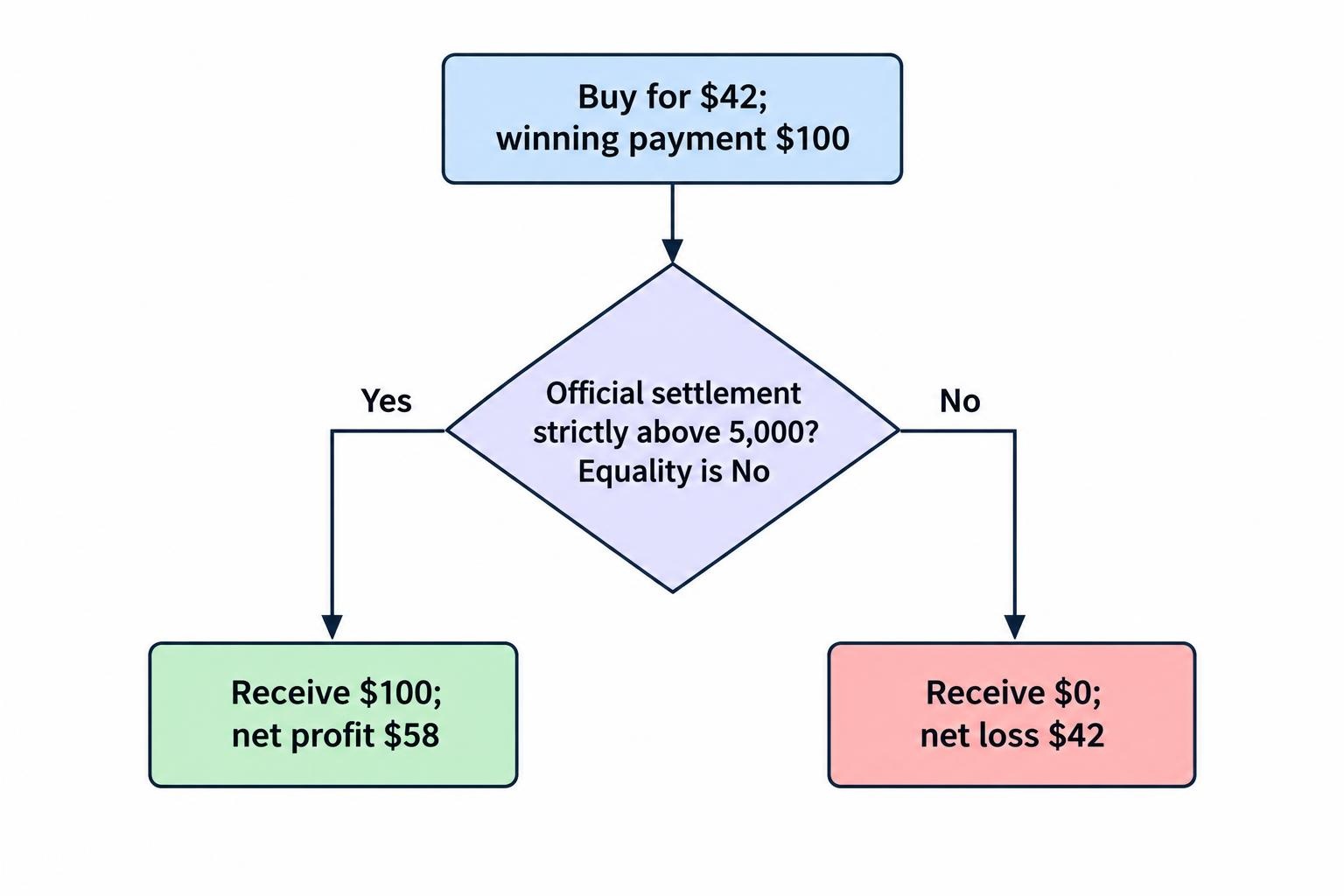
In a quoted-price format, you pay a premium for a contract with a stated winning payment. For a hypothetical contract paying either $100 or $0, buying at $42 produces these outcomes before fees:
| Official settlement level | Condition: strictly above 5,000 | Cash received | Net profit or loss |
|---|---|---|---|
| 5,000.01 | Satisfied | $100 | $58 profit |
| 5,000.00 | Not satisfied | $0 | $42 loss |
| 4,999.99 | Not satisfied | $0 | $42 loss |
The $100 payment includes recovery of the $42 paid. It is not $100 profit. A settlement far above the strike does not increase the payment: clearing the condition by a fraction or by a wide margin produces the same contractual result.
Contract denominations vary. The $100 figure is an illustration, not a rule that applies to every exchange or product.
A Stake With an Advertised Percentage Return
Another format presents an amount at risk alongside a percentage profit if the trade wins. Suppose the terms state that a $100 stake earns 80% profit on a winning outcome, with no refund on a loss. A win returns $180 in total: the original $100 plus $80 profit. A loss returns $0.
Do not assume that a display labelled “80% payout” uses that exact meaning. Establish whether the percentage describes profit, total proceeds, or something else. The CFTC and SEC warning about binary payout structures shows why an advertised winning return can obscure an unfavorable relationship between gains and losses.
Describing this format does not establish that an operator is authorized to offer it where you live. Contract arithmetic and platform authorization are separate checks.
How Binary Option Prices Relate to Probability
For a contract paying $100 if an event occurs and $0 otherwise, a $42 purchase price creates a simple benchmark: ignoring fees and financing, the event must occur more than 42% of the time across equivalent opportunities for that purchase price to have positive expected value.
That follows from the arithmetic. A 42% chance of receiving $100 gives an expected payment of $42. Paying $42 leaves no expected profit before costs. It does not mean the event’s true probability is 42%.
A market quote reflects the prices participants are prepared to trade, along with the spread and available liquidity. It is not a certified forecast. A midpoint displayed between the bid and ask may not be executable either.
Suppose the bid is $40 and the ask is $44. An immediate purchase at the ask costs $44, not the $42 midpoint. Your cost benchmark is therefore 44% before fees. The distinction between displayed price and executable price belongs in any review of binary options payouts and trading costs.
Why the Price Changes Before Expiry
The contract’s price can change as the underlying moves relative to the strike, time passes, or expectations about future movement change. More time gives the underlying more opportunity to cross the threshold in either direction.
Higher expected volatility does not automatically make every binary option more valuable. More movement can help an outcome that is currently unlikely, but it can also threaten an outcome that currently appears secure. The effect depends on the contract’s condition and the underlying’s position relative to the strike.
For the hypothetical 80% profit format, winning half of otherwise identical trades would not cover full-stake losses. The break-even rate is about 55.6% before extra costs. The separate guide to calculating binary options break-even win rates covers that calculation without mixing it up with quoted contract prices.
Expiry Is a Deadline, Not a General Market View
A binary option can expire unsuccessfully even when your broader directional forecast proves correct. If the contract asks whether a market will be above a threshold at 2:00 p.m., a rally at 2:05 p.m. does not rescue it.
Likewise, being above the strike earlier in the session is not enough for a condition measured only at expiry. Do not substitute “traded above” for “settled above.” A touch-style condition would need different wording.
Check the complete date, time zone, and applicable trading calendar. A local clock display is not enough if the contract uses exchange time. Daylight saving changes and shortened trading sessions are reasons to verify the published schedule rather than rely on habit.
Trading Cutoff, Expiry, and Cash Availability
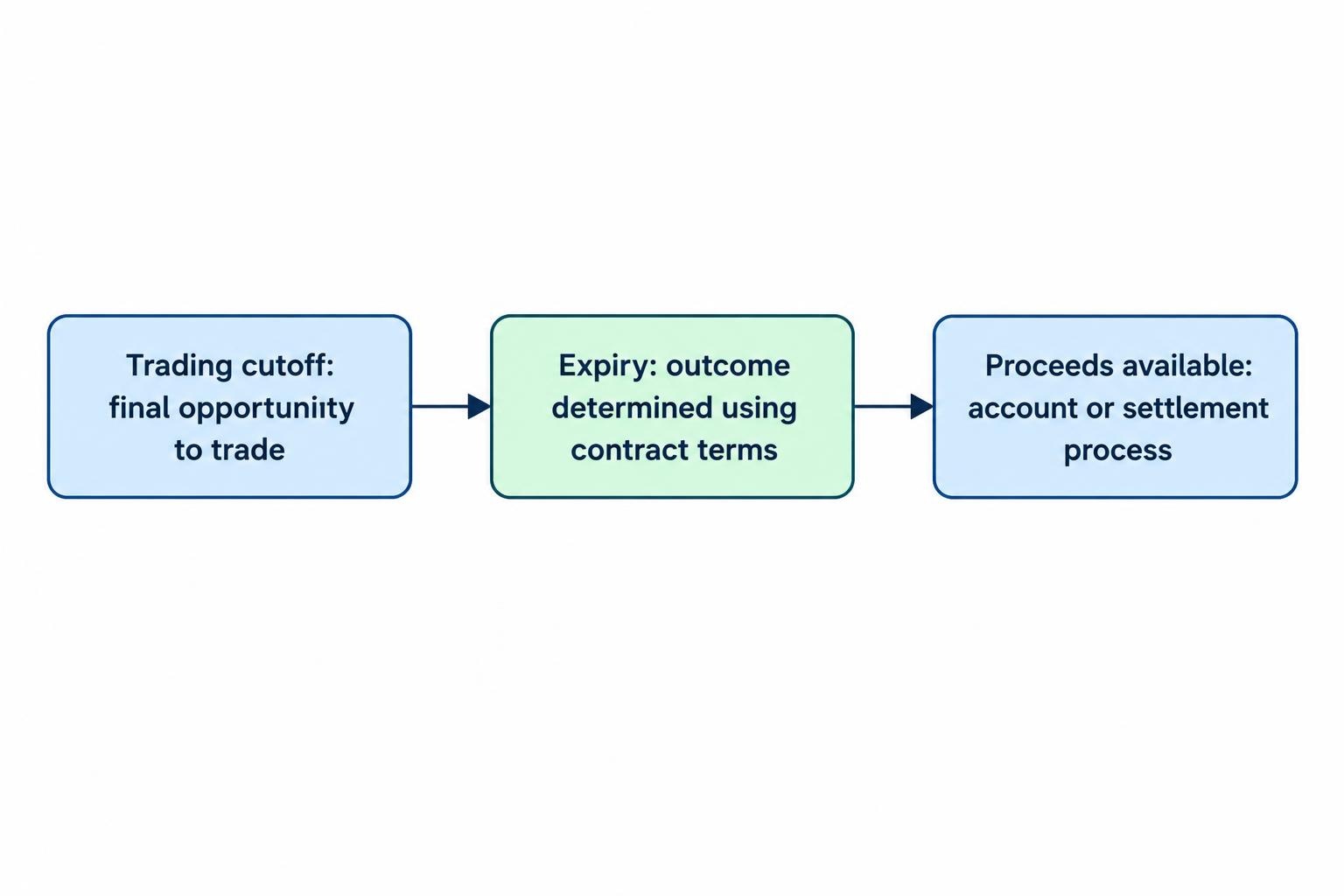
Keep three events separate: the final opportunity to trade, the determination of the outcome, and the availability of settlement proceeds. Do not assume all three happen simultaneously. Read the contract and account terms to establish the sequence.
A concrete example appears in CME Rulebook Chapter 23 on event contracts. These contracts use the daily settlement price of the designated underlying futures month, rather than an arbitrary chart tick. Trading terminates at the end of the underlying’s daily settlement period on the contract’s expiration date. The rules specify a $1 winning settlement value and $0 for an unsuccessful outcome.
Those are product rules, not universal binary options conventions. Never carry an expiry assumption from one contract into another just because both have a yes/no payoff.
How the Settlement Reference Determines the Outcome
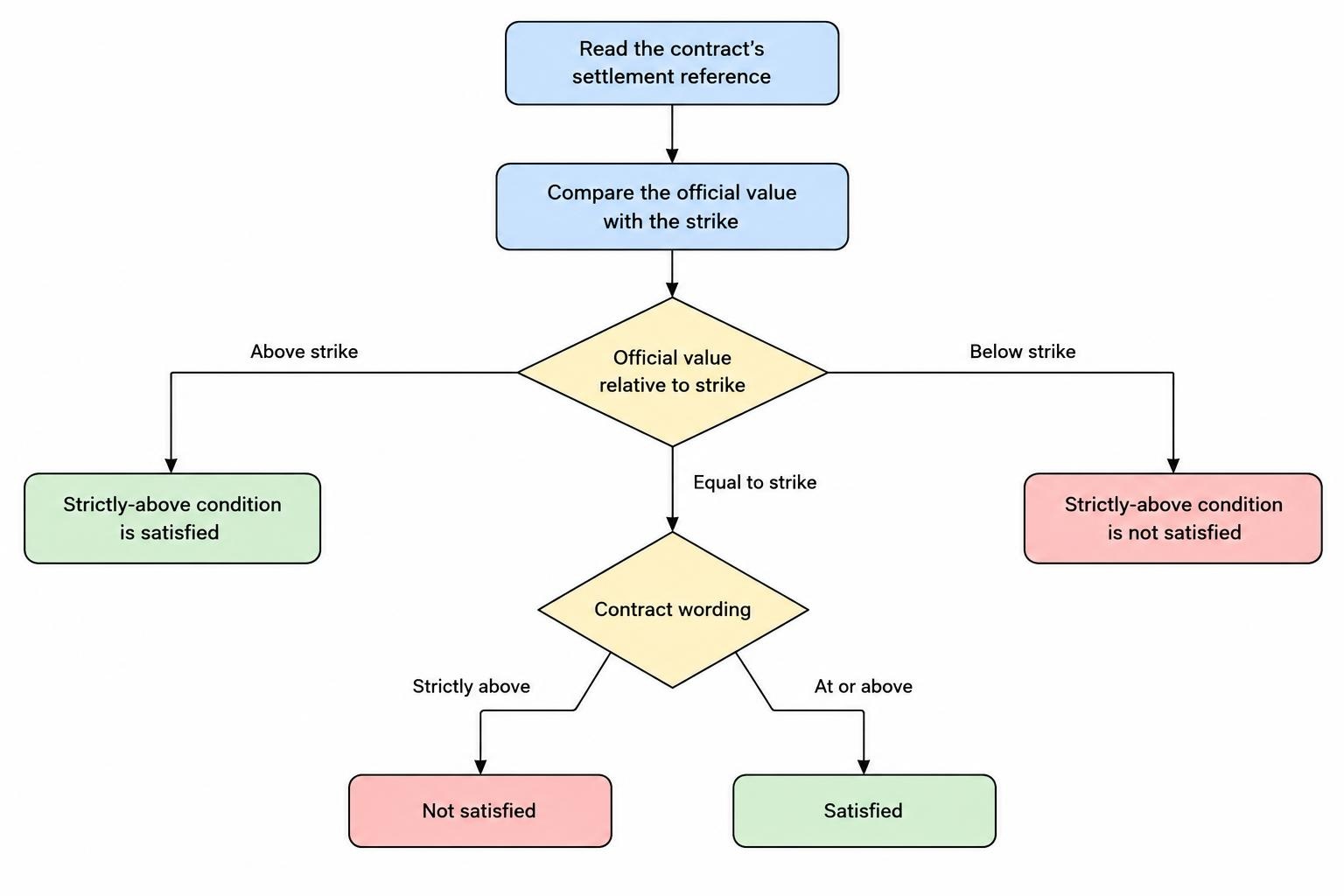
The settlement reference is the value the contract uses to decide whether its condition has been met. Your trading chart is useful for monitoring the market, but it is not a substitute for that definition.
Before entering, establish whether the contract references a cash index, a futures contract, a currency quotation, or another stated measure. Then check how the final observation is calculated. Is it a single observation, an average over a window, or an official settlement value?
For example, suppose a hypothetical contract uses the arithmetic average of observations during its final minute. The last visible tick could be above the strike while the prescribed average remains below it. The correct outcome would follow the average because that is what the contract purchased.
Check precision too. A chart rounded to two decimal places may conceal a difference that matters under the settlement method. Any rounding rule must come from the contract, not an assumption based on how many digits the screen displays.
What Happens When the Reference Equals the Strike?
A tie is not automatically a refund. In the earlier hypothetical contract, “strictly above 5,000” excludes exactly 5,000. A condition written as “at or above 5,000” would include it.
CME’s Chapter 23 example makes this distinction explicit: its call condition requires a settlement strictly above the strike, while its put condition includes equality with the strike. The same boundary therefore belongs to different outcomes depending on the wording. Read the operator’s actual rule before treating a tie as a win, loss, or returned stake.
Closing Before Expiry Is a Separate Transaction
An early exit, where available, realizes a trading price rather than the final binary payment. If you buy the hypothetical $100 contract for $42 and later sell it at an executable bid of $55, the profit is $13 before fees.
You do not receive the $100 winning payment after selling the entire position. You have exchanged the remaining outcome exposure for the sale proceeds.
Do not build a plan around an exit that the product does not permit. Even where secondary trading exists, a displayed valuation does not guarantee an executable buyer at that price or for your full position.
This matters most near expiry, when a small underlying move can change the apparent outcome. Before entering, decide whether the plan depends on holding to settlement or closing beforehand. Those approaches have different practical requirements, even though they involve the same contract.
Settlement Is Not the Same as Withdrawal
Cash settlement determines the contractual payment. It does not, by itself, mean money has arrived in your bank account. Treat the outcome decision, account posting, and withdrawal process as separate stages.
For a fully paid purchased contract, calculate the result as settlement proceeds minus the premium and applicable fees. Do not subtract the premium twice because it was debited earlier. Conversely, do not call the entire settlement credit profit.
Keep the order confirmation, contract identifier, accepted expiry, entry price, quantity, and relevant rule version. If the outcome appears wrong, compare those records with the official settlement reference. A screenshot of an unrelated chart may show a genuine price without proving anything about the contract’s required observation.
Before funding an account, complete the checks in checking binary options platform registration and availability. Clear settlement wording is necessary, but it does not establish that a firm is authorized to accept your business.
Checks to Complete Before Placing an Order
A short contract check is more useful than trying to reconstruct the terms after expiry:
- Condition: Write the exact threshold and whether equality satisfies it.
- Timing: Record the trading cutoff, expiry date, time, and time zone.
- Reference: Identify the underlying, official data source, and calculation method.
- Cash result: Calculate proceeds and net profit or loss for both outcomes, including fees.
- Exceptions: Read the rules for outages, missing data, cancellations, and disputed results.
Unexplained changes to an accepted expiry or obstacles to receiving funds are not ordinary pricing mechanics. The Investor.gov warning on binary options fraud documents complaints involving refused reimbursements and software manipulation, including allegations that winning trades had their countdown extended until they became losses.
The practical standard is straightforward: you should be able to state what you pay, the exact event being measured, the authoritative measurement, and the cash result under either outcome. If any answer depends on guesswork, the contract is not ready for an order.