A trading system is a repeatable process for deciding what to trade, when to enter and exit, how much capital to commit, and when to stop trading. It connects a market idea to a set of decisions that can be recorded, tested and reviewed.
A system does not have to be automated. A trader working through a written checklist can follow a system just as a computer can follow programmed rules. The difference is who makes each decision and how much judgment the process permits.
The practical value is consistency. A trading system gives you a basis for separating a weak idea from poor execution, excessive risk or ordinary losses. It does not make an unprofitable idea profitable simply by adding rules.
What a Trading System Includes
A complete trading system covers the whole trade, not just the signal that starts it. “Buy when price breaks resistance” describes an entry idea. It leaves unanswered questions about which resistance level counts, how much to buy, what happens after a failed breakout and whether another position already uses the available risk budget.
These decisions belong in the system before money is committed.
| Component | What it defines | Practical question |
|---|---|---|
| Market selection | Eligible instruments, trading hours and liquidity requirements | Which opportunities are worth considering? |
| Entry conditions | The setup, trigger and circumstances that invalidate a signal | What must happen before opening a position? |
| Position sizing | Trade size and exposure across open positions | How much can this decision put at risk? |
| Exit rules | Loss exits, profit exits and time exits | What ends the trade? |
| Execution | Order types, timing and handling of unfilled orders | How does the decision become an actual trade? |
| Review and controls | Records, performance checks and suspension conditions | When should the system continue, change or stop? |
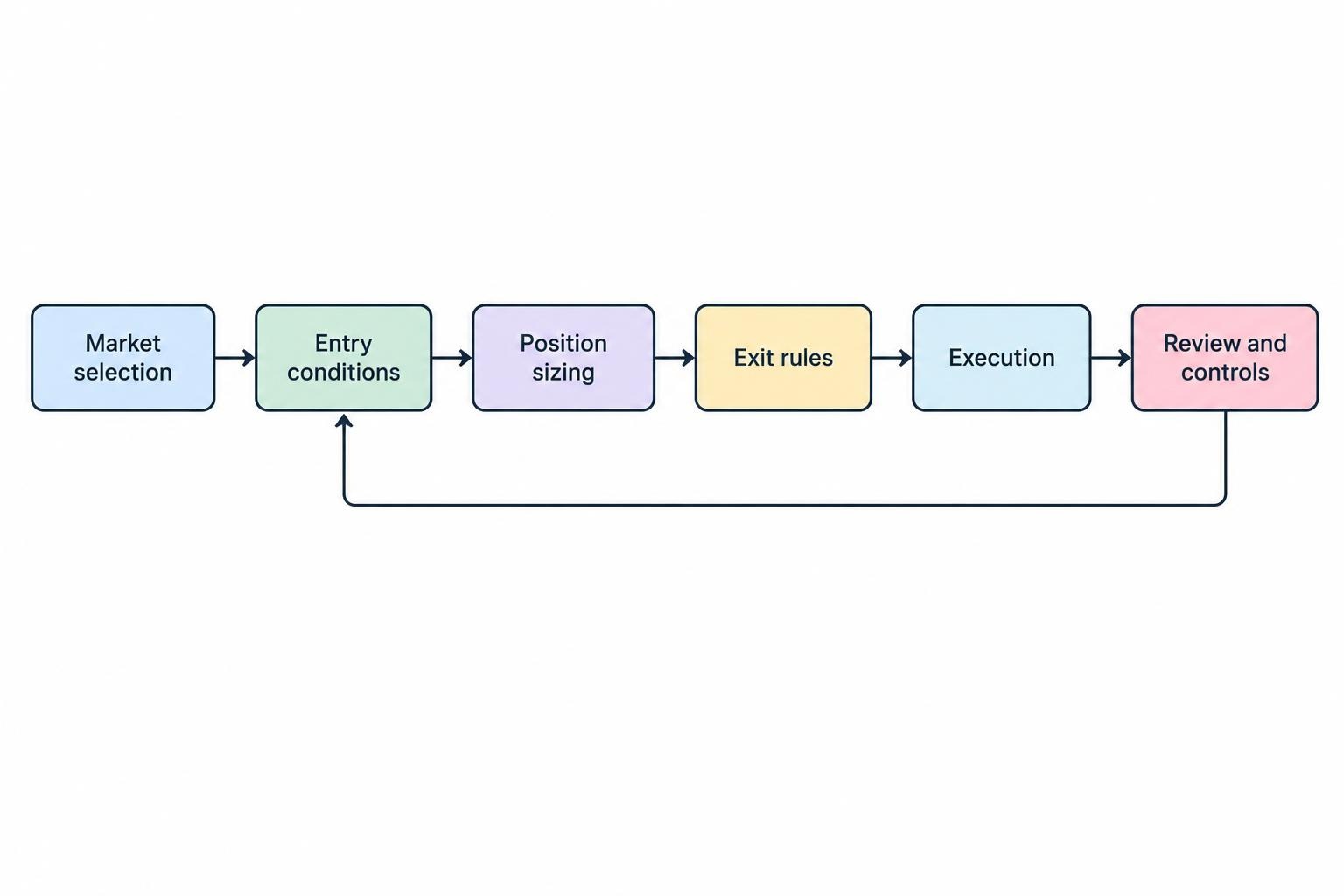
The rules should be precise enough that a later review can establish what should have happened. If two people regularly interpret the same instruction differently, the instruction needs work. The guide to building a rules-based trading system develops that process beyond this overview.
System, Strategy and Platform Are Different
A strategy is the market approach: following trends, trading reversals or reacting to an event. The system adds sizing, execution, controls and review. A platform is the software used to analyze markets or submit orders.
Those distinctions matter when assessing a product. A charting package may help identify setups without providing a trading system. A signal subscription may suggest entries without taking responsibility for exits or exposure. A trading bot may automate instructions that have never been properly evaluated.
Buying software does not answer the question of why a trade should earn money after costs.
Discretionary, Systematic and Automated Trading
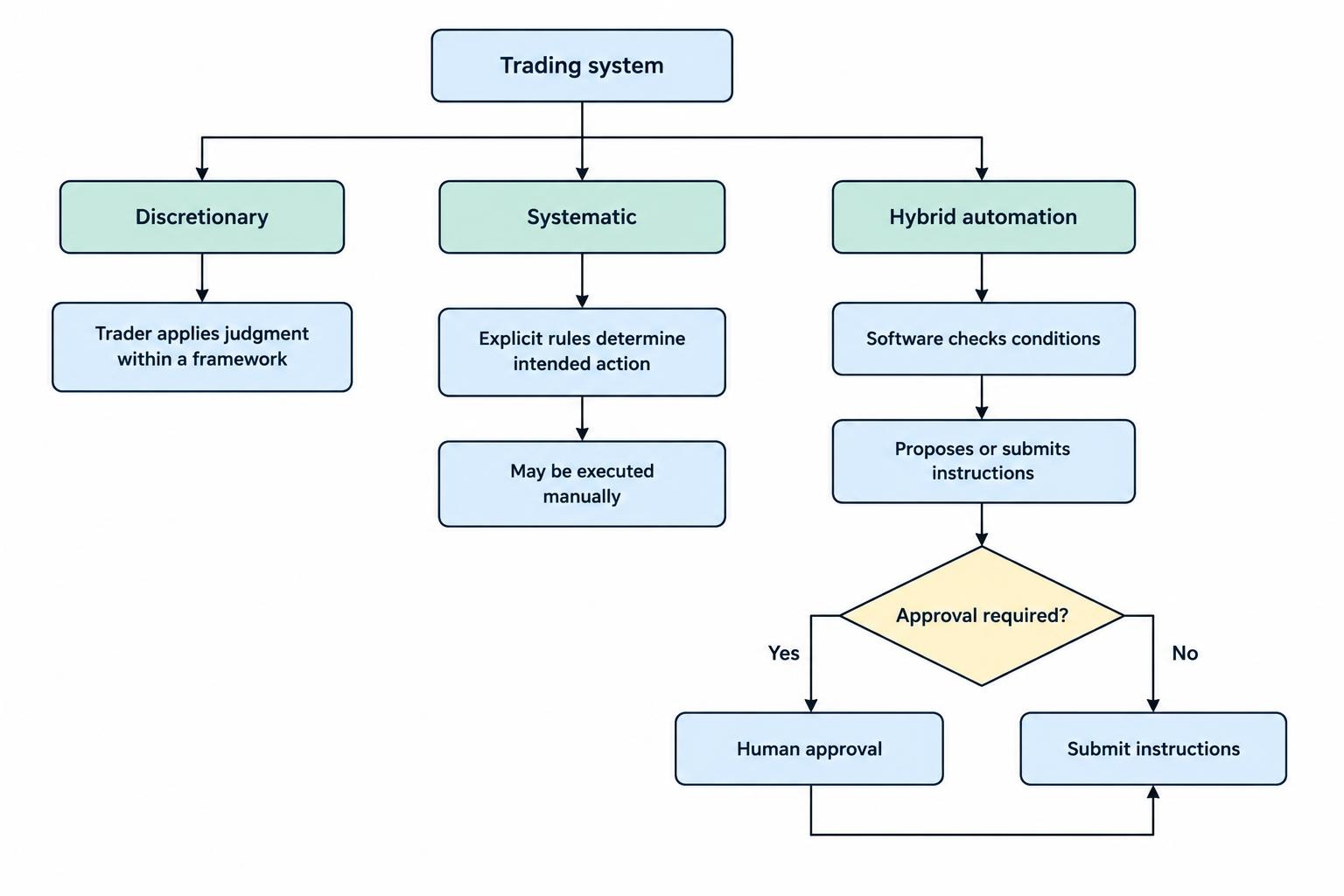
Trading systems differ in how they divide decisions between people and software. Treat judgment and automation as separate choices rather than opposite ends of one scale.
Discretionary Systems
A discretionary trader applies judgment within a defined framework. The system might restrict trading to liquid stocks during regular hours, set an exposure ceiling and require a documented reason for entry. The trader still decides whether the setup is persuasive.
That flexibility makes documentation more demanding. “The chart looked strong” is difficult to evaluate later. Recording the evidence, rejected alternatives and reason for an exception makes the decision more useful for review.
Systematic Systems
A systematic approach translates decisions into explicit rules. Given the same inputs and account state, the rules should produce the same intended action. A person can execute those instructions manually; systematic does not automatically mean computerized.
The trade-off is that a rule must address situations that human judgment might otherwise resolve. What happens when two signals arrive together? Which one gets priority? Is a missing price a reason to skip the trade or obtain another data feed? The comparison of discretionary and systematic trading examines these choices in more detail.
Automated and Hybrid Systems
Automation allows software to perform tasks such as checking conditions, calculating order size and submitting instructions. A hybrid system might generate alerts automatically but require approval before execution.
The approval boundary needs to be clear. A human reviewing a proposed trade should know what they are checking and how long the approval remains valid. Otherwise, the process becomes a mixture of fixed rules and improvised exceptions that is difficult to test or explain.
Common Types of Trading Systems
Trend-following systems attempt to participate in sustained price moves. Moving averages, breakouts and trailing exits are possible tools. Their underlying proposition is that some moves will continue far enough to cover unsuccessful entries and trading costs.
Mean-reversion systems trade on the expectation that a price or relationship will move back toward a reference level. The difficult question is whether the deviation is temporary or reflects a lasting change. A falling price is not, by itself, evidence that a rebound is due.
Event-driven systems organize decisions around earnings, economic releases or other announcements. They need rules for both interpreting the event and deciding whether the available price still justifies a trade.
Relative-value systems assess one instrument against another or against a model. They may involve several positions, making combined exposure and execution part of the design rather than an afterthought.
These are categories of trading logic, not rankings of quality. Start by writing a testable proposition about why the opportunity might exist, who takes the other side and what could cause the relationship to disappear.
A Simple Trading System Example
Consider a hypothetical stock system that checks for a breakout after the market closes. It defines an eligible stock list, the breakout calculation, an entry procedure for the following session and conditions for cancelling the setup. This is an illustration, not a recommended strategy.
Suppose an eligible trade can be entered at $50, with a planned loss exit at $48 and a profit exit at $54. The intended price risk is $2 per share. If the example uses a $250 trade risk budget, dividing $250 by $2 produces 125 shares before allowances for costs and execution uncertainty. The position value would be $6,250.
This separates three figures that are easy to confuse: position value, intended loss and cash available. None is interchangeable with the others. The system must also decide whether other open trades leave enough room for this position.
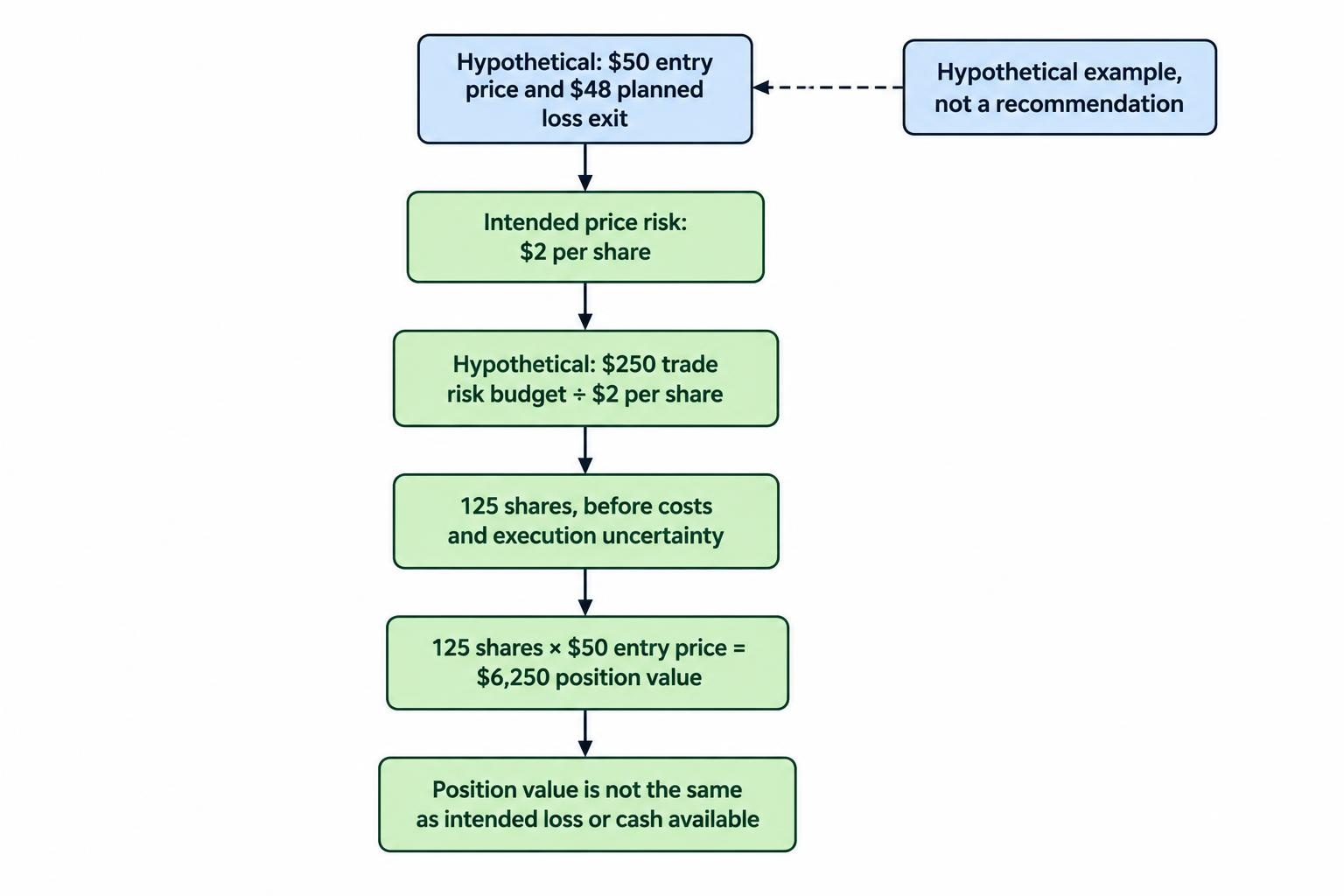
The entry, exit and position-sizing rules need to work together. If the entry changes but the loss exit stays fixed, the intended risk changes too; the original share calculation no longer applies.
That example also needs instructions for partial fills, a price gap beyond the permitted entry and a trading halt. A neat calculation is useful, but the market does not sign it.
Execution Turns Rules Into Results
A signal price is not necessarily an available trading price. Your system should distinguish the moment a condition becomes known, the moment an order is submitted and the price at which it actually trades.
Order choice introduces a trade-off. A stock market order does not guarantee its execution price. A limit order sets a price boundary but may remain unfilled. A standard stock stop order becomes a market order when triggered, so the stop price is not a guaranteed exit price. These distinctions are set out in the SEC’s explanation of stock order types.
Include commissions, spreads, slippage and any relevant financing or borrowing charges when evaluating results. Keep the accounting consistent: if simulated fills already use bid and ask prices, do not subtract the same spread again.
Write down what happens to an unfilled entry. Chasing the price, leaving an order active and cancelling it are different trading decisions. They should not depend on how frustrating the missed opportunity feels.
How to Evaluate a Trading System
Backtesting
Backtesting applies trading rules to historical data. Its purpose is to investigate how the proposed process would have behaved under stated assumptions, not to certify future profits.
A credible evaluation uses only information available at each decision point. It also addresses missing data, corporate actions, trading costs and realistic execution timing. Testing a stock universe made only of present-day survivors can exclude companies that disappeared during the period.
Changing settings until a historical chart looks attractive creates another problem: the rules may fit that sample rather than a repeatable relationship. Reserve data for evaluation that did not shape the design, and record every material revision. The guide to backtesting a trading strategy covers the testing process separately.
Paper Trading and Live Observation
Paper trading can check whether signals arrive correctly, instructions are clear and the workflow operates as intended. It cannot establish that real orders will receive the same fills.
Hypothetical results also leave out parts of the experience of committing money. Simulated prices may not reflect actual market conditions, and the ability to sustain losses can affect whether a trader follows the process. The CFTC advisory on trading-system promotions addresses these weaknesses and warns against promises of high profits with minimal risk.
Separate strategy testing from operational testing. A profitable simulation does not prove that order handling works. Correct order handling does not prove that the strategy has an advantage.
Performance Measures That Matter
Win rate is incomplete without average gains, average losses and costs. A system can win frequently yet lose money if occasional losses outweigh its smaller profits.
A simple expectancy calculation is:
Expected result per trade = (win probability × average win) − (loss probability × average loss) − average trading cost.
For illustration, assume 45% winning trades, a $100 average gross win, a $60 average gross loss and $8 average cost per completed trade. The calculation is $45 minus $33 minus $8, leaving $4 per trade. That thin hypothetical margin could disappear if costs or losses were slightly higher. The inputs are assumptions, not a forecast.
Drawdown measures the decline from a previous equity peak. Review its depth and duration, not just the final return. Also examine whether profits depend on a few trades, one instrument or one short period.
A useful report should distinguish results from the process that produced them. Were the rules followed? Were trades missed? Did actual fills differ from assumptions? Without those answers, a disappointing month tells you little about what needs fixing.
Risk Controls and Human Oversight
Build suspension conditions into the system. Examples include stale market data, inconsistent position records, repeated rejected orders or exposure above the permitted ceiling. Define what must be checked before trading resumes.
Stopping new orders is not the same as cancelling working orders or closing positions. An emergency procedure should address each action separately. It should also identify how positions will be checked if the main platform becomes unavailable.
Automation makes those responsibilities more pressing, not less. FINRA’s algorithmic trading control guidance covers development controls, testing, monitoring and mechanisms for disabling algorithms. It addresses regulated firms; it is not a universal retail trading checklist.
For an individual trader, a practical principle is to define failure responses before a failure occurs. Keep a record of rule changes, test them away from live trading and avoid altering several parts of the system at once. Otherwise, the cause of any improvement or deterioration becomes harder to identify.
Choosing and Maintaining a Trading System
Choose a system you can operate, not just one whose historical returns look appealing. Match its decision frequency to your availability, its data requirements to your budget and its potential losses to capital you can afford to put at risk.
Before using or purchasing a system, ask whether its rules are understandable, its results include costs and its advertised performance is simulated or actual. Check whether the method still makes sense when assumptions become less favorable. Treat unexplained performance claims as questions, not evidence.
Keep development changes separate from the active version. A trading journal and performance-tracking process should record signals, decisions, fills, costs, exceptions and rule versions. That record allows you to investigate losses without rewriting the system after every uncomfortable trade.
A useful trading system makes decisions repeatable and mistakes visible. Its value rests on a plausible market idea, realistic evaluation, controlled exposure and disciplined review—not the number of indicators on the screen.