Trading system security and risk controls protect more than login credentials. They govern who can submit orders, how much exposure a system can create, what happens when data becomes unreliable, and how trading stops when something goes wrong.
A secure account can still suffer losses from faulty automation. A sensible trading strategy can still become dangerous if an API connection repeats orders or a compromised administrator changes its limits. Treat cybersecurity, trading risk and operational recovery as connected responsibilities, not separate checkboxes.
The practical goal is to prevent unauthorized activity, contain mistakes before they spread, and retain enough reliable information to recover safely. These controls do not make a strategy profitable or remove market risk. They help keep a technical problem from becoming an uncontrolled trading position.
What Trading System Security Should Cover
Start by mapping the full path from market information to an executed trade. Include data feeds, research tools, strategy software, order gateways, broker connections, account access and monitoring. Record which components can read information, change settings, submit orders or move money.
For each component, ask three questions: what could fail, what financial exposure could follow, and who can intervene? A spreadsheet that calculates order quantities belongs in this review just as much as a cloud server. Risk does not care whether the offending software looks sophisticated.
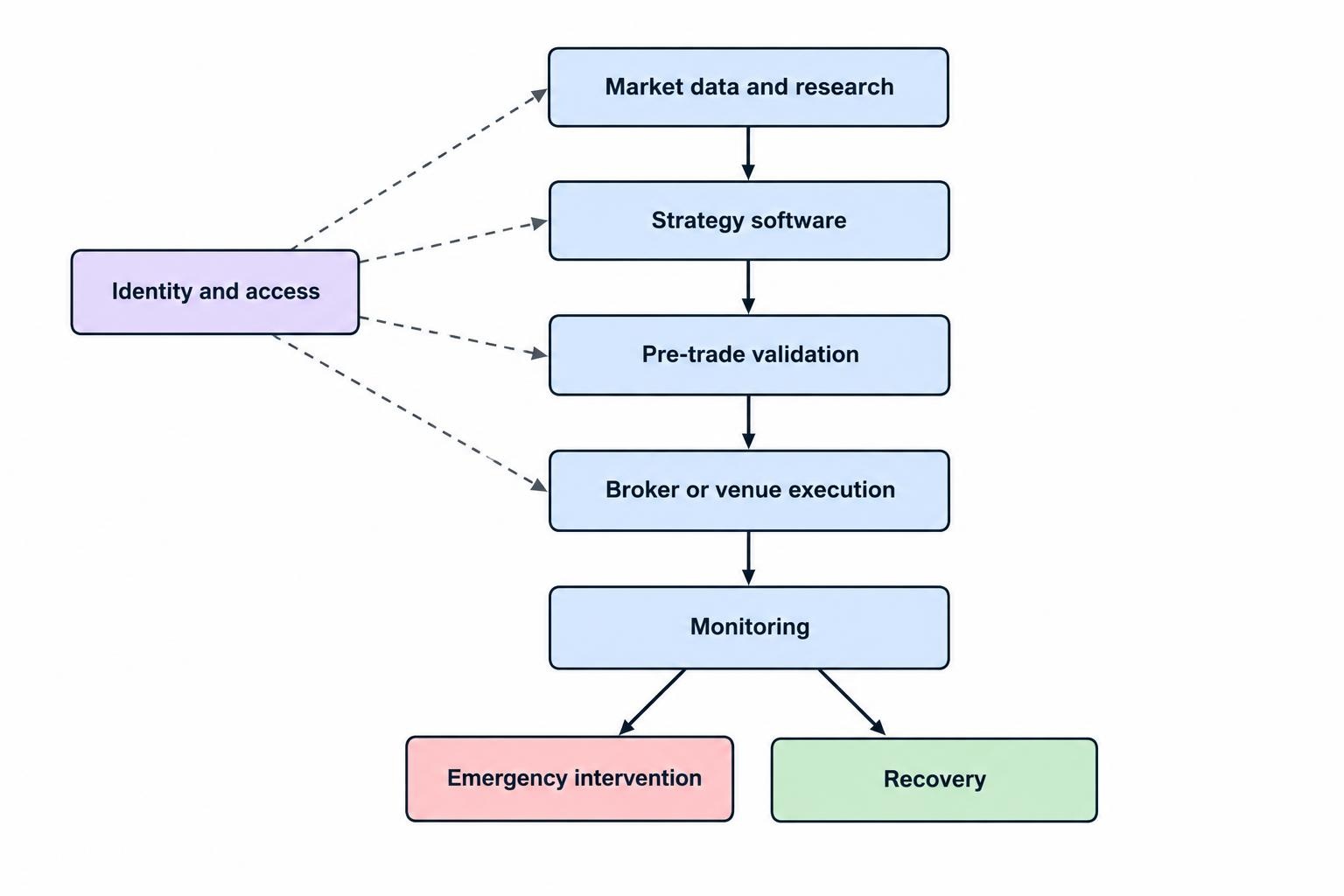
| Control layer | Main purpose | Example control |
|---|---|---|
| Identity and access | Restrict who and what can act | Separate credentials for research and live execution |
| Order validation | Block unacceptable orders before submission | Maximum quantity and exposure checks |
| Operational monitoring | Identify unexpected behavior | Alerts for missing acknowledgments or position mismatches |
| Emergency intervention | Contain an active failure | Disable new orders and verify cancellation results |
| Recovery | Restore a known, verified operating state | Reconcile positions before restarting automation |
Assign an owner and backup owner to each layer. Even a solo trader should distinguish routine operation from emergency intervention, with written instructions that remain accessible if the main workstation fails.
Protect Accounts, Credentials and Administrative Access
Use separate identities for people and software wherever the platform supports them. A research application that only needs prices should not receive trading permissions. An execution service should not receive withdrawal rights simply because those permissions appear in the same setup screen.
For human access, prioritize phishing resistant multifactor authentication where available. FIDO/WebAuthn methods are covered in CISA’s guidance on implementing phishing resistant MFA. Protect the email account and recovery process associated with the trading account too; securing the front door while leaving account recovery exposed defeats the purpose.
Store application credentials in a controlled secrets store rather than strategy files, shared documents or chat messages. Keep production credentials separate from development credentials. Where supported, restrict API access by permission, account, network location and expiry date.
Build a revocation procedure before it is needed. It should identify who can disable a credential, which applications depend on it, and how replacement credentials reach approved services. After suspected compromise, verify the provider’s session and token invalidation behavior rather than assuming a password change ends every active connection.
The detailed setup belongs in protecting trading accounts, API keys and login credentials. At the system level, the governing principle is simple: give each identity only the access its task requires, and review that access when the task changes.
Place Risk Checks Before Order Submission
Pre-trade controls should assess an order before it reaches the broker or trading venue. Useful checks include permitted instruments, maximum quantity, maximum order value, acceptable price ranges, available buying power and projected exposure after execution.
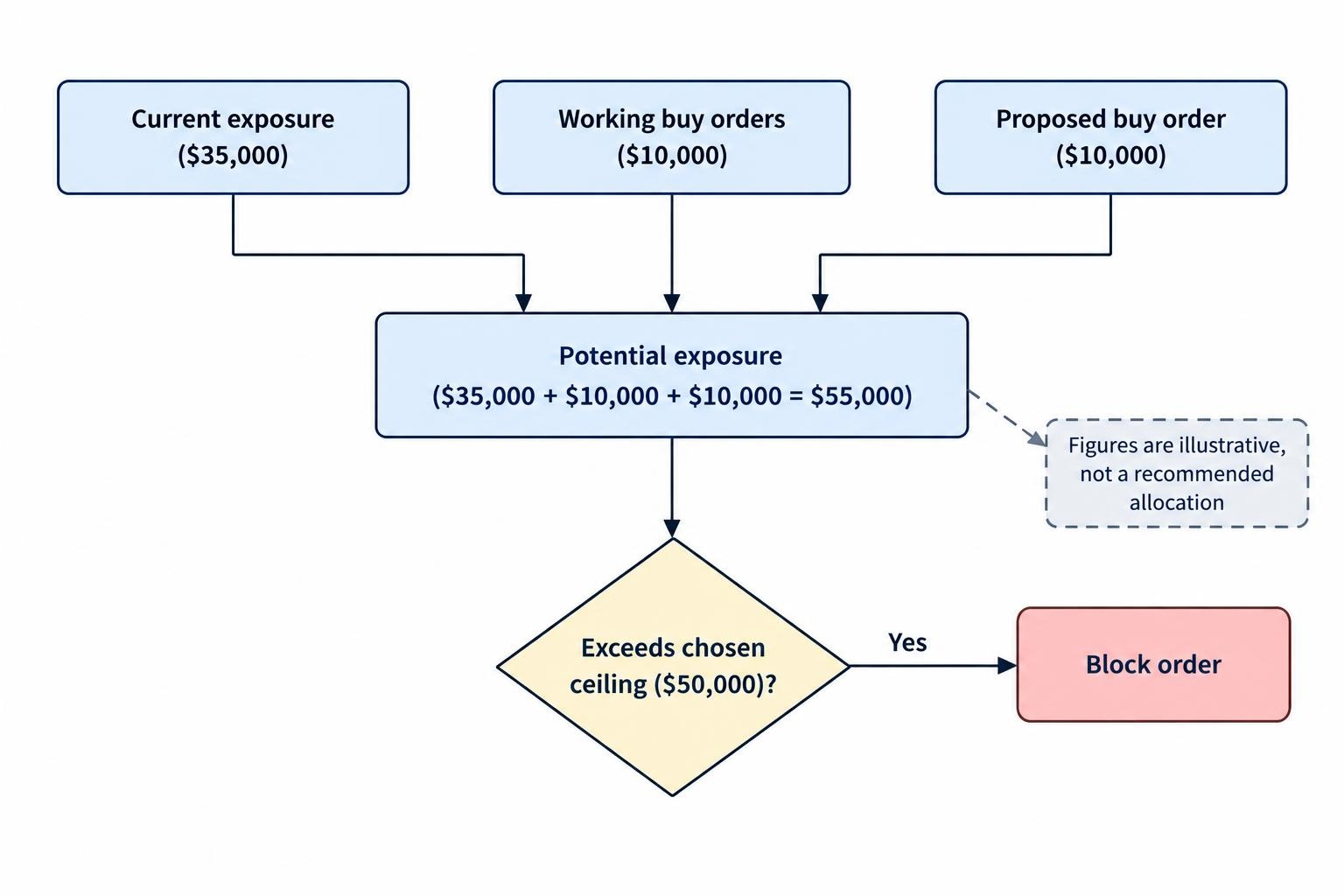
Apply limits across strategies as well as within them. Two bots can each remain within their own allocation while creating an unacceptable combined position. Working orders also deserve attention because they represent potential exposure, even before a fill arrives.
For illustration, suppose an account has a chosen exposure ceiling of $50,000. It already holds $35,000 of the relevant exposure and has $10,000 in working buy orders. Another $10,000 buy order would take potential exposure to $55,000 if all orders filled. Checking only current holdings would miss the breach. These figures illustrate the calculation, not a recommended allocation.
For U.S. broker-dealers with market access, this is also a regulatory matter. SEC Rule 15c3-5 on market access risk controls requires controls reasonably designed to prevent orders exceeding appropriate preset credit or capital thresholds and to prevent erroneous orders. These duties apply to covered broker-dealers; they are not a blanket legal requirement for every retail trader running a bot.
Where practical, separate the risk check from the strategy generating the order. A strategy should not be able to raise its own ceiling during a trading session without authorization. Record limit changes, including the previous value, new value, approver and reason.
The companion guide to pre-trade checks for order limits and position exposure covers the calculations in more detail. Here, the architectural requirement matters most: every route capable of submitting an order should pass through the intended controls.
Define Safe Behavior for Bad Data and Connection Failures
Write down what the system should do when an input becomes questionable. Examples include stale prices, a missing currency conversion rate, an unavailable position service or an unexplained difference between local and broker records. Do not leave these decisions to whatever the application happens to do by default.
Distinguish increasing exposure from managing existing exposure. A system may need to block new entries while preserving a verified route for cancellations or approved risk reduction. “Stop everything” is not a complete policy when positions and working orders already exist.
Handle uncertain order status explicitly. If a submission times out, do not automatically treat it as rejected. Query the order state through the supported process and reconcile execution reports before deciding whether to submit again. Design this behavior around the provider’s documented identifiers and retry rules.
For systems using AI, treat generated text as untrusted input. A news summary should not change account permissions, rewrite limits or authorize a live order. Keep any path from model output to execution constrained by validated fields, approved instruments and independent risk checks.
Test Controls Separately From Strategy Performance
A profitable backtest does not demonstrate that a live system handles partial fills, duplicated messages or a failed cancellation. Performance testing asks whether the trading logic might have merit. Control testing asks whether the application behaves acceptably when its assumptions break.
FINRA Regulatory Notice 15-09 on algorithmic trading controls identifies effective practices including change management, testing separate from production, independent quality assurance and heightened monitoring after deployment. Its suggested practices complement applicable obligations; implementing the list alone does not establish compliance.
Build tests around failure scenarios, not just normal orders. Useful cases include a price feed freezing while the connection remains open, an execution arriving after a cancellation request, and a risk service returning an error. Each test needs an expected result that can be checked.
Use the same discipline for configuration changes as for code changes. A misplaced decimal in an order ceiling can matter more than a substantial software update. Preserve the approved configuration, test results, release identifier and rollback instructions.
Introduce material changes cautiously, with exposure restricted to an approved pilot scope. Define the conditions for expansion and the conditions for stopping. “It ran without an error message” is not sufficient evidence that order handling and position accounting are correct.
Monitor Trading Behavior, Not Just Server Health
Separate infrastructure monitoring from trading monitoring. A responsive server does not prove that orders are correct, and an active connection does not prove that its data is fresh. Set alerts around the behavior the system is supposed to produce.
Useful monitoring includes order rates, rejection rates, missing acknowledgments, data age, position differences and unexpected permission changes. Compare intended activity with confirmed activity. If a strategy intends to hold 100 shares but the broker reports 200, investigate the mismatch rather than relying on the strategy’s own log.
Give each alert an owner, a severity level and a required response. State whether the response is observation, blocking new entries, cancellation or escalation. Route urgent alerts through a channel that does not depend entirely on the trading application being healthy.
Keep records that connect decisions to outcomes: strategy version, configuration, relevant input timestamps, risk decisions, order identifiers, acknowledgments and fills. Protect these records against unauthorized alteration and exclude secrets. A useful incident record should reconstruct events without becoming a second place to steal credentials.
Make Emergency Shutdown Procedures Precise
Stopping a strategy, blocking new orders, cancelling working orders and closing positions are different actions. A shutdown procedure should name each action and explain its scope. Turning off a laptop is not a reliable substitute for confirming what remains active elsewhere.
Check venue and provider behavior rather than assuming all kill switches work alike. The CME Globex kill switch documentation identifies exceptions, including mass quotes and resting orders during certain market states. That makes verification part of shutdown, not an optional task afterward.
Provide an intervention route that does not rely solely on the strategy process being responsive. Depending on the setup, this might involve a separate administrative interface or an authorized contact procedure. Test who can use it and which accounts, sessions and order types it covers.
Use the guide to trading kill switches and emergency shutdown procedures to develop the operational steps. Specify restart authority as carefully as stop authority. A system should not resume trading automatically just because its connection returns.
Recover the Trading State, Not Just the Software
Back up approved code, configurations, deployment records and the information needed to investigate activity. Protect backups from the same credentials and systems whose compromise they are intended to survive. CISA’s ransomware prevention and recovery guide recommends offline, encrypted backups and regular testing of their availability and integrity.
For trading, restoring files is only part of recovery. A recovered database may describe the account before executions that occurred during an outage. Before restarting, compare local records with current broker positions, working orders and execution records.
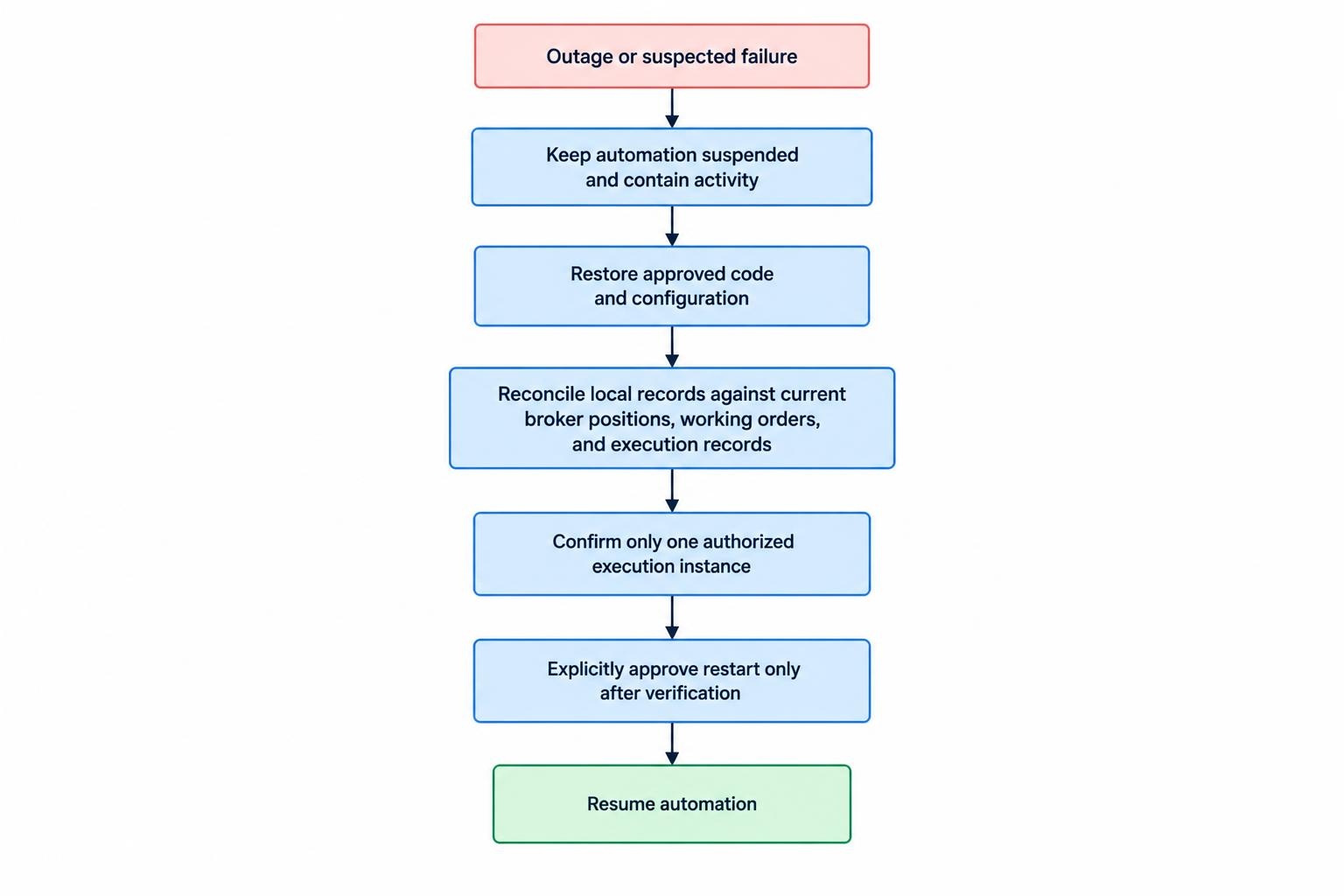
Guard against two active execution instances during failover. The recovery design should establish which instance is authorized to submit orders and how the previous instance loses that authority. Otherwise, restoring service can create a new source of duplicated activity.
Set recovery objectives around acceptable downtime and acceptable data loss, then test whether the process meets them. Maintain alternate communication arrangements and record who may approve manual trading while automation remains suspended.
The guide to trading platform backups, failover and recovery develops those procedures. The restart decision should rest on verified account state, tested controls and explicit approval, not pressure to get the dashboard green again.
Keep Controls Proportionate and Reviewable
A single account does not need the same operating structure as a multi-desk firm, but both need clear limits, restricted access and a workable emergency process. Scale controls to potential exposure, execution speed, instrument risk and the number of connected services.
For each important control, retain its purpose, owner, setting and most recent test result. Review the arrangement after a material change, an incident or the addition of another strategy or provider. Remove obsolete access and investigate exceptions rather than allowing temporary workarounds to become permanent policy.
The test is practical: can you show what prevents an unacceptable order, who can stop activity, and how you will establish the account’s true state afterward? If those answers are clear and tested, the system has a defensible operating foundation. If they depend on assumptions, that is where the next improvement belongs.