Forex trading software provides the working connection between a market observation and a trading account. At its simplest, it displays currency quotations, accepts an instruction and shows the resulting position. Other functions support preparation, monitoring and review through charts, alerts, research and transaction records. These tasks can be handled inside one platform or divided between several applications. A trader might analyse a currency pair in one service, enter the order through a broker and review performance in a separate journal. The useful question is whether the arrangement preserves an accurate understanding of exposure throughout that process. Software should make it easier to see what is being traded, why the instruction was placed and what happened after the broker received it.
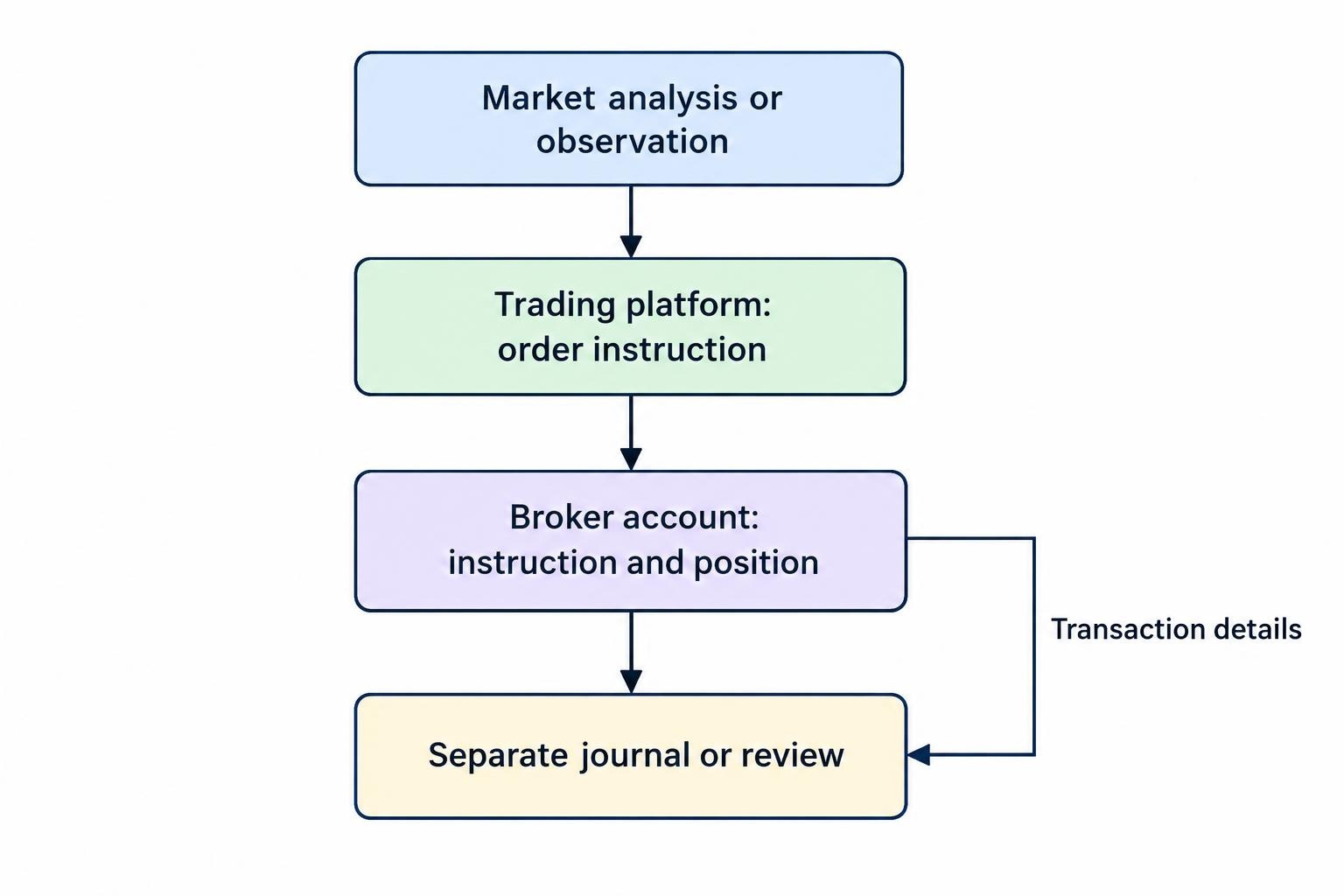
The application and the account are different parts of the arrangement. A software developer may supply the platform, while a brokerage supplies the prices, instruments and execution terms. Two brokers using the same application can have different spreads, commissions and financing charges. Their accounts may also record or manage positions differently. A trader who already knows an interface gains a practical advantage in learning its controls, but that familiarity does not establish the quality of every business using it. The company receiving the deposit needs separate assessment. Platform comparisons become more useful when they identify the legal entity and account type being considered rather than discuss the software as though it creates identical trading conditions wherever it appears.
The product also needs to be identified before examining the controls. Retail forex platforms commonly provide leveraged contracts rather than a foreign currency balance that can be spent or transferred. Depending on the account and jurisdiction, the transaction may be rolling spot forex, a contract for difference or another arrangement. Currency futures have different contract and exchange features even if an application displays them alongside other instruments. A EUR/USD symbol alone does not explain those terms. The trader needs the contract definition, quantity convention and account currency to interpret the screen correctly. Those details determine how exposure, margin and charges are calculated, making them the foundation for assessing whether the software presents the transaction clearly enough to manage.
Analysis and market data
Begin with a consistent view of the market
Charting software organises price observations into a form that can support a repeatable decision. A trader might use daily candles to assess a broader movement and shorter intervals to plan an entry. The usefulness of that process depends on consistent settings. Session boundaries and time zones can alter how candles are constructed, while missing history can distort an indicator. Save the relevant chart configuration alongside the method so that a later review uses the same basis. A different result after switching data sources may reflect changed observations rather than a changed market principle. More indicators do not resolve that problem. The first requirement is a price record whose source and construction are understood well enough to support the intended analysis.
Foreign exchange quotations require attention to the feed and quote side. Over the counter retail forex does not provide one universal executable price for every account. An independent chart, a broker’s quotation and another provider’s indicative data may differ. One display may show the bid, another a midpoint, while the trading ticket shows both bid and ask. A short position is commonly bought back at the ask, so its closing cost may move differently from a chart displaying only the bid. Exact order trigger rules depend on the contract and account terms. Before investigating an apparent discrepancy, match the symbol, time, source and quote side rather than assume that every chart labelled with the same currency pair is directly comparable.
Use indicators to express a defined observation
Indicators can make a rule easier to apply consistently. A moving average summarises past prices, while a volatility measure describes the variation in its input data. Neither independently establishes what the next price will be. The trader needs a reason for including the measure and a rule explaining how it affects a decision. Several indicators derived from similar prices can repeat much of the same information while making the screen appear more persuasive. A useful setup keeps the relationship between observation and action visible. If changing an indicator setting changes the trade, that setting belongs in the method’s record. An application offering hundreds of measures provides little benefit if the trader cannot explain the purpose of the ones actually being used.
News tools and economic calendars support a different part of the analysis. They can help identify scheduled releases, central bank decisions and events affecting an open position. The trader needs to distinguish a forecast, the published figure and any later revision. Time zone settings also matter when an alert is intended to arrive before a release. A faster headline feed is useful only if the method can interpret it and act under realistic trading conditions. Prices may move before an instruction is accepted, and the first interpretation can change as details become available. For a trader holding positions for several days, a dependable reminder and the original release may provide more value than a continuous stream of brief headlines demanding attention.
Alerts can reduce the need to watch charts continuously, provided their operation matches the plan. A notification that a price level has been reached is different from an order held by the broker. The first asks the trader to decide or act; the second instructs the account under stated conditions. Test whether alerts run on the device, on a hosted service or through another arrangement, and what happens when the application is closed. Also check whether the alert uses the same price series as the account. A carefully chosen level can still produce confusion if its notification is based on another feed or rounded display. Alert configuration is part of the trading process rather than an incidental preference added after the analysis is complete.
Orders position sizing and trading costs
Turn the market view into a measurable exposure
The order ticket should translate the trading decision into an instruction that can be checked before submission. It needs to identify the instrument, direction, quantity and order type clearly. Quantity may be entered in units or lots, with the contract specification determining the conversion. A retained quantity from an earlier trade can create a much larger exposure than intended if it is not reviewed. The trader also needs to know how opposite instructions are treated. Some accounts offset transactions into a net position, while others can display separate positions. Closing an existing exposure and opening another are not always the same operation. Practice should establish what each control does before rapid price movement makes a misunderstanding harder to correct without further financial loss.
Position sizing becomes clearer when the chosen price distance is expressed in account currency. For a hypothetical EUR/USD position of 30,000 euros, a movement of 0.0001 dollar per euro represents $3, conventionally one pip for this pair. A 25 pip adverse movement would therefore represent approximately $75 before charges and execution differences. Against a $5,000 account, that is 1.5% at the stated values. The calculation measures exposure rather than guaranteeing a maximum loss of $75. Other currency pairs and account currencies require other conversions. A sizing tool should make those assumptions visible so that they can be checked independently, rather than offer a suggested lot size whose relationship to the account and proposed exit remains unclear.
Understand what the instruction can achieve
A market order requests execution under the available account conditions. A limit order imposes a price condition and may remain unfilled. A stop introduces a trigger, after which the resulting execution depends on the order design and market conditions. The application should show acceptance, rejection, partial execution, cancellation and expiry in a way the trader can interpret. A submitted request is not necessarily a completed transaction. This matters after a delayed response or lost connection, when resubmitting without checking can duplicate exposure. Reliable status information helps prevent that mistake. The trader should be able to connect each request with its resulting position or rejection and compare the displayed account with the broker’s record when something appears inconsistent or incomplete.
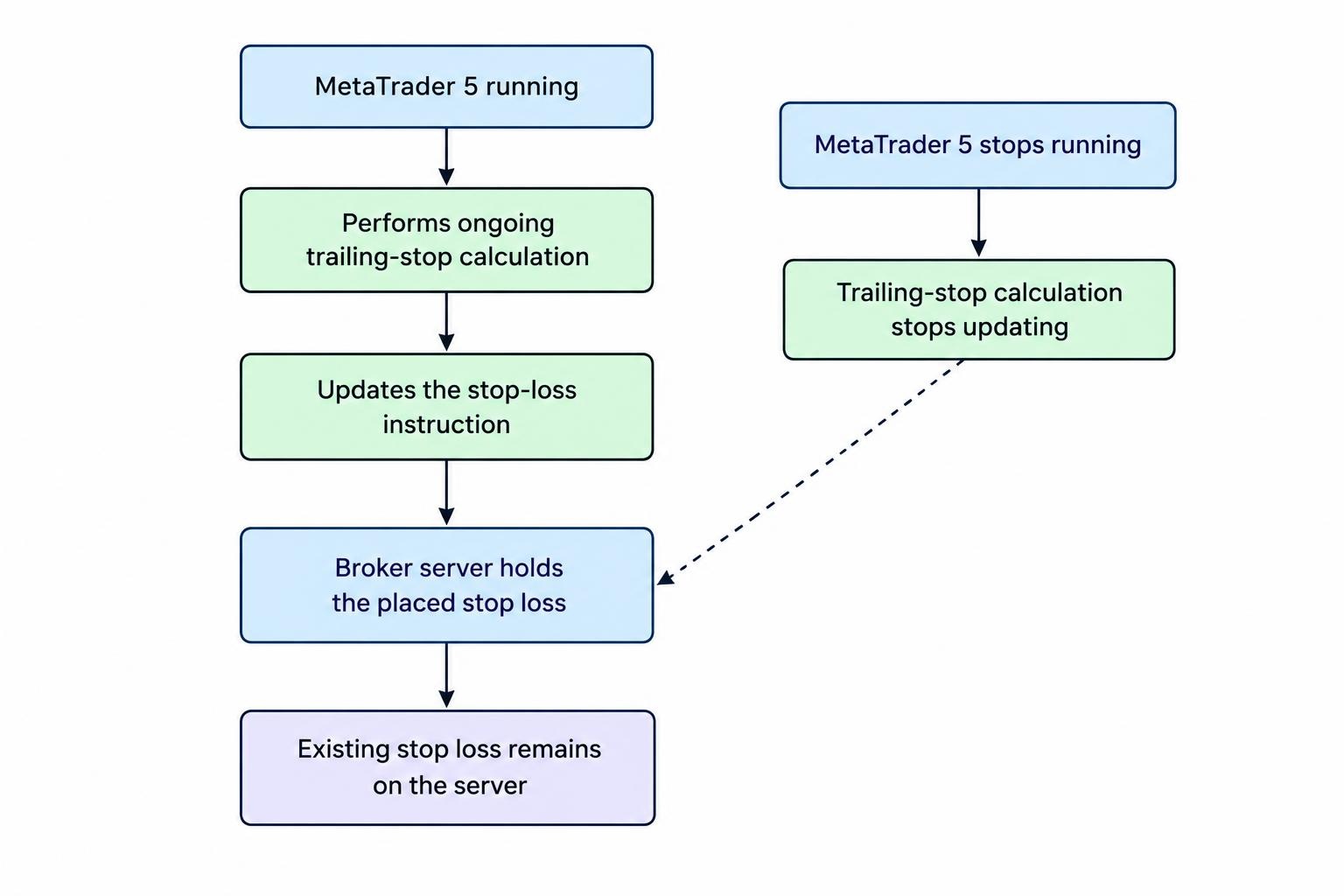
An ordinary stop loss does not guarantee execution at its selected trigger. A price gap or shortage of executable liquidity can lead to a worse result. Guaranteed stops, where available, operate under separate terms and may carry charges. Software controls also differ in where they operate. MetaTrader 5’s trading principles documentation explains that its trailing stop runs in the trading platform, while the resulting stop loss is held on the server. When the platform stops running, the trailing calculation stops updating, although an already placed stop loss remains. Other systems need their own checks. The trader must establish what continues working independently of the device before relying on a control to manage an unattended position.
Measure the complete cost of the trade
Spread and commission need to be assessed together at the intended quantity. Suppose a hypothetical account quotes a 0.6 pip EUR/USD spread and charges $8 for a complete entry and exit per 100,000 euros. On a 30,000 euro position, the spread costs approximately $1.80 and the commission $2.40, giving $4.20 before financing or execution differences. That equals 1.4 pips at $3 per pip. Another account advertising a wider spread might still have a similar complete cost if it charges no commission. The example describes arithmetic rather than a current offer. It shows why comparisons need consistent quantities and fee conventions, including whether commission is quoted per side or for the full trade and which currency is used.
Financing becomes more relevant when positions remain open across rollover periods. The account’s current schedule determines charges or credits, and the result need not equal the difference between central bank policy rates. Broker adjustments, calendar conventions and contract terms can affect it. The application should preserve these entries alongside the transaction record so that performance can be assessed after actual charges. A short intraday method may be more sensitive to repeated spreads and fills, while a longer holding period can make financing material. The software does not determine which cost dominates, but it should supply enough information to calculate both. A profitable looking price move is not a complete account result until the associated costs and currency conversions have been included.
Forex platform examples
MetaTrader and established custom tools
MetaTrader 4 combines charting and account functions with support for programmable tools. Its Expert Advisor documentation describes programs used to automate analytical and trading activity. That is relevant to traders who already rely on tools written for that environment. The decision still requires checking the broker’s implementation, supported instruments and device requirements. An existing program may depend on symbol names, contract sizes or operating assumptions that differ between accounts. A manual trader should assess ordinary tasks such as modifying instructions and exporting records before assigning much value to automation. The presence of an Expert Advisor function explains what the application can run; it does not establish that a particular program provides a profitable or suitable method.
MetaTrader 5 offers another environment for trading, analysis and automated research. Its Strategy Tester documentation describes historical testing and optimisation of trading programs, including strategies using several instruments. Those functions can support investigation when their data and assumptions fit the question. MT4 and MT5 should not be treated as interchangeable destinations for every custom indicator or strategy. Differences in their programming and trading models mean migration must be checked against the actual tool. A trader comparing them should test the required workflow rather than choose only by version number. Broker support, available instruments and the way the account handles positions may matter more to the daily routine than a general statement about which application is newer.
cTrader charting services and broker applications
cTrader is another platform with trading functions and an automation environment. Its introduction to cBots explains trading programs and historical testing. A trader considering it should examine the tasks that will actually be performed: reading the quote, entering a quantity, modifying an instruction and reviewing the completed trade. Features should be checked on the relevant device rather than inferred from a desktop demonstration. Browser and mobile versions can have different functions or operating requirements. A trader moving custom software also needs to assess adaptation and testing work. Similar looking controls or familiar terminology do not establish identical execution logic, and the broker account remains part of the assessment even when the platform itself is already understood.
TradingView starts from charting and analysis while also supporting simulated trading and connections to supported brokers. Its Paper Trading documentation describes a simulator covering forex among other markets. Simulation can help a trader learn controls and record a practice method. A live broker connection is a separate arrangement whose instruments and order functions need confirmation. The chart selected for analysis can use a different price source from the connected account, so the trader must understand that relationship before interpreting an execution. A convenient workspace is useful when it reduces repetitive tasks while preserving clarity about which service supplies the analysis and which broker accepts the instruction. Familiar charts do not make every connected account equivalent in its prices or terms.
Broker developed platforms can combine charts, account administration and statements inside one interface. They may suit traders whose routine does not require custom programs or several external services. Browser access can simplify movement between devices, while a mobile application can assist monitoring away from a desk. Neither format is automatically more reliable or complete. Check the functions on the device that will actually be used and practise changing an instruction from another authorised route. A small screen can make detailed quantities or order status harder to inspect. The useful comparison concerns the trader’s work under ordinary conditions and after a disruption, rather than whether the platform has an independent software brand or appears more elaborate in promotional images.
Automation and strategy testing
Separate alerts from authority to trade
An indicator can analyse prices without submitting orders. A signal service can recommend an action, while a robot can carry out instructions automatically. A copying arrangement introduces another set of assumptions about timing, allocation and the activity being followed. These permissions should be assessed separately. A method that looks successful in an originating account may not produce the same outcome when received later or executed under different charges. Establish which decisions remain with the trader and which actions the software can take. The maximum quantity, instruments and stopping conditions should be understandable. Turning off new entries may leave existing positions open, and closing an application may leave broker accepted orders active. Operational testing needs to cover those situations before authority is delegated.
A robot requires rules for failure as well as entry signals. It should respond appropriately to missing quotes, rejected requests, partial fills and restarts. It also needs to recognise positions already present when it begins running again. Without that check, a second instance or restart can create duplicate exposure. Preserve the program version and settings used in each evaluation, together with logs of decisions and broker responses. A label such as artificial intelligence does not replace those records or explain the financial logic. The trader still needs an account of how exposure is opened, increased and closed. Software can apply a rule consistently while repeating a mistake more quickly than a person could notice and correct it during the same period.
Historical results depend on assumptions
A backtest asks what a defined method would have done under stated historical conditions. Its result depends on spread, commission, financing and execution assumptions as well as the price series. Tests using completed candles can conceal the order in which prices reached an entry and exit level within the interval. Tick observations can add detail without reproducing every live liquidity condition. Historical results should therefore be read as conditional calculations rather than a forecast. The report should identify what was recorded, generated or assumed. If a small increase in costs or delay removes the apparent advantage, that sensitivity belongs in the evaluation. A smooth performance chart does not make the underlying assumptions more realistic or the proposed live arrangement more dependable.
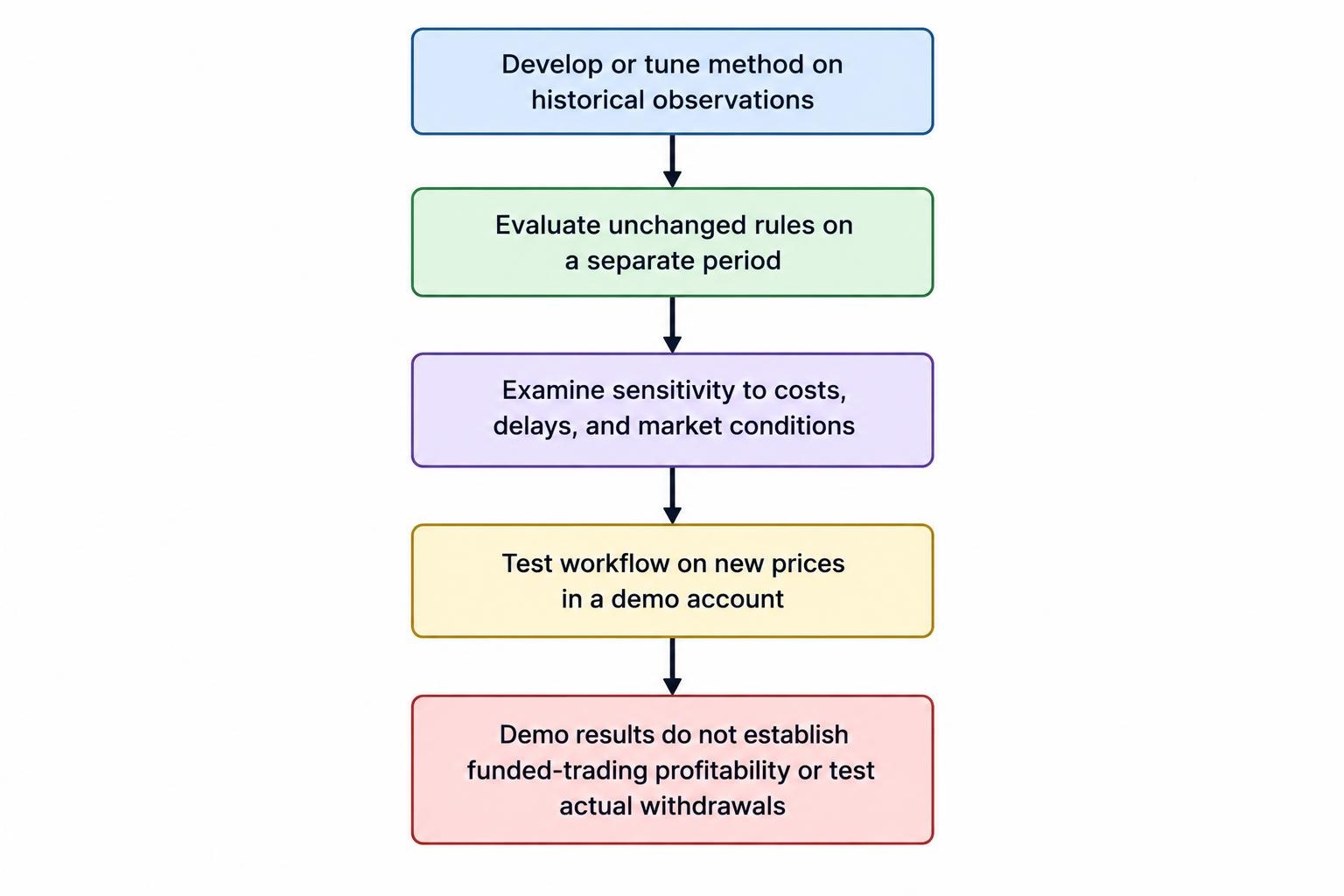
Development and evaluation should use separate observations. Trying many indicator settings or filters and retaining the strongest result can select a chance pattern. Repeating the same test on the same history then measures the selection process rather than providing independent evidence. Reserve another period for unchanged rules and examine whether results depend on one pair, short episode or unusually favourable conditions. A demo account can then test the workflow as new prices arrive, using a realistic balance and quantities. Demo execution may differ from live execution, and it does not test actual withdrawals. The exercise is useful when its scope remains clear: it provides evidence about the simulated method and controls without establishing that funded trading will be profitable or the provider reliable.
Records reliability and selecting a setup
Preserve a usable account history
A journal connects a trading decision to its financial outcome. It should retain the intended entry, actual fill, quantity, exit, charges and reason for the trade. Distinguish mistakes in applying the method from losses produced when it was followed correctly. Imported history can reduce manual work, but the records still need reconciliation. Deposits and transfers should not be counted as trading profit, and currency conversions should be treated consistently. Screenshots can preserve chart context, while broker statements establish account transactions. Together they support review when instruments and timestamps match. Exporting records also preserves access if a subscription ends or the account is closed. A convenient application becomes less useful when its history cannot be understood outside the original service.
Performance review should go beyond the proportion of winning trades. Average gains and losses, charges, losing sequences and the account’s decline from a previous peak all matter. A hypothetical account falling from $2,000 to $1,500 has lost 25% and needs a gain of approximately 33.3% from the lower balance to recover. Inspect open equity as well as closed balance, particularly for methods that keep losing positions while recording smaller realised gains. Several currency pairs can also create related exposure to the same currency. The software should help make that concentration visible. The question is whether the method and its financial demands remain acceptable through weak conditions, rather than whether one selected period shows an attractive headline return.
Check reliability and access permissions
Reliability includes the ability to regain control when the usual device or connection is unavailable. Learn which instructions remain active on the server, how alternative access works and how to contact the broker. A virtual private server can keep some programs running independently of a home computer, but it adds configuration and monitoring responsibilities. It does not guarantee broker availability or favourable execution. Permissions should match the task: a journal service may need statements without requiring authority to trade or transfer money. Review connected applications, use appropriate multifactor authentication and preserve recovery methods. Software updates also deserve relevant checks before a custom method depends on them again. A working installation establishes that code runs, not that its settings or financial behaviour are correct.
Assess the account and the software together
Broker comparisons such as ForexBrokersOnline.com can help identify accounts and platform choices for further research. Confirm the details against current broker terms and official platform documentation, including the service available to the reader’s location and customer category. Financial permissions and product restrictions differ between jurisdictions, so a website accepting registration does not itself settle eligibility. Compare the exact account rather than a general brand description. Two accounts using the same software can differ enough to change the suitability of a method through costs, contract settings or execution arrangements. The comparison should end with a clear description of the business, account and application being assessed so that later observations refer to the same complete arrangement.
The final trial should reproduce a representative part of the intended routine. Prepare the analysis, calculate a quantity, submit and modify a practice order, then inspect its record and costs. Check alerts, disconnection behaviour and exports rather than test only the feature that first attracted attention. Include subscriptions, data and hosting in the budget alongside trading charges. The appropriate setup is the smallest complete arrangement that performs the required tasks reliably and makes exposure understandable. A manual method may need clear charts and a straightforward journal; an automated method creates further testing and monitoring requirements. Software earns its place by improving that process and producing records that can be checked, rather than by adding functions that the trader has no defined reason to use.