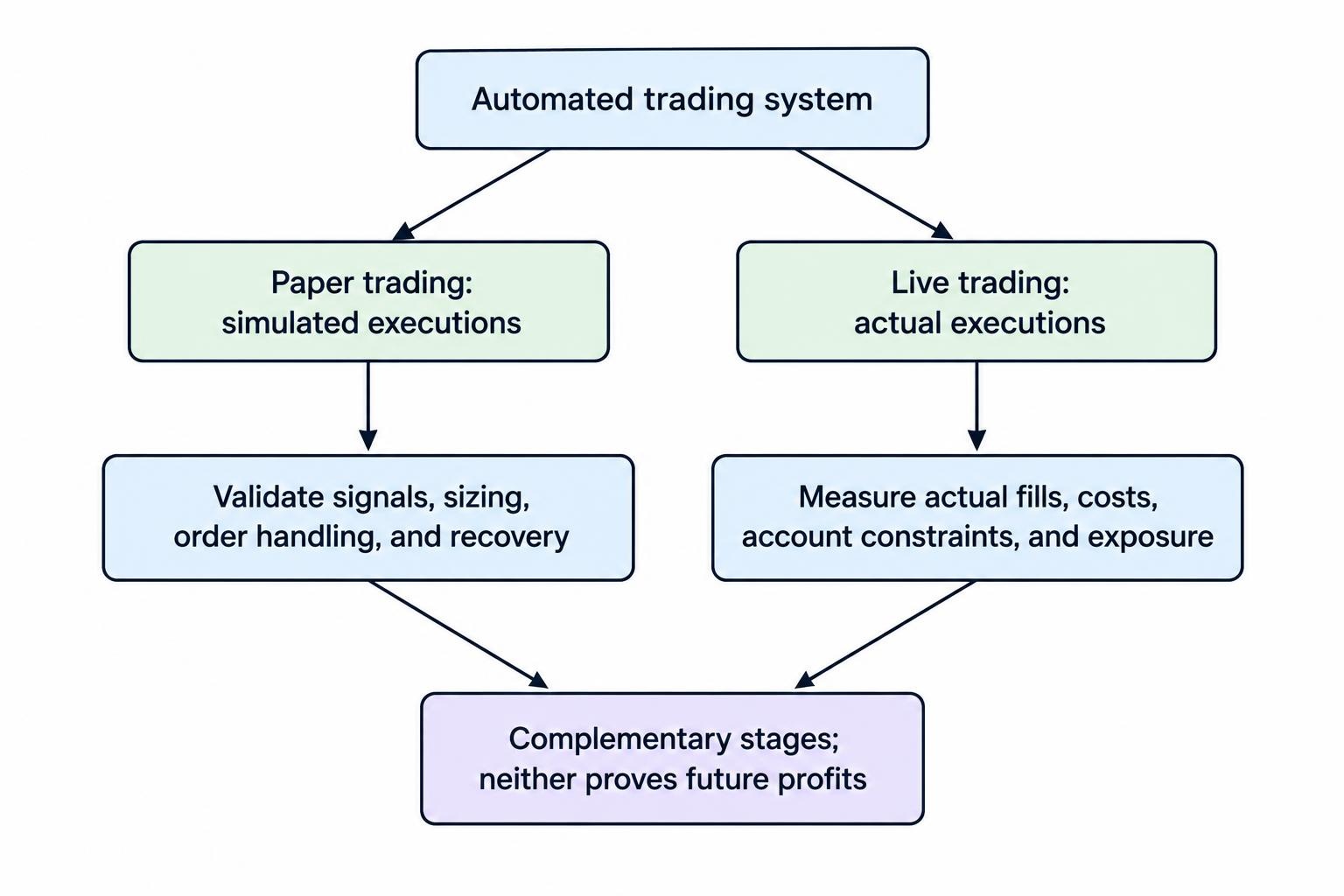
Paper trading tests an automated system without putting trading capital at risk. Live trading tests the same system against actual execution, account restrictions and financial losses. Both belong in a development process, but they answer different questions: does the software behave as intended, and can that behavior survive real trading?
A profitable paper account is not a certificate of readiness. Treat it as evidence about the parts of the system the simulator can reproduce, then use a controlled live pilot to investigate what it cannot. The aim is to find expensive mistakes while they are still cheap.
Paper Trading vs Live Trading: What Changes?
Paper trading, also called simulated trading, processes hypothetical orders and maintains a virtual account. It may use current market prices, delayed prices or replayed data. Real market data alone does not make the executions real: the CME Group trading simulator FAQ distinguishes its use of real market data from its simulated trading environment.
Live trading submits actual orders through a trading account. The resulting executions determine real positions, costs and gains or losses. For an automated system, that transition changes more than the account balance.
| Area | Paper trading | Live trading |
|---|---|---|
| Order fills | Generated by the simulator’s execution rules | Depend on available liquidity and the execution process |
| Trading costs | Must be checked against the simulator’s assumptions | Appear in actual executions and account charges |
| Account behavior | Reflects the restrictions implemented in the test environment | Reflects the permissions and constraints of the funded account |
| Failure testing | Suitable for deliberate fault injection without trading losses | Requires safeguards because failures can create real exposure |
| Main purpose | Validate behavior and discover implementation faults | Measure actual execution and operation with capital exposed |
These are complementary stages, not competing choices. A system that has never run against incoming data has unanswered operational questions. A system that has only traded virtually still has unanswered execution questions.
What Paper Trading Can Validate
Signals, sizing and order handling
A useful paper test follows the entire chain from incoming data to the recorded position. Check whether the system calculates its indicators correctly, acts only on information already available, submits the intended quantity and respects its trading schedule.
Compare expected decisions with actual logs. If a strategy should enter once after a completed price bar, verify that repeated updates do not trigger several orders. If it should stop entering after a loss threshold, confirm that restarting the application does not reset that restriction.
This is different from historical research. Backtesting an automated trading strategy examines past data under chosen assumptions. Forward paper trading adds a running clock, incoming messages and a continuously changing account state. It can expose implementation faults even when the trading rules performed well historically.
Recovery and exception handling
Use the paper stage to deliberately interrupt normal operation. Disconnect the data feed, restart the application with an open position, delay an order response and submit a cancellation while a fill message is pending. Record what the system should do before running each test.
A timeout deserves particular attention. It means the application has not received a timely answer; it does not establish whether an order exists. Design the recovery process to retrieve and reconcile order status before retrying. Blindly sending the same instruction again is a poor substitute for knowing what happened.
Where the simulator cannot reproduce a failure, use a separate test harness or controlled message replay. A normal paper session should not be expected to produce every awkward event by chance.
Why Paper Profits May Not Survive Live Trading
Hypothetical results cannot fully represent the effects of liquidity, slippage or financial pressure. These limitations are addressed in the NFA notice on hypothetical performance results. Forward paper trading avoids some hindsight problems when rules remain unchanged, but its executions are still hypothetical.
A touched price is not a guaranteed fill
Suppose a bot places a buy limit order at $50.00. The market trades at that price, and the simulator records a complete fill. Before accepting that result, ask what the simulation actually checked: a last traded price, an executable quote, traded volume or an estimate of the orders ahead?
For exchange order books, queue information can matter. CME Group’s Market by Order documentation distinguishes individual order and queue information from aggregated price level data. A simulator working from a coarse view cannot be assumed to reconstruct the execution opportunity of an individual resting order.
Review the simulator’s documentation rather than assuming every fill is generous or every fill is conservative. Pay particular attention to partial fills, thinly traded instruments, orders larger than displayed liquidity and strategies that depend on joining the best bid or offer.
Order behavior needs separate checks
Test each order type the strategy uses, including its trigger, remaining quantity and cancellation behavior. A stop instruction and a stop limit instruction do not provide the same execution outcome. The CME Group explanation of futures order types describes these distinctions, including the possibility that a triggered stop limit order remains unfilled.
For a multi-leg strategy, test what happens when only one leg executes. For bracket orders, verify how protective orders change after a partial entry. A clean entry signal does not help much if the exit logic protects twice the position actually held.
Small cost differences can erase a small edge
Consider an illustrative strategy that earns an average of $0.04 per share before execution costs. If it buys 100 shares and later sells all 100, its gross expected profit is $4 per completed trade. Suppose the paper report deducts $1 in total costs, leaving $3.
If live execution is $0.02 per share worse on entry and another $0.02 worse on exit, that adds $4. With the same $1 of other costs, the expected result becomes a $1 loss. These are hypothetical numbers, not a forecast; they show why measuring costs matters more than admiring a smooth profit chart.
Build a cost ledger that covers applicable commissions, fees, financing and borrowing charges. Measure execution prices against a consistent benchmark, and avoid counting the spread twice when it is already reflected in those prices.
Make the Paper Environment Comparable
Use an account balance, position size and exposure ceiling that resemble the intended deployment. A virtual account with vastly more buying power than the planned live account can hide sizing mistakes and financing assumptions.
Check the instrument identifiers, contract multipliers, tick sizes, trading sessions, currencies and permitted order types. Confirm whether the data is delayed, and whether the strategy consumes trades, bid and ask quotes, or completed bars. Comparing unlike data feeds can make an execution problem look like a signal problem.
Keep the strategy rules and software version fixed during a formal evaluation window. Store a version identifier with every decision and order. When a change affects the strategy’s behavior, start a new evaluation record rather than blending the results.
Separate paper and live credentials, account identifiers and connection settings. Make the operating mode conspicuous in logs and alerts. Before each deployment, verify the destination account independently of the strategy’s own configuration.
Decide When the System Is Ready for a Live Pilot
A calendar target alone is a weak readiness test. Twenty quiet sessions might provide little evidence about a strategy that trades infrequently or depends on volatile conditions. Set acceptance criteria around observed behavior, trading opportunities and deliberately tested failures.
The following checklist is a practical starting point, not a guarantee of profitability:
- Decision accuracy: recorded signals and quantities match the approved rules.
- Position accuracy: internal positions reconcile with the paper account after fills, cancellations and restarts.
- Failure handling: disconnections, rejected orders and missing responses produce the intended response.
- Cost tolerance: results remain acceptable under documented, less favorable execution assumptions.
- Risk controls: order, exposure and loss restrictions have been exercised rather than simply configured.
There is no universal trade count that proves a system works. Repeated entries from the same market episode do not necessarily provide independent evidence. Record which conditions the evaluation covered and which remain untested.
Before exposing capital, define pre-trade order limits and exposure checks separately from entry logic. Include outstanding orders when calculating possible exposure. A bot should not be allowed to exceed its budget simply because several orders have not filled yet.
Move to Live Trading in Controlled Stages
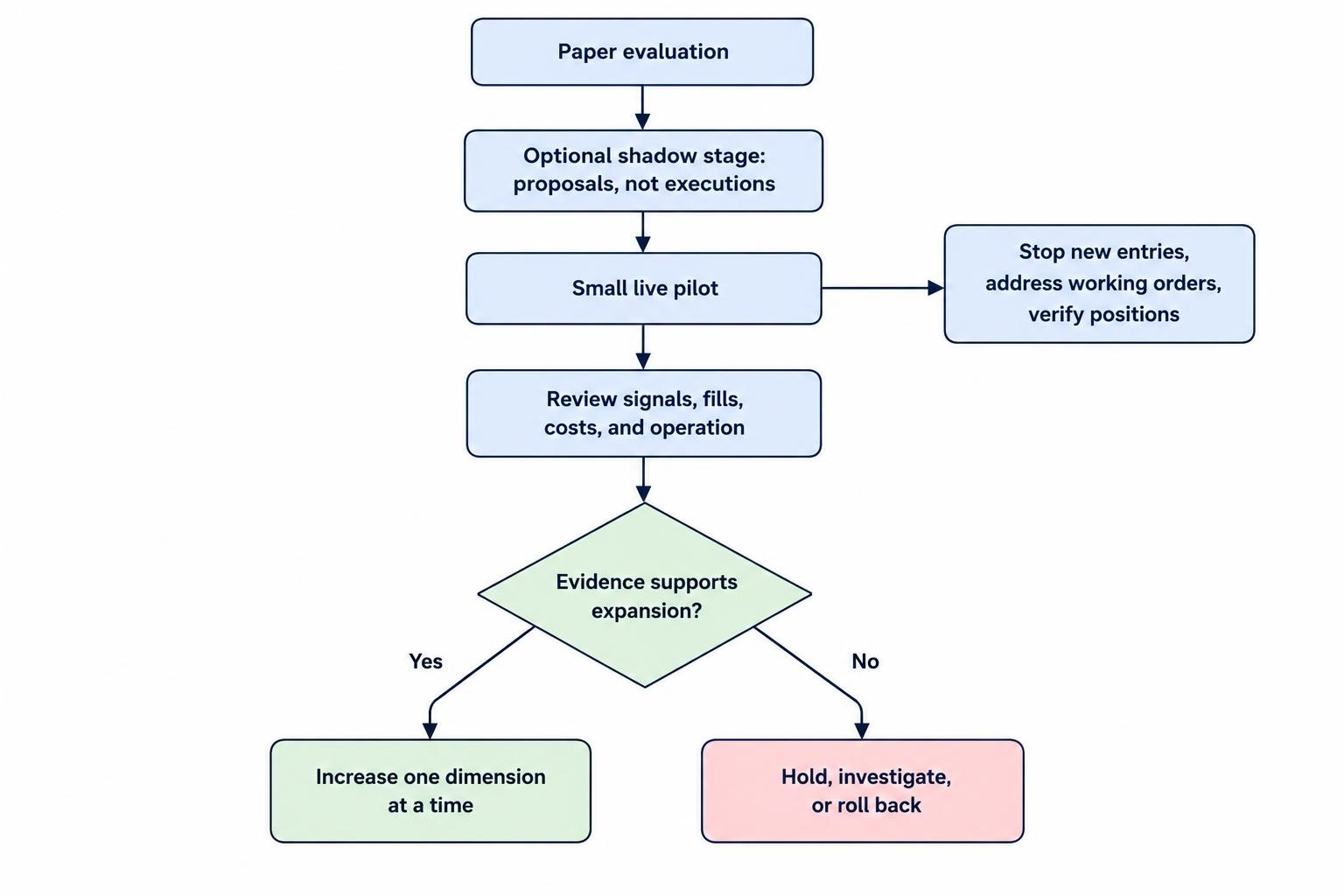
Run a shadow stage where useful
A shadow system consumes the intended data and records proposed orders without submitting them. Use it to compare timing, identifiers and signals with the approved paper version. It is especially useful after changing the hosting environment or data connection.
Shadow results are still not executions. Label proposed trades clearly, and do not merge their hypothetical returns with actual account performance.
Start with a small live pilot
Use the smallest practical deployment that can answer the execution questions without creating unacceptable exposure. Define its maximum position, permitted instruments, operating hours and shutdown conditions before starting. Small notional size does not automatically mean small risk, particularly with leveraged instruments.
A staged launch has an institutional precedent: FINRA’s algorithmic trading control guidance identifies small pilot deployments, heightened monitoring and rapid disablement as effective practices for member firms. These practices are useful design references, not a certification of an individual trader’s system.
Keep the pilot’s purpose narrow. Measure whether live signals match the approved logic, whether orders behave as expected and how actual costs compare with the assumptions. Do not increase size simply because the first few trades make money.
Scale only after reviewing the evidence
Review execution and operational results before changing allocation. Increase one dimension at a time: order size, instrument coverage, trading hours or concurrent strategies. Changing all four makes it harder to identify the cause when behavior changes.
Define a rollback route too. The operator should know how to stop new entries, address working orders, verify remaining positions and restore a previously approved version. Stopping a program and closing its positions are separate actions.
Compare Paper and Live Results at the Order Level
Account returns alone are too blunt for diagnosing the transition. For comparable signals, record the decision time, reference bid and ask, submission time, acknowledgement time, fill quantities, execution prices and charges.
Then separate the gaps. Different signals suggest a data, timing or configuration issue. Matching signals with different fills suggest an execution issue. Matching executions with different reported returns suggest an accounting or cost treatment issue.
Track unfilled opportunities as well as completed trades. Comparing only filled orders can conceal a strategy that captures easy paper profits but misses those same entries live. Review execution shortfalls by order size, session and market conditions rather than relying on one average.
Retain this process after the pilot. Monitoring trading bots and detecting strategy failures should cover both financial performance and operational behavior. A profitable session can still contain duplicate orders, stale data or an unresolved position mismatch.
Keep Paper Trading After Going Live
Retain a separate simulation environment for software changes, new instruments and recovery rehearsals. Do not make the funded account the default place to find out whether a restart procedure works.
Use paper trading to remove avoidable software and process errors. Use a tightly controlled live pilot to measure execution and account behavior. Keep the evidence separate, document what remains uncertain, and expand only when the results justify the next step. Neither stage proves future profits, but together they provide a more defensible basis for deployment than either alone.