REST APIs suit trading tasks that need a discrete answer: retrieve historical prices, check a balance, submit an order or query its status. WebSocket APIs suit tasks that need continuing updates, such as quotes, trades and execution notifications. For an application that needs both, a hybrid design is a sensible starting point.
The decision should follow the application’s timing requirements and recovery needs, not a blanket claim that one technology is faster. A streaming price feed is useful only while its data remains current. An order request is useful only when the application can establish what happened to it.
How REST and WebSocket APIs differ
REST and WebSocket are not quite equivalent categories. REST is an architectural style, with constraints that include stateless interactions and a uniform interface. WebSocket is a communication protocol. The original REST architectural definition covers more than sending JSON through an HTTP endpoint.
In trading documentation, “REST API” generally refers to an HTTP interface organised around resources such as instruments, accounts and orders. The client sends a request and receives a response. To keep this comparison practical, that is the usage followed here.
REST: request the information or action you need
A client might request a price snapshot, submit an order, then request the order’s current status. Each interaction has a defined purpose and response. Statelessness does not mean opening a new network connection for every request: HTTP connections can be reused, and HTTP/2 supports multiplexing. These distinctions are covered in the MDN overview of HTTP requests and connections.
Consider a daily portfolio review. The application needs account balances, holdings and a set of closing prices. Design those as discrete retrieval tasks. Maintaining a live stream throughout the day would add operational work without necessarily improving that review.
WebSocket: maintain a channel for continuing messages
WebSocket establishes a connection over which either side can send messages independently. That allows a server to deliver updates without waiting for a fresh polling request. The protocol also defines control messages, including Ping and Pong, but it does not define trading subscriptions, order types or execution states. Those belong to the provider’s application protocol, layered over the WebSocket protocol defined in RFC 6455.
For a live watchlist, the intended workflow is different: connect, authenticate where required, subscribe to instruments and process incoming updates. Read the subscription acknowledgement before treating a symbol as active. Sending a subscription request and receiving permission to consume that data are separate milestones.
REST vs WebSocket for common trading tasks
Use the following table as a design starting point, not a promise about any provider’s available endpoints. Verify the actual API contract before building around it.
| Task | Starting choice | What to verify |
|---|---|---|
| Download historical prices | REST | Pagination, date boundaries, adjustments and download limits |
| Display continuing quote updates | WebSocket | Subscription limits, timestamps and update frequency |
| Load balances and positions | REST snapshot, with streaming changes if needed | How snapshots and later updates fit together |
| Submit or cancel orders | The documented order interface | Acknowledgements, duplicate prevention and status queries |
| Track fills and order changes | WebSocket where supported | Recovery after missed events or disconnection |
| Rebuild state after an outage | Snapshot, replay or status queries | The provider’s supported recovery procedure |
Do not make order placement depend on a general REST versus WebSocket preference. Select the supported interface that provides the required order controls and recovery behaviour. The broader guide to trading APIs and platform integrations covers how that interface fits alongside market data, authentication and account services.
Latency: compare data freshness, not protocol labels
For a trading application, define the deadline first. Does a screen need a fresh quote every second? Must a strategy process every trade? Is a completed five minute bar enough? These are different requirements, and they should produce different designs.
A simple polling example shows the tradeoff. Suppose an application requests a snapshot once each second. A change occurring immediately after one snapshot may wait almost a second for the next request, before network and processing time are counted. Under an idealised model with changes arriving uniformly between polls, the average polling wait is half a second.
Streaming removes that scheduled polling wait, but do not assume immediate delivery. Check whether the service publishes individual events, batches them, filters them or sends periodic replacements. A continuously moving display is not proof that every underlying change reached the application.
For a fair test, compare the same instruments, permissions and data product. Record the provider’s event timestamp, local receipt time and the time the strategy finishes processing. Check clock synchronisation before interpreting differences between machines. Measure slower responses as well as typical ones; a good average can hide an unacceptable tail.
Polling frequency and request budgets
Suppose a watchlist contains 50 symbols. Requesting each symbol separately once a second creates 50 requests per second. A supported batch endpoint could reduce that to one request per second. Both designs still sample at one second intervals; batching changes request volume, not the sampling interval.
Use this arithmetic before increasing polling frequency. Build a request budget that leaves room for order checks, cancellations and recovery. For retry scheduling and quota handling, use the separate guide to broker API rate limits and connection errors.
A hybrid design for market data and account state
A useful design separates initial state from subsequent changes. Load the information needed to start, consume continuing updates, and keep a documented path for rebuilding state. Treat that recovery path as part of the design rather than an outage day improvisation.
For an illustrative intraday application, REST could load instrument details and historical bars. A WebSocket connection could then supply quotes and account events. The strategy should read from a validated local state store, rather than directly from whichever message arrived most recently.
Join snapshots and streams without creating gaps
Where the provider supports a snapshot plus incremental updates, follow its documented synchronisation procedure. Do not assume that fetching a snapshot and then subscribing creates a complete handover. Establish how updates occurring between those operations will be handled.
A recovery plan might require buffering incoming updates while retrieving a snapshot, then applying only updates that follow the snapshot’s sequence position. Use that approach only when the API supplies compatible sequence information and defines how to use it. Check whether sequence numbers belong to a connection, channel or instrument, and when they reset.
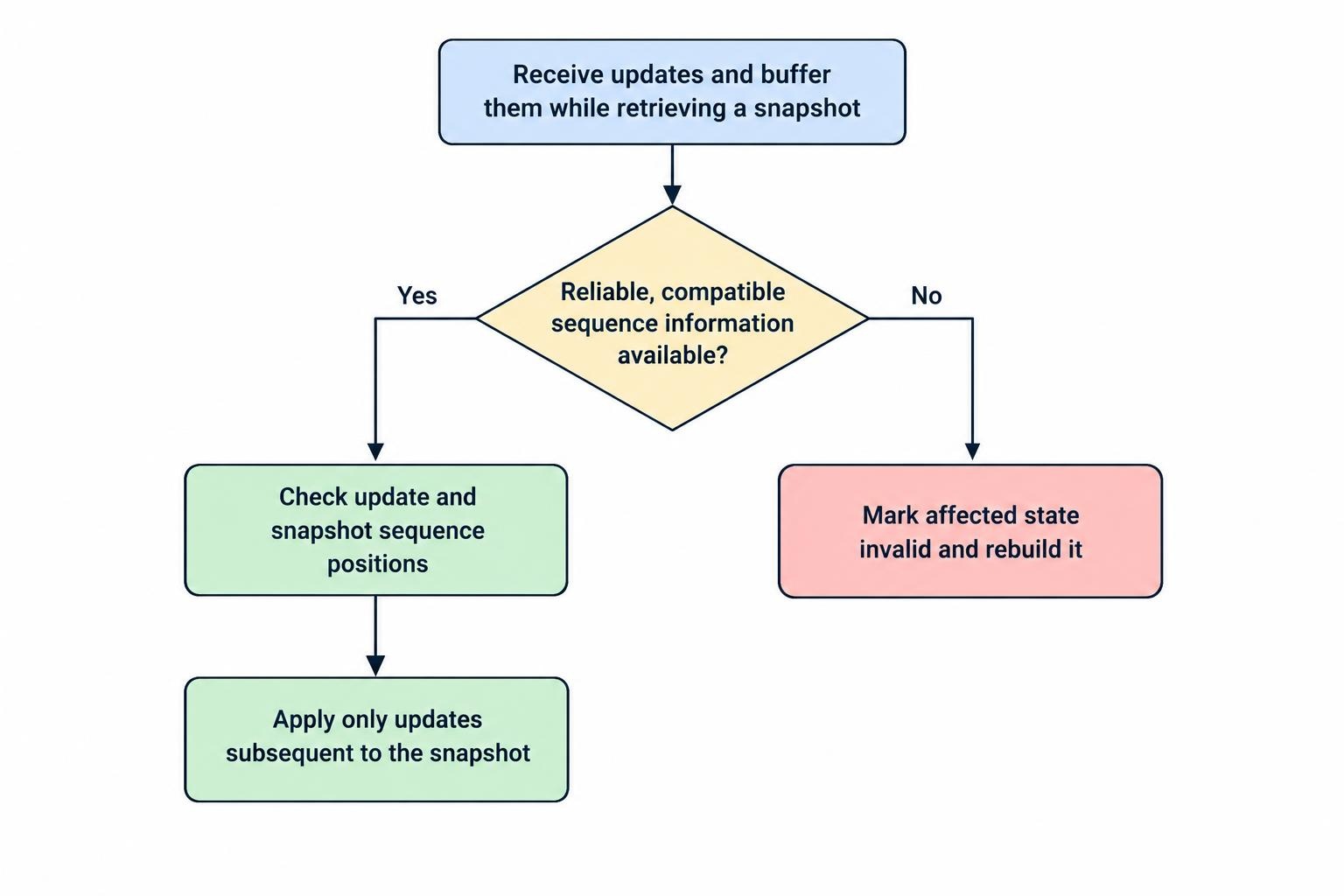
Some services send complete replacements rather than changes to apply to an earlier state. Treat these differently. Replacing a displayed quote with a newer complete quote is not the same operation as rebuilding an order book from incremental messages. If the provider offers no supported way to bridge a gap, mark the affected state invalid and rebuild it.
Order submission: a timeout is not a rejection
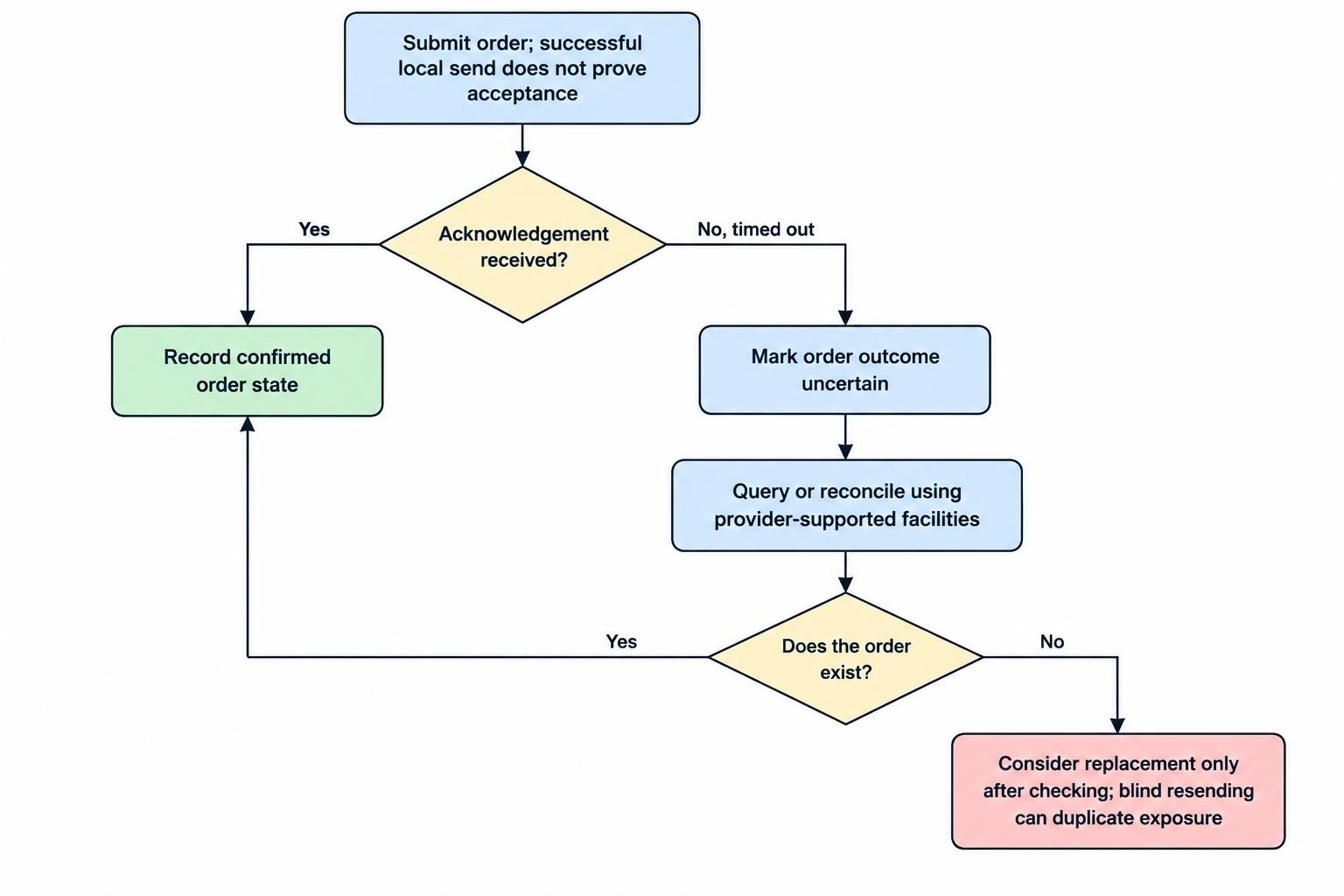
Plan for an ambiguous result. In a hypothetical failure, an application sends an order, the service accepts it, and the connection fails before the acknowledgement arrives. The application has no confirmation, but sending another order could duplicate the intended exposure.
HTTP distinguishes methods whose intended effect can safely be repeated from those that cannot. Automatic retries of non-idempotent requests require a way to establish that repetition is safe or that the original request was not applied. This restriction appears in the HTTP standard’s rules on idempotency and retries.
For trading, design the timeout path around the provider’s documented facilities. Where supported, assign a client order identifier before submission, save it locally and use it to query the uncertain order. If an idempotency mechanism exists, verify its scope and expiry. Do not assume that a client identifier automatically prevents duplicates.
Apply the same discipline to WebSocket order messages. Treat a successful local send as a transport event, not proof of acceptance or execution. Record separate states for submission, acknowledgement, partial fill, fill, cancellation and rejection. Reconcile uncertain orders before permitting a replacement order that could increase exposure.
Disconnections, stale feeds and recovery
Set separate tests for connection health and data freshness. A heartbeat can help establish that a connection is responsive; it should not be your sole test that a particular instrument’s price is suitable for a decision. Define freshness thresholds around the data product, trading session and strategy.
Display stale data clearly and decide what the strategy should do with it. A cautious design can block new entries that depend on an expired quote while leaving approved risk reduction actions available through a separate path. Document those choices before the feed fails.
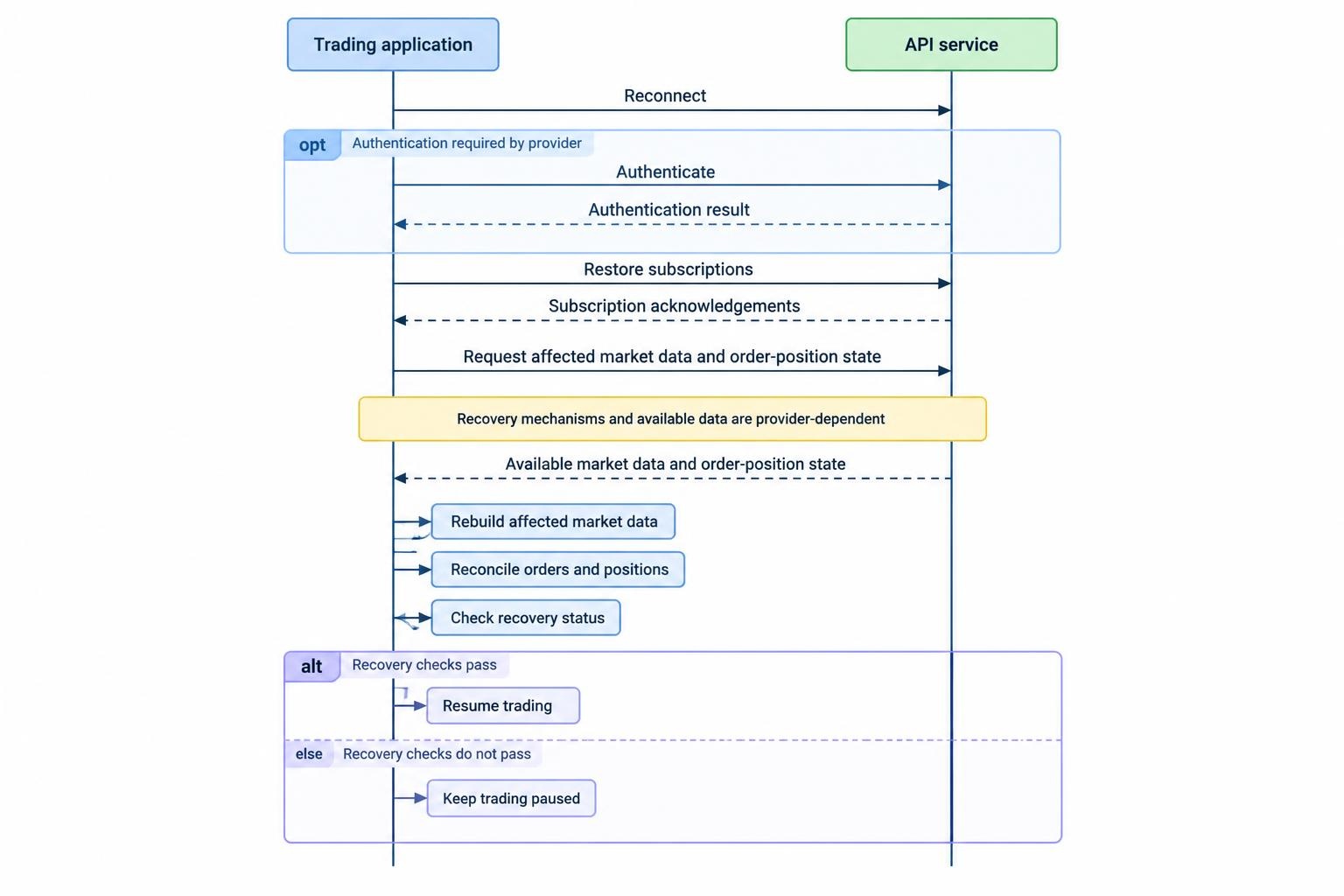
Reconnection should restore application state, not just reopen a socket. A concrete example is the CME Group WebSocket order entry recovery test, which includes reconnecting, querying order status and searching for trades. Its cancellation behaviour also depends on whether Cancel on Disconnect is enabled.
Build your own recovery sequence around the relevant provider contract: authenticate again if required, restore subscriptions, check acknowledgements, rebuild affected market data and reconcile orders and positions. Resume trading only after those checks pass. A “connected” status is not a clean bill of health.
Handling bursts without falling behind
Include overload tests, not just connection tests. The browser’s standard WebSocket interface has no built-in mechanism for applying backpressure when incoming messages exceed processing capacity. Buffer growth and unresponsive processing are documented risks in the MDN WebSocket API reference.
Separate receiving messages from slow work such as chart rendering, database writes and strategy calculations. Set bounded queues and monitor their age as well as their length. An application can look busy while processing prices that have already gone stale.
Choose an overload policy by message type. A display may permit replacing an older queued quote with a newer complete quote. Do not apply that shortcut to incremental order book changes, fills or order transitions. If required updates cannot be processed reliably, invalidate the affected state and recover it rather than silently dropping messages.
Security and testing before live use
Require encrypted connections and valid certificate checks for both interfaces. Keep long lived trading credentials out of public browser code, separate research access from order permissions, and remove secrets from logs. Manage these controls through the same process used for protecting trading accounts and API keys.
Define a small failure test set before deployment:
- Uncertain submission: interrupt the connection after sending an order and verify reconciliation without duplication.
- Feed interruption: confirm stale data detection, resubscription and state rebuilding.
- Processing overload: replay a burst and check queue limits, message age and the trading pause response.
- Credential expiry: verify renewal and recovery without exposing credentials in logs.
- Partial service failure: test what happens when quotes work but order status queries do not, and vice versa.
Use recorded events and a test environment where available, while keeping live deployment acceptance criteria separate. Judge success by correct state and controlled behaviour, not simply by whether the application stayed running.
Choosing the right interface for the application
Start with REST when discrete retrievals satisfy the task. Add WebSocket when continuing updates justify subscription management, freshness checks and reconnection handling. Use both when the application needs initial snapshots, live events and a reliable reconciliation path.
Before committing, write down the required update frequency, acceptable data age, order acknowledgement rules and recovery procedure. Then test those requirements against the actual service. The better interface is the one that lets the application act on valid information and establish what happened after a failure—not the one with the most impressive speed claim.