Communication in trading operations is the controlled exchange of instructions, execution updates, risk decisions and operational information between traders, brokers, analysts, technology teams and support staff. Its purpose is practical: the right person must receive an accurate message, know what action is required and leave a usable record of what happened.
A trading desk can have fast systems and still struggle with an ambiguous instruction. “Cancel that order” is not much help when three orders are working. A message marked “delivered” does not prove that anyone accepted responsibility for it, either.
Good communication therefore needs more than a messaging application. It needs clear ownership, agreed terminology, suitable channels and a process for resolving uncertainty. These controls matter during routine trading, but they become particularly valuable when markets move sharply, systems disconnect or a desk hands responsibility to another team.
What Trading Operations Communication Covers
Trading communication follows the transaction from preparation through execution and reconciliation. Before trading, teams exchange research, permitted instruments, account restrictions and risk limits. During execution, they communicate order instructions, acknowledgements, fills, amendments and exceptions. Afterward, they resolve allocation questions, booking differences and settlement issues.
Keep these categories separate. An analyst’s market view is not an instruction to trade. A trader’s request for approval is not approval itself. A broker’s acknowledgement of a query does not confirm that an order has been cancelled.
A useful operating model gives each message a purpose, an accountable recipient and an expected response. The following examples are workflow recommendations, not universal response standards.
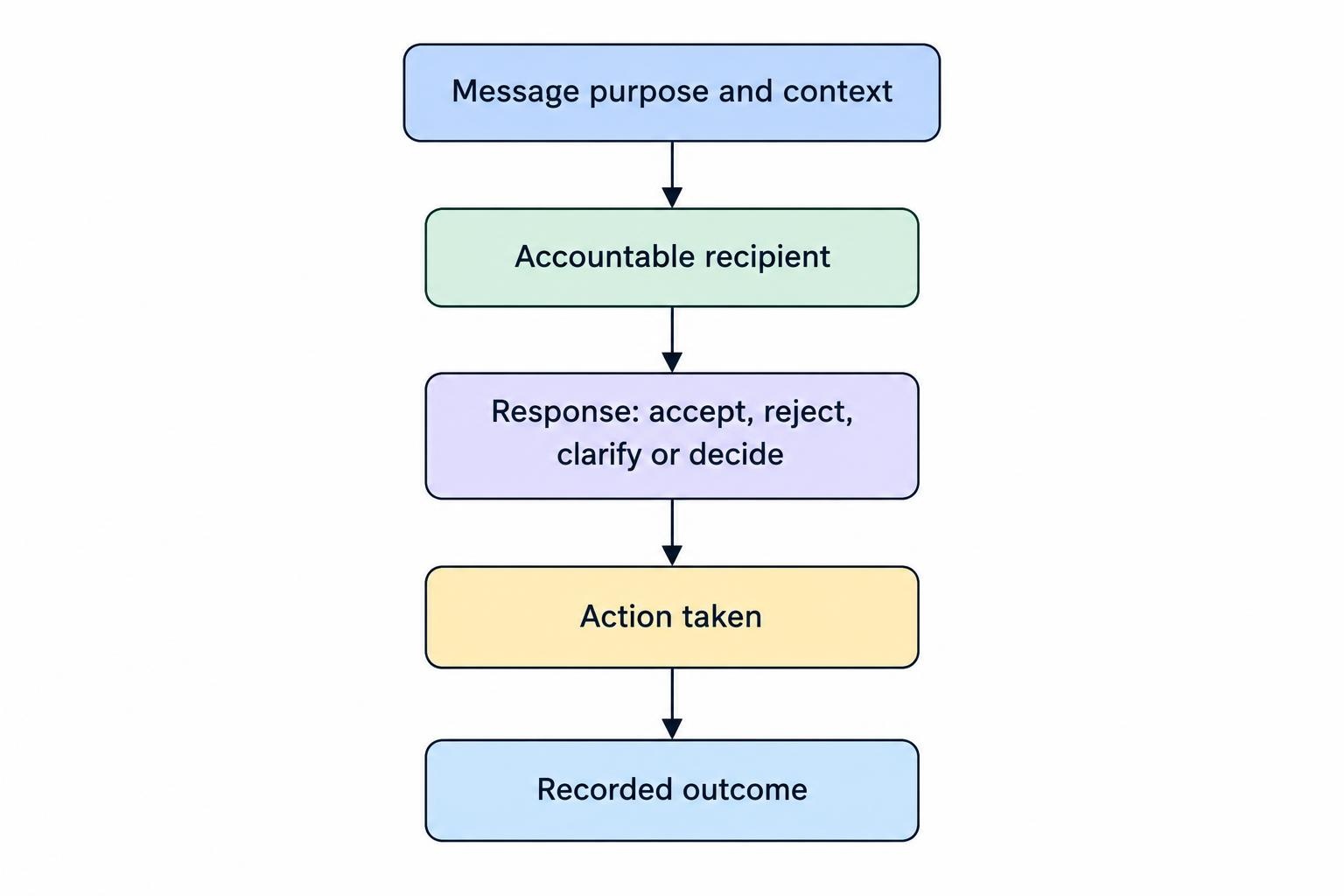
| Message type | Required context | Expected response |
|---|---|---|
| Trade instruction | Instrument, account, side, quantity, order conditions and identifier | Acceptance, rejection or request for clarification |
| Risk escalation | Exposure, breached threshold, affected activity and requested decision | Named decision owner and documented action |
| Operational incident | Affected service, observed symptoms, known impact and start time | Incident owner, interim instructions and next update time |
| Reconciliation exception | Trade references, conflicting records and unresolved difference | Assigned investigation and evidence of resolution |
The format can remain short. Completeness matters more than length, especially when the recipient is handling several conversations at once.
Choose Channels by Purpose, Not Convenience
Give each communication channel a defined job. Use approved chat for short coordination, an order management system for authoritative order state, and a case or incident system for issues that require ownership and follow-up. Email can suit formal notices and less urgent correspondence, but it should not become an unmonitored queue for time-sensitive decisions.
Voice communication can help when a problem needs rapid discussion. Where firm procedures permit it, follow the conversation with a written confirmation of the decision, responsible person and outstanding actions. That confirmation should supplement, not replace, any required recording or recordkeeping process.
Evaluate messaging and collaboration tools for trading teams against the actual workflow. Relevant questions include whether users can identify external participants, restrict room membership, retrieve attachments and connect conversations to an order or incident reference.
Also define which channel takes priority when messages conflict. If chat says an order is cancelled but the execution system still shows it as working, staff should investigate the discrepancy rather than choose the more reassuring answer.
Access should follow responsibility. A research discussion does not need every account identifier attached to it, and an external support contact does not need access to the desk’s internal risk deliberations.
Make Trade Instructions Unambiguous
Standardise the information required before an instruction can be acted on. Depending on the product and workflow, this may include the account, instrument identifier, buy or sell direction, quantity, price conditions, order type and duration. Use units explicitly: shares, contracts and currency amounts are not interchangeable.
Reference the order identifier in every amendment or cancellation request. Avoid relying on phrases such as “the earlier order” or “the remaining balance,” particularly across shifts or when several orders involve the same instrument.
Separate Receipt, Acceptance and Completion
Use distinct statuses for different stages. “Received” means the message arrived. “Accepted” means the recipient has taken responsibility for the instruction. “Completed” means the requested action has been confirmed through the relevant process. Teams should define these terms in their own procedures rather than assume everyone interprets them identically.
Consider a hypothetical cancellation request. A trader sends the request, receives a chat acknowledgement and then submits a replacement order. If the original cancellation has not been confirmed, both orders may remain exposed to execution. The safer communication pattern identifies the original order, states that cancellation is pending and blocks assumptions about the remaining quantity until its status is reconciled.
For material verbal instructions, use a read-back where appropriate: repeat the instrument, direction, amount and conditions, then obtain confirmation before proceeding.
Design Alerts Around an Action
An alert should explain what happened, why the recipient needs to care and what to do next. A notification that says “connection error” leaves too much work for the recipient. A better message identifies the affected connection, the last successful update, whether order status is uncertain and the person responsible for investigation.
Separate informational notifications from warnings and urgent incidents. Define severity by operational impact rather than dramatic wording. A routine data refresh failure and uncertainty over live orders should not receive identical treatment.
The delivery method also matters. Email, SMS, push notifications and webhooks for trading alerts serve different roles; choose them around urgency, acknowledgement needs and available fallback arrangements.
For urgent events, require a response from a named role and escalate if it does not arrive within the desk’s agreed interval. Do not treat a delivery receipt as evidence that someone is investigating.
Group repeated notifications under one incident where practical, while retaining the underlying event history. Ten identical messages do not create ten times the awareness. They create a strong temptation to mute the channel.
Keep Handoffs Explicit
A handoff should transfer responsibility, not simply provide a summary. Identify who is taking over and ask that person to confirm acceptance. Until then, the outgoing owner should follow the desk’s agreed coverage procedure rather than assume the transfer is complete.
Include working orders, unresolved execution questions, active restrictions, open incidents and pending decisions. For each outstanding item, state the next action, responsible person and relevant deadline. Distinguish confirmed facts from assumptions that still need checking.
Use timestamps with a clear time zone. “Before the open” can mean different things to teams covering several markets. Similarly, distinguish the time an event occurred from the time someone reported it.
A concise handoff might state that an order amendment remains unconfirmed, identify the broker contact handling it and specify what the incoming trader must verify. Copying a long chat history without identifying the unresolved issue is not a substitute for that explanation.
Communicate Clearly During Outages
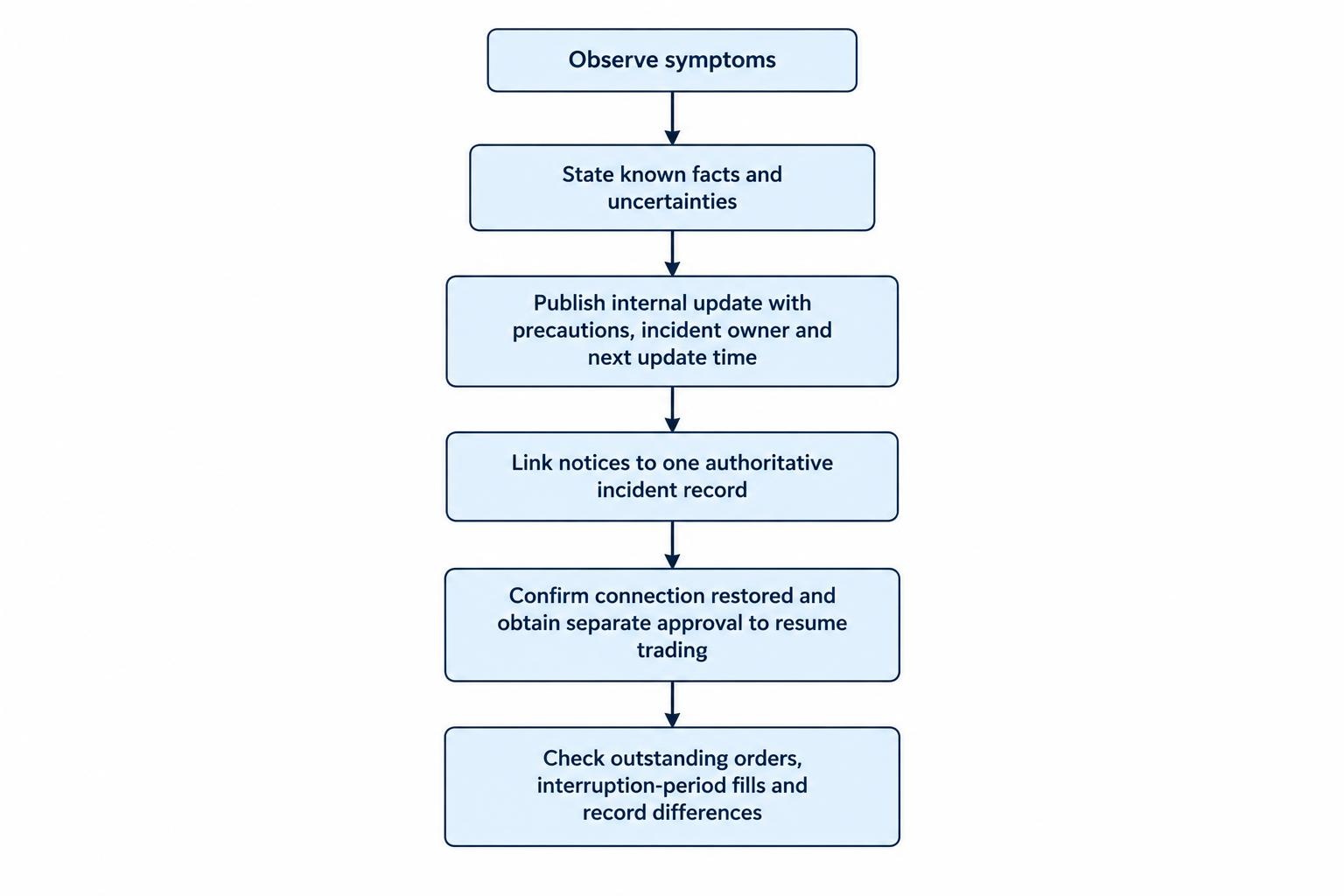
During a disruption, separate observed symptoms from confirmed causes. A frozen screen does not establish whether the problem sits with a workstation, network, broker service, market data feed or exchange. State what is known and label what remains under investigation.
Use authoritative operational notices alongside the firm’s own checks. For Nasdaq-related services, Nasdaq’s market system status messages provide exchange-issued service updates. Their scope still needs checking: a notice about one service does not establish the status of every connection or order.
The first internal update should identify the affected activity, immediate precautions, incident owner and next update time. If order state is uncertain, say so plainly. Avoid giving an estimated recovery time unless there is a defensible basis for it.
Maintain one authoritative incident thread or record. Other channels can distribute notices, but they should direct recipients back to the same incident identifier. This makes it easier to correct an earlier statement without leaving conflicting instructions in circulation.
Detailed procedures for outage communication between brokers, exchanges and traders should define escalation contacts, approved fallback channels and who can authorise a return to normal activity.
Recovery also needs a clear message. Distinguish “connection restored” from “trading approved to resume.” Before closing the incident, assign checks for outstanding orders, fills received during the interruption and any differences between internal and external records.
Build Supervision and Recordkeeping Into the Workflow
For regulated firms, communication controls must reflect the entity, jurisdiction, activity and record type. A personal trader’s support conversation does not carry the same obligations as a registered broker-dealer’s business correspondence. Avoid applying one retention period or approval process to every participant.
For US FINRA member firms, supervisory procedures must address incoming and outgoing written correspondence and relevant internal communications. Required reviews must also be evidenced in writing; these duties are set out in FINRA Rule 3110 on supervision. An archive alone does not demonstrate that the required supervisory work took place.
Operationally, define approved channels before staff begin using them. Check how edits, deletions, attachments, external users and mobile access affect capture and review. A channel’s convenient features should not be enabled without assessing whether the firm can support its obligations.
Assign responsibility for archive failures as well. If messages stop being captured, the response needs an owner, an impact assessment and a documented decision about continued use of the affected channel. Test retrieval using realistic requests rather than relying only on a successful backup notification.
Electronic preservation involves more than keeping a readable copy. The SEC’s guidance on broker-dealer electronic recordkeeping describes the audit-trail alternative, including preservation of a complete timestamped history that permits reconstruction of modified or deleted records. Ordinary searchable chat history should not be assumed to meet those requirements.
Keep the retention schedule separate from the channel directory. A conversation can move between chat, email and a case system while still relating to the same business activity. The firm needs a consistent way to identify, preserve and retrieve the relevant records.
The detailed treatment of trading chat records, retention and compliance should cover record categories, preservation requirements, access controls and supervisory evidence. At the operating level, staff need clear instructions about where to communicate and what to do if an approved channel fails.
Use AI Without Losing the Original Meaning
AI tools can assist with draft incident updates, conversation summaries and action lists. Treat those outputs as drafts until a responsible person checks them against the underlying record. A summary that changes “cancellation requested” to “order cancelled” has altered the operational meaning, even if the sentence reads more smoothly.
Preserve the distinction between original messages and generated text. Show who reviewed the output, retain access to its supporting material where required, and prevent the summary from silently replacing an authoritative order or incident record.
For member firms, using generative AI does not remove applicable communication duties. FINRA’s 2026 Annual Regulatory Oversight Report addresses supervision and retention of AI-assisted customer and chatbot communications. Review the proposed use against those obligations before deployment.
Set boundaries around confidential information and permitted actions. A tool approved to summarise an incident should not automatically receive permission to send external instructions, amend orders or disclose account information.
Test the Process Before It Is Needed
A communication procedure is useful only if staff can follow it under pressure. Run short exercises involving an unconfirmed cancellation, an unavailable supervisor, a failed messaging channel and conflicting execution records. Include external contacts where appropriate and agreed.
Measure acknowledgement time, ownership gaps, unresolved handoff items and the ability to reconstruct a decision. Review examples of misunderstandings as well as response speed. A fast but incorrect acknowledgement is not a successful outcome.
Finish each review with an assigned change: revise a message template, remove an unnecessary channel, update an escalation contact or clarify who can approve resumption after an incident. Trading operations communication works best when it turns uncertainty into a named task, a documented decision and a confirmed result.