Messaging and collaboration tools for trading teams should make decisions easier to communicate, verify and hand over. A useful setup connects traders, analysts, risk staff and operations without turning every market update into an interruption. It also keeps internal discussion separate from external conversations and makes responsibility clear when something needs action.
Choose tools around the work, not the popularity of the app. A research discussion, a broker inquiry and an urgent position discrepancy need different audiences, permissions and response expectations. The practical goal is fewer missed instructions and less ambiguity, not more messages.
Start With the Trading Team’s Communication Needs
Before comparing platforms, map who communicates with whom and why. Include the execution desk, research, portfolio management, risk, technology and settlement teams. Record which conversations involve clients, brokers or other external participants, and which must remain within a restricted group.
For the broader operating model, place messaging within your approach to communication in trading operations. Chat should support established responsibilities rather than become an informal substitute for them.
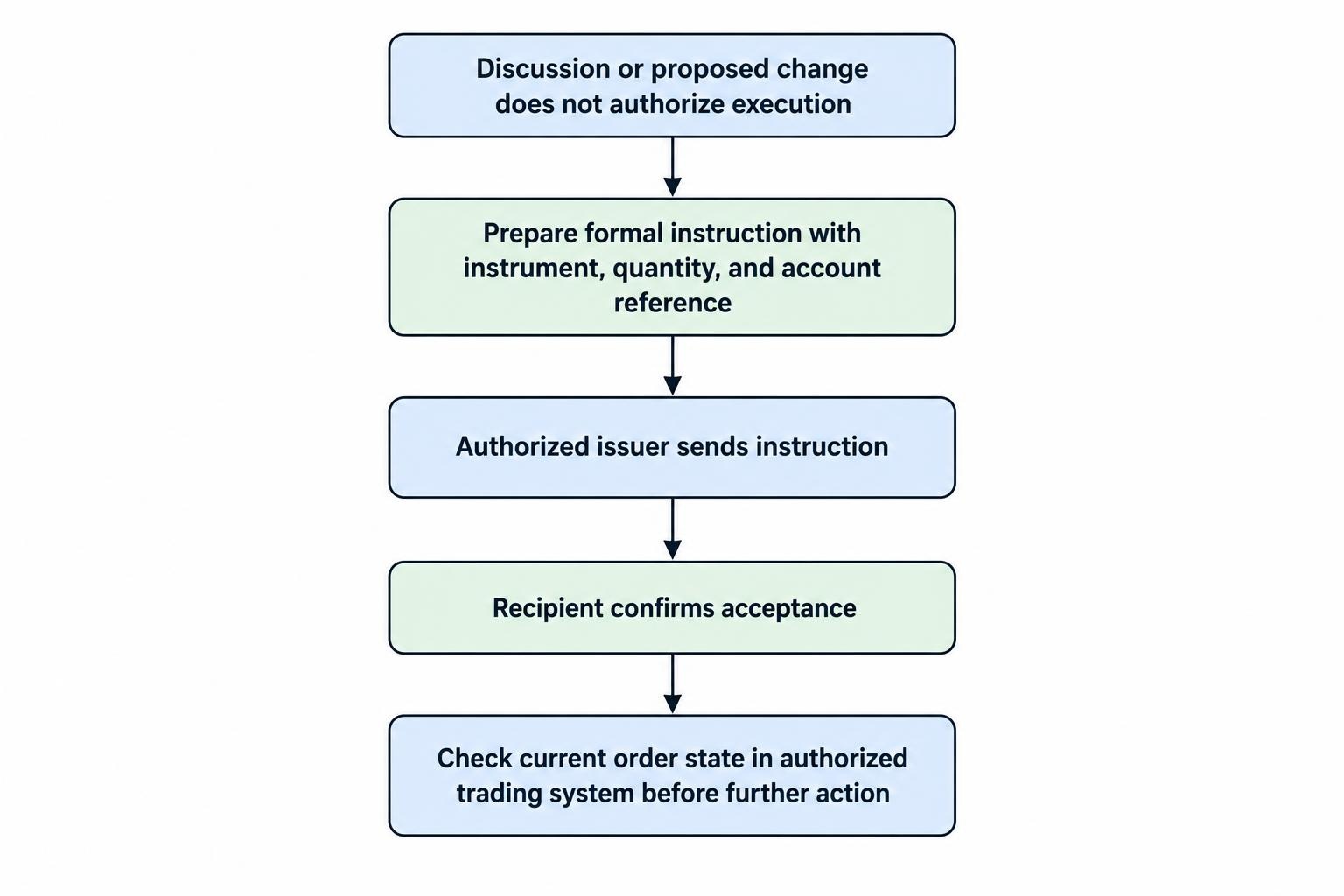
A practical requirements document should distinguish discussion from instruction. “We should reduce this exposure” is not the same message as an approved instruction containing an instrument, quantity and account reference. Decide where formal instructions belong, who can issue them and how recipients confirm acceptance.
| Workflow | Useful communication format | Control to assess |
|---|---|---|
| Research discussion | Threaded channel with document links | Source visibility and access permissions |
| External market inquiry | Approved conversation with identified counterparties | Participant verification and record capture |
| Risk escalation | Priority message with a named responder | Acknowledgment and escalation deadline |
| Settlement exception | Case thread linked to an operations record | Ownership, status and closure evidence |
| Shift handover | Structured summary linked to open work | Receiving team acceptance |
Comparing Messaging Platforms for Trading Teams
Enterprise workplace tools and finance-focused messaging platforms deserve different evaluation questions. For an internal workspace, assess how well it fits document handling, identity management and technical support. For external communication, establish whether the intended counterparties can actually participate through an approved connection.
Microsoft Teams: Check the External Collaboration Model
Microsoft Teams shared channels allow collaboration with people outside the parent team, including external participants through Microsoft Entra B2B direct connect. Shared channels also integrate with Microsoft Purview controls. However, external participation requires configuration by both organizations, and some controls have boundaries: information barriers apply to users in the host organization, not those users’ participation in another organization’s shared channel. These distinctions are covered in Microsoft’s shared channel administration documentation.
For a trading team evaluating Teams, test the exact arrangement you intend to use. Can an external operations contact enter the right channel and open the required document without gaining access elsewhere? Can administrators remove that access cleanly? Test the participant’s experience, not just the host administrator’s screen.
Slack: Examine Retention Before Building Workflows
Slack’s retention controls distinguish between keeping messages with edits and deletions, keeping messages without that history, and deleting content after a chosen period. Available settings depend on the plan and administrative policy. Its data retention documentation also warns that retention settings affect exports and that retention-based deletion is permanent.
Treat these settings as procurement questions, not housekeeping. During evaluation, create a message, edit it, delete it and retrieve the resulting record through the proposed archive process. Repeat the exercise with a private conversation and an attachment. A search box containing yesterday’s messages is not proof that the required record is preserved.
Symphony: Assess Financial Workflows and Archive Integration
Symphony Messaging offers internal and external messaging, role-based administration, information barriers, APIs and connections to third-party archival systems. Its Content Export Bridge supports exporting content into compliance and archiving systems. Those capabilities are described on the Symphony Messaging product and archiving page.
Evaluate the complete deployment rather than treating the product name as approval. Establish which counterparties are reachable, which integrations require extra services and who operates the archive connection. Ask the vendor to demonstrate your proposed workflow, including message corrections, external participants and failed exports.
Build Channels Around Decisions and Responsibilities
Use channels with a defined purpose, audience and owner. A desk research channel can hold discussion and challenge; a risk escalation channel should focus on matters requiring action. An operations exception channel should make unresolved cases visible without burying them beneath market commentary.
Publish a short description for each channel. State what belongs there, who monitors it, when coverage applies and where urgent matters go outside those hours. Assign a deputy owner so that channel administration does not depend on one person being available.
Keep sensitive matters out of broadly accessible rooms. Before creating a channel, ask whether every proposed participant needs the information. Recheck membership after transfers, role changes and the end of external projects. Avoid relying on a channel’s name to communicate confidentiality; enforce access through permissions.
Make Action Messages Self-Contained
A hypothetical operations message such as “Please check that fill” leaves too much work for the recipient. A better version identifies the account reference, instrument, order identifier, observed discrepancy, responsible person and requested response time. Use identifiers rather than unnecessary client details.
Separate acknowledgment from resolution. “Received; investigating” confirms ownership but does not mean the problem is fixed. Define status language such as open, investigating, awaiting confirmation and resolved. A thumbs-up can remain a courtesy rather than carrying the burden of an operational decision.
When correcting an actionable message, make the change explicit and refer to the earlier instruction. Do not assume everyone will notice an edited number. Where execution is involved, confirm the current order state in the authorized trading system before anyone acts again.
Control Notifications Without Hiding Urgent Work
Set notification rules by urgency and responsibility. Research updates can usually wait for scheduled review. An unexplained exposure or a possible duplicate order should follow a defined escalation path with an assigned responder. Do not give every automated message the same priority.
For automated events, design the routing separately from the discussion around them. The choice between email, SMS, push notifications and webhooks for trading alerts should reflect coverage, sensitivity and the need for acknowledgment.
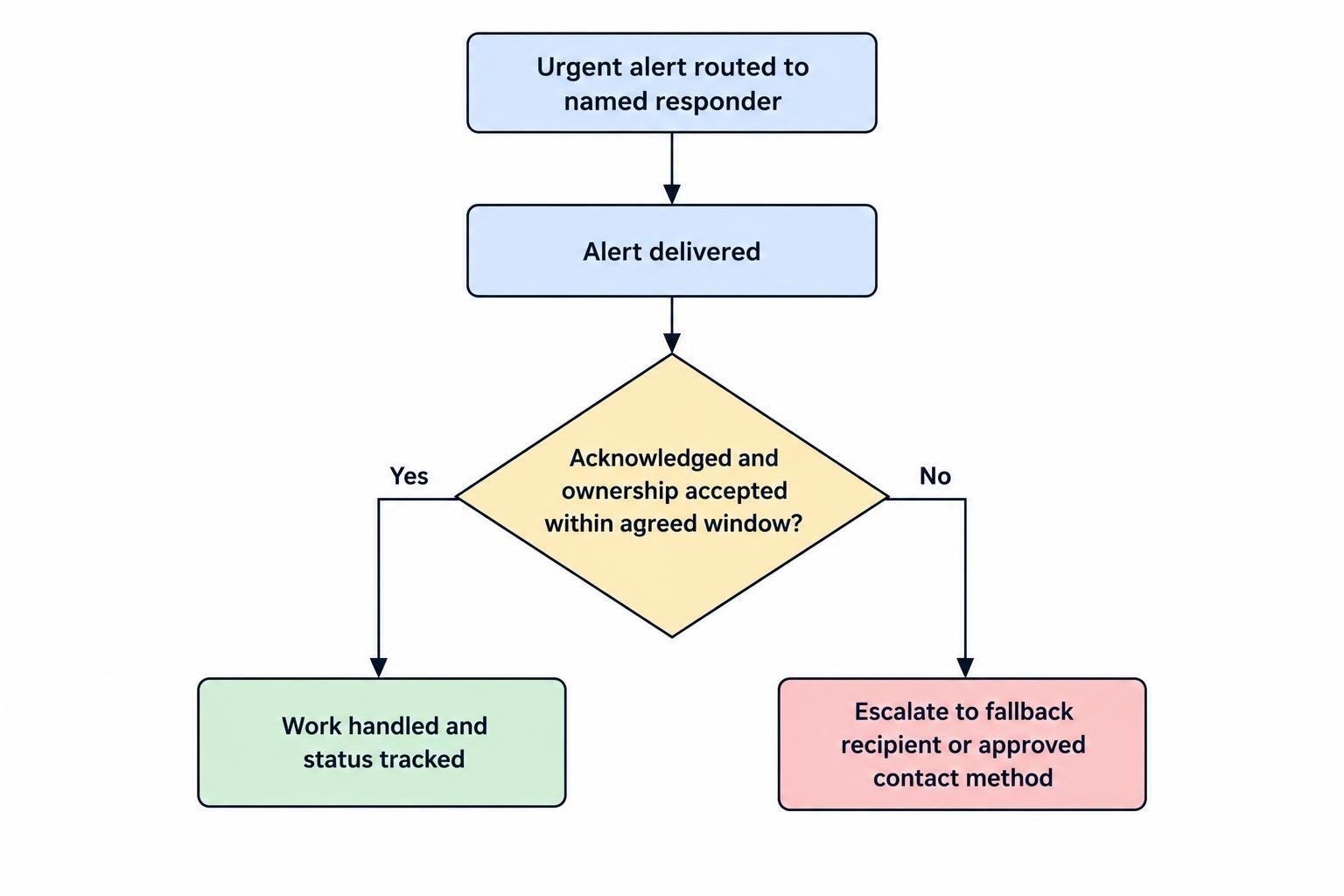
Give urgent alerts a response deadline and a fallback recipient. If nobody accepts ownership within the agreed window, escalate to the next person or approved contact method. Measure acceptance separately from delivery: a successful delivery notification does not demonstrate that somebody is handling the issue.
Group repeated alerts under one incident identifier where appropriate, but preserve access to the underlying events. Make it possible to distinguish ten reports of the same fault from ten separate faults. Review noisy rules instead of asking staff to develop heroic filtering skills.
Keep Business Communication Within Approved Channels
For FINRA member firms, whether a digital communication must be retained depends on its content, not the device or technology used. Before permitting business communication through a messaging app or chat service, firms must establish that they can retain the required records. FINRA Regulatory Notice 17-18 on digital communications sets out this distinction.
Translate the approved-channel policy into daily instructions. Tell staff which applications, account types and external connections they may use. Provide a procedure for handling business messages received through an unapproved route, including whom to notify and how to preserve the communication.
Do not treat encryption, searchable history, retention and supervision as interchangeable requirements. During selection, ask separate questions about each. Who can access content? What is captured? How can an authorized reviewer retrieve it? What happens if the archive connection stops working?
The consequences are not theoretical. On August 14, 2024, the SEC announced settlements with 26 firms involving electronic recordkeeping failures and combined civil penalties of $392.75 million. The conduct included unapproved communications involving supervisors and senior managers, as detailed in the SEC’s off-channel communications enforcement announcement.
This does not mean every trading team has the same obligations. Have compliance or legal staff determine which requirements apply to the entity, activity and jurisdiction. Detailed retention periods, archive arrangements and supervisory procedures belong in the team’s trading chat recordkeeping and compliance policy, rather than an assumed platform default.
Connect Chat to Trading Systems Carefully
Start integrations with read-only information and clearly assigned actions. Useful pilot candidates include an exception notification linking to an operations case, or an order-status update linking to the authoritative order record. Keep the transaction state in the system responsible for it.
Require each integration to identify its source, timestamp, relevant reference and service owner. Where delivery can be retried, test whether the recipient can recognize duplicates. Test delayed and out-of-order messages too, so an old update cannot be mistaken for a fresh instruction.
If chat-based approvals are proposed, define the permissions, confirmation steps and audit evidence before implementation. Do not let an informal phrase trigger execution simply because a bot can interpret it. The team should know precisely where discussion ends and an authorized action begins.
Use AI Summaries as Reviewable Drafts
If the platform offers AI summaries, begin with a narrow use case such as drafting an end-of-shift note. Require links back to the underlying conversation and a named reviewer. Test whether the summary preserves qualifications, corrections, unresolved questions and changes in ownership.
Do not allow a generated summary to replace the original record or become the sole authority for an actionable instruction. Evaluate the feature against deliberately awkward examples: conflicting messages, an instruction later withdrawn, or a question that never received an answer. A polished paragraph is not an acceptance test.
Test Handovers and Messaging Outages
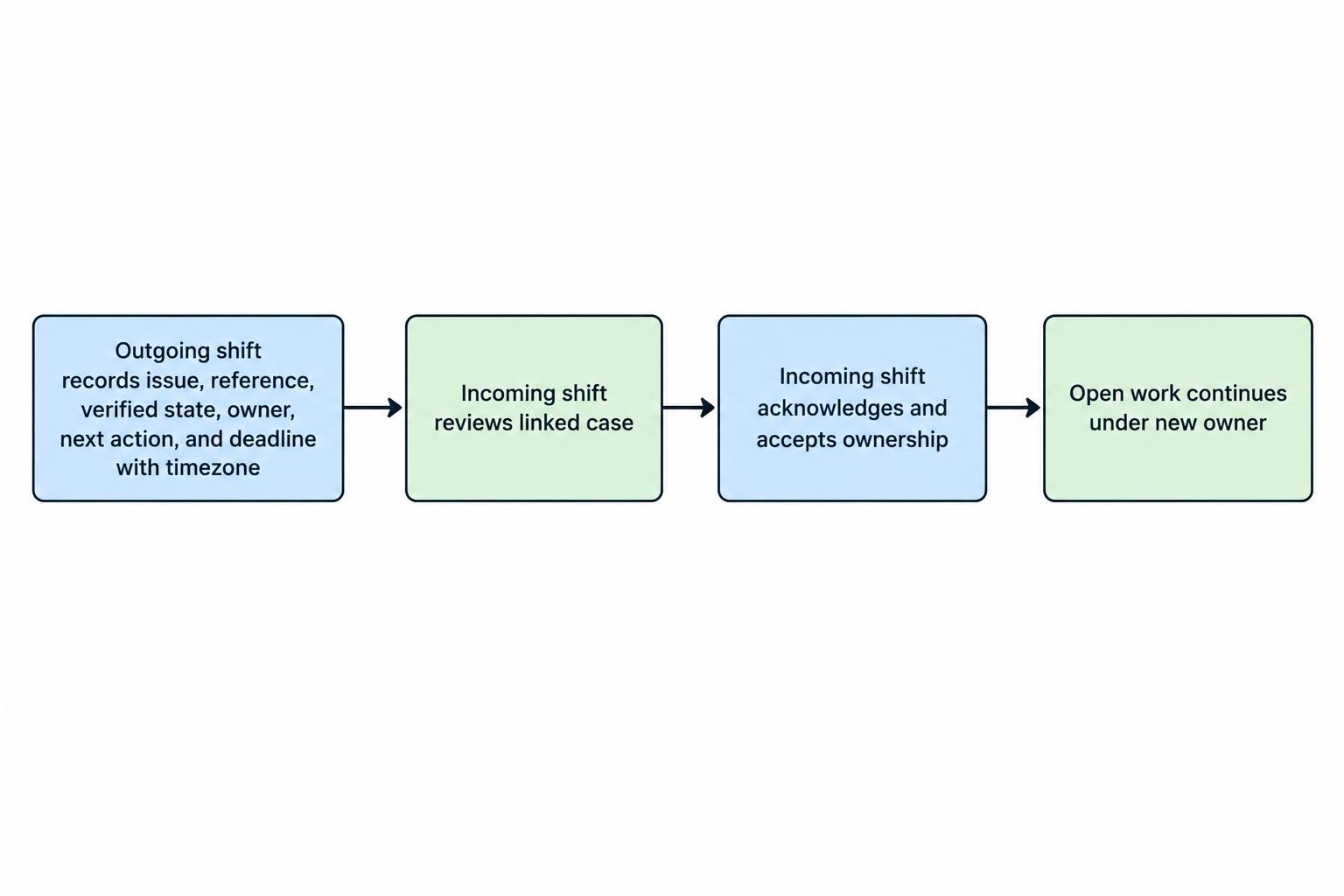
Use a consistent handover format: current issue, relevant reference, latest verified state, owner, next action and deadline. Require the receiving shift to accept open responsibilities. Include a timezone with deadlines, especially when teams work across regions.
Consider a hypothetical reconciliation issue that remains open at a shift change. The outgoing analyst should link the case, identify what has been checked and name the next step. The incoming analyst should acknowledge ownership in the agreed record. Neither should need to reconstruct the plan from fifty loosely connected replies.
Also rehearse losing the primary messaging service. Establish how staff reach the incident lead, where approved updates appear and which communication methods remain available. Keep this aligned with outage communication between brokers, exchanges and traders, rather than improvising a new group chat during the failure.
Choose Through a Controlled Pilot
Shortlist platforms only after defining the required workflows and controls. Then run a pilot involving trading, operations, risk, technology and compliance. Include an external participant if external messaging is part of the proposed deployment.
- Retrieve a conversation containing an edited message and an attachment.
- Remove a departing participant and verify access removal.
- Route an urgent issue through acknowledgment, escalation and closure.
- Interrupt an integration and reconcile messages after recovery.
- Complete a shift handover using only the agreed records.
Compare total operating cost, including licenses, archiving, supervision, integrations, administration and support. Ask for written confirmation of the features and service tiers required for your configuration; avoid pricing decisions based on an entry-level subscription that cannot support the intended controls.
Select the platform that passes these tests with the fewest awkward workarounds. A successful messaging setup makes the next action, its owner and its supporting record easy to find. More conversation is optional. Clear responsibility is not.