A trading kill switch is an emergency control that blocks further trading activity within a defined scope. Depending on its design, it may also cancel working orders. It does not necessarily close positions, remove every order, or stop activity across every connected account.
Those distinctions matter during an incident. Stopping a malfunctioning strategy is one task; confirming what remains at the broker or exchange is another. A useful emergency shutdown procedure covers both, then sets clear conditions for restarting. The objective is to stop uncontrolled activity without creating a second problem through rushed cancellations, duplicate orders, or an unplanned liquidation.
What a Trading Kill Switch Actually Does
A kill switch should have an explicit contract: which accounts, strategies, sessions, instruments, and destinations it controls, and what happens after activation. Avoid a vague “stop everything” label unless the system can demonstrate what “everything” includes.
The following actions should be treated separately, even when a platform combines them behind one button.
| Control | Intended action | What still needs checking |
|---|---|---|
| Pause strategy | Stop the strategy from generating new instructions. | Working orders, queued messages, and other order sources. |
| Block order entry | Reject new orders within the selected scope. | Whether replacements, manual orders, and alternate connections are covered. |
| Cancel working orders | Request removal of outstanding orders. | Cancellation confirmations, partial fills, rejected requests, and exclusions. |
| Flatten positions | Submit trades intended to reduce positions to zero. | Execution prices, remaining quantities, liquidity, and hedge relationships. |
A cancellation request is not a cancellation confirmation. Likewise, an order-entry block is not evidence that existing exposure has disappeared. Display these states separately rather than turning the screen green as soon as someone presses the button.
Emergency controls also complement, rather than replace, pre-trade checks for order limits and position exposure. Preventive controls reject unacceptable instructions before submission; the kill switch handles situations where continued activity itself has become unsafe.
Place Controls Beyond the Trading Strategy
Do not make the strategy solely responsible for shutting itself down. Design an independent order gate that can reject its instructions even if the strategy process freezes, restarts, or continues sending messages. Where available, add broker or venue controls with documented scope.
Use several shutdown levels. A strategy-level stop can isolate one faulty process. An account-level stop can contain a shared position error. A broader block may be appropriate when the order gateway or position service cannot be trusted. Choose the narrowest scope that safely contains the incident, with a clear route to escalate.
Venue controls have their own boundaries. The CME Globex Kill Switch documentation states that its control blocks new order entry and cancels eligible Day and Good Till orders, but excludes mass quotes and has cancellation restrictions during certain market states. Its stated order-blocking time and cancellation completion time also differ. Do not assume that activation means every affected order has already disappeared.
Make the shutdown state survive restarts
Store the shutdown state outside the strategy process and require an explicit reset. A process supervisor should not restart a failed bot directly into live order submission while an incident remains open.
On reconnection, hold trading until orders and positions have been reconciled. Queued instructions should not automatically replay simply because the network has recovered. A stale order can be perfectly formatted and still be the wrong trade.
Assign authority before an emergency
Identify who may activate each control, who takes over when that person is unavailable, and who may authorize recovery. Make activation quick for authorized operators; apply stronger review to re-enabling trading. An emergency stop that requires finding three people is not much of an emergency stop.
For US securities broker-dealers within its scope, SEC Rule 15c3-5 on market access risk controls requires documented financial and regulatory controls, generally under the broker-dealer’s direct and exclusive control, subject to stated exceptions. A customer-operated kill switch does not replace those obligations. This is a market-access rule, not a universal specification for every retail trading application.
Define Automatic Shutdown Triggers
Build triggers around observable failures and approved risk boundaries. For each trigger, document the measurement, threshold, shutdown scope, notification recipient, and reset condition. Avoid using “abnormal activity” as the whole specification; operators need to know what the system actually measured.
Candidate triggers include excessive order submission rates, repeated duplicate instructions, exposure above an approved ceiling, stale market data, and unresolved differences between internal and broker-reported positions. A missing execution feed may also justify blocking new exposure even when order entry still works.
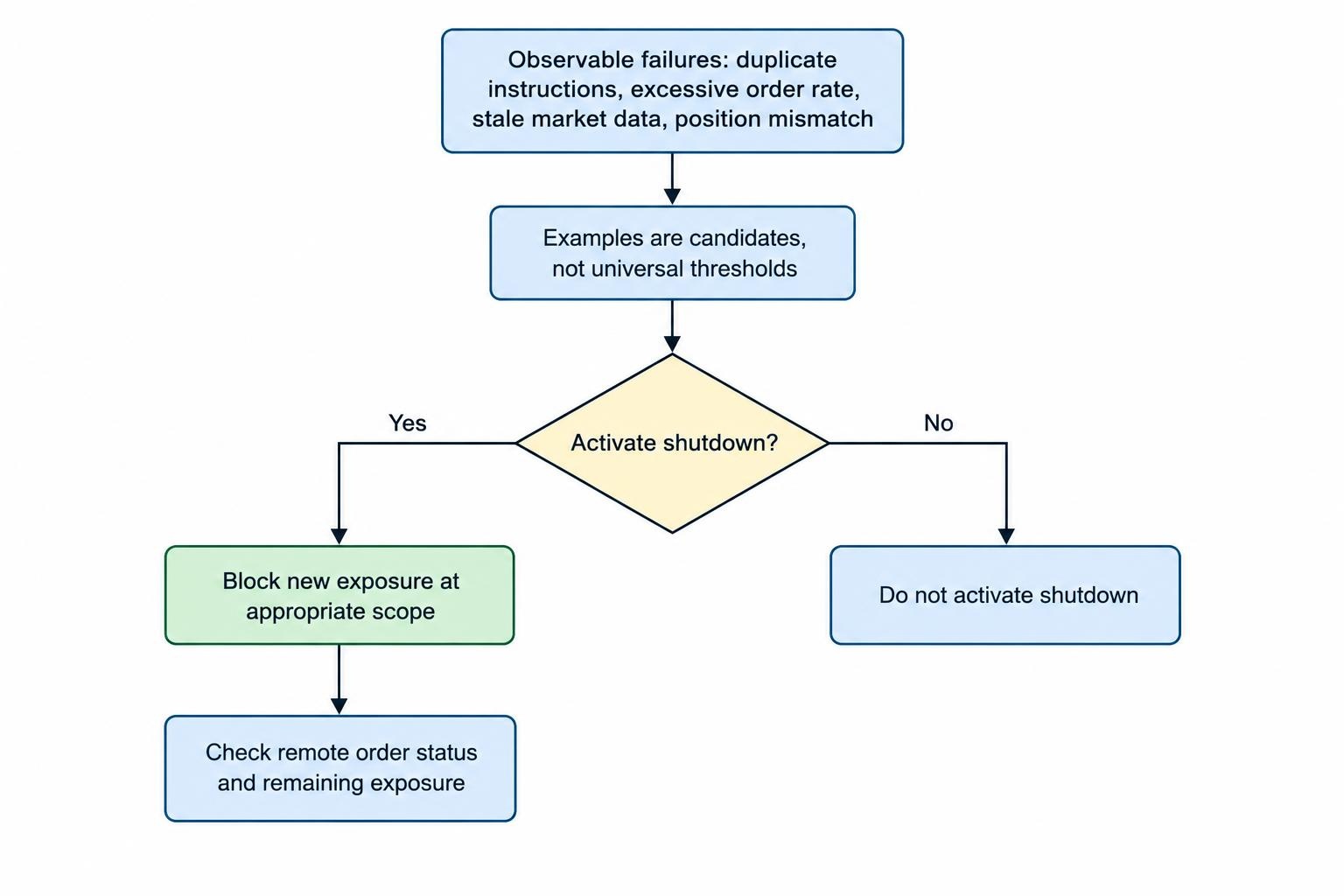
Use warning thresholds where intervention remains practical and hard shutdown thresholds where continued submission is unacceptable. A daily loss threshold needs an agreed calculation covering realized losses, open-position valuation, fees, currency conversion, and the reset boundary. Otherwise, two screens can disagree about whether the threshold has been crossed.
There is no universal safe timeout or loss percentage. Set values against the strategy’s behavior, instrument liquidity, account exposure, and operating constraints. For the monitoring layer that feeds these decisions, see monitoring trading bots and detecting strategy failures.
Treat missing information as a separate risk
Distinguish a healthy system reporting no activity from a system that has stopped reporting. Track data freshness, connection health, and reconciliation status separately from trading performance.
When state is uncertain, block new exposure while preserving tested routes for cancellation and supervised risk reduction where supported. Do not assume every venue permits those messages after a kill switch is active; record the permitted emergency actions for each connection.
Why Disconnecting Is Not a Shutdown Procedure
Closing the trading application or disconnecting a network cable does not, by itself, prove that remote orders have been removed. Cancel-on-disconnect functionality must be verified for the actual session, configuration, and order types involved.
The CME cancel-on-disconnect configuration documentation describes cancellation of non-GTC and non-GTD orders following an ungraceful disconnect. Good Till Cancel and Good Till Date orders are excluded from that described behavior. Treat disconnect protection as a documented backstop, not a substitute for checking outstanding orders.
Before trading, establish where stop orders and contingent orders are held. Also document what happens to protective orders during a mass cancellation. Removing an entry order and removing the only protective exit are not equivalent decisions. Any procedure that cancels both must account for the position left behind.
A Practical Emergency Shutdown Procedure
Keep a short operational runbook accessible outside the affected trading platform. It should identify account and session details, authorized contacts, backup access methods, and escalation routes. The sequence below is a framework to adapt and test, not a promise that every platform supports each action.
-
Activate the appropriate block. Stop new order generation and enforce the independent order-entry block. Record the trigger, activation time, and affected scope. Disable automatic retries and restarts that could resume submission.
-
Remove eligible working orders. Use the documented cancellation route for the affected scope. Include relevant child orders and quotes where supported. Record exclusions and rejected requests rather than assuming one mass-cancel instruction covers every destination.
-
Verify remote state. Obtain broker or venue confirmations and reconcile orders submitted around activation. Track partial fills, pending cancellations, and unconfirmed instructions. If the primary interface is unreliable, use a prearranged independent channel.
-
Assess remaining exposure. Establish positions from confirmed executions and account records. Review linked positions together. Decide whether to hold, hedge, or flatten through an approved process; do not send an improvised liquidation through the same faulty component.
-
Escalate unresolved uncertainty. Contact the broker, clearing firm, or venue support route when order status cannot be established. Provide account identifiers, affected instruments, order references, timestamps, and actions already attempted.
-
Preserve evidence and maintain the block. Save logs, execution reports, configuration versions, alerts, and operator actions. Mark unresolved items clearly. Keep trading disabled until recovery conditions are met and the designated person authorizes restart.
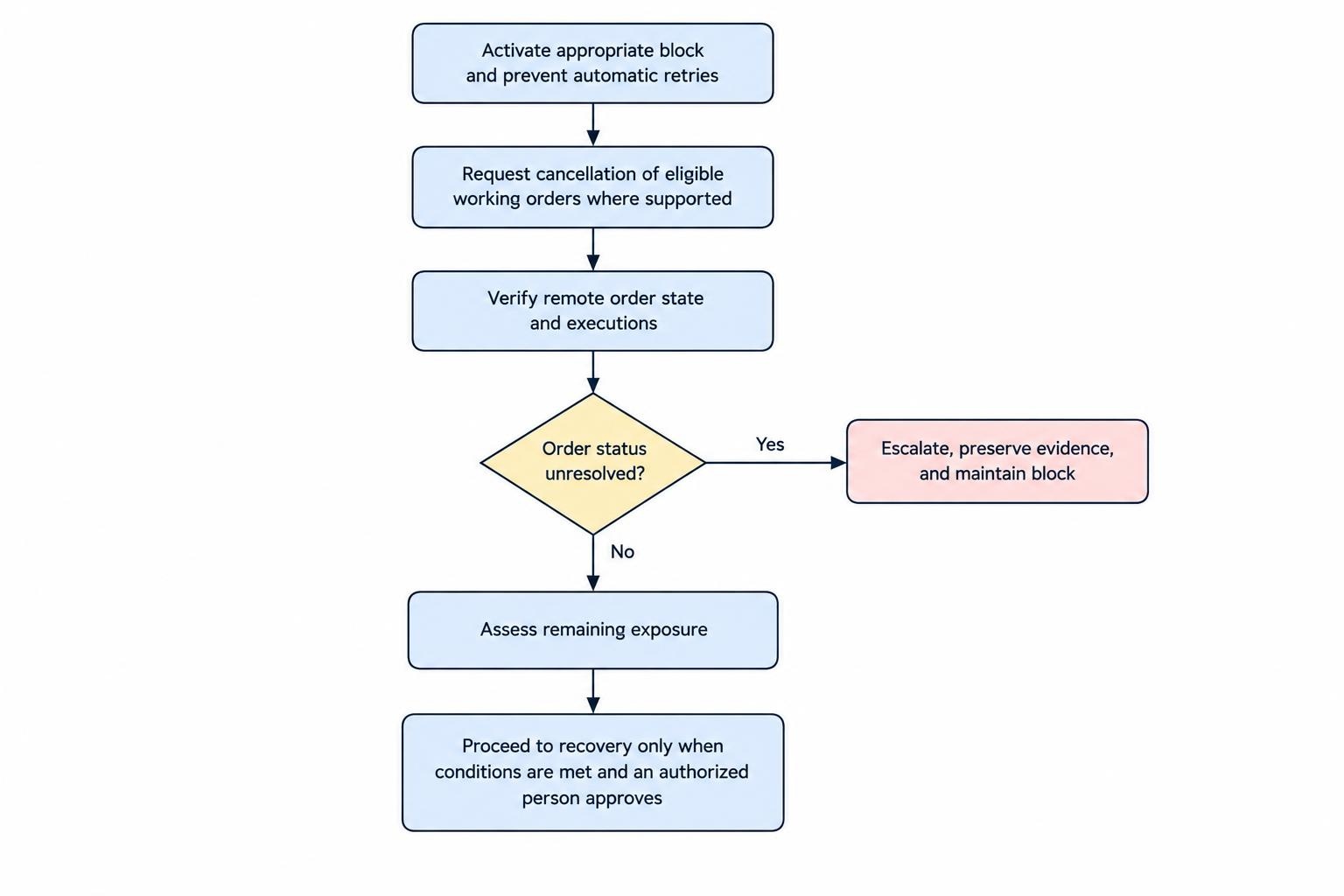
Use precise status messages throughout. “Shutdown activated; order verification pending” is more useful than “all safe.” Separate confirmed facts from assumptions, especially when several people are working on the incident.
Where the shutdown involves a wider service failure, coordinate the response with the procedures for trading platform backups, failover, and recovery. Moving to a backup system should not bypass an active trading block.
Example: An Order Acknowledgment Arrives Late
Consider a hypothetical strategy that submits an order to buy 100 shares. Its acknowledgment is delayed. The strategy incorrectly interprets the delay as rejection and submits another 100-share order. Both reach the broker.
An independent duplicate-order check or submission-rate trigger could block further instructions. The shutdown process would then request cancellation of outstanding orders and establish which quantities actually filled. Stopping the strategy alone would leave that work unfinished.
Suppose the first order filled completely and 40 shares of the second order filled before its remaining quantity was canceled. The resulting position is 140 shares. The cancellation confirmation concerns the unfilled remainder; it does not reverse those 40 executed shares.
Now suppose an operator sends a sell order for 200 shares based on the submitted buy quantities rather than confirmed fills. If that sell order fills completely, the account becomes short 60 shares. The attempted cleanup has created a new position.
The lesson is procedural: reconcile executions before sizing corrective trades. When execution status remains uncertain, escalate that uncertainty rather than replacing it with a confident guess.
Test the Failure Path, Not Just the Button
A successful button click proves little unless the intended block took effect and remote order state was checked. Measure the sequence from detection through activation, order rejection, cancellation processing, and reconciliation. Report unresolved orders separately from completed cancellations.
FINRA Regulatory Notice 15-09 on algorithmic trading controls identifies mechanisms for quickly disabling an algorithm or supporting platform with few steps as a suggested effective practice. It also addresses testing, monitoring, and reconciliation. Treat those as connected activities rather than testing the interface in isolation.
In an isolated test environment, exercise delayed acknowledgments, partial fills during cancellation, rejected cancellation requests, lost execution messages, and a strategy process that restarts while blocked. Include a failure of the monitoring service itself. Verify that unrelated accounts remain unaffected when a narrow shutdown is intended.
For each exercise, record the expected result, observed result, remaining uncertainty, and remediation owner. Simulation cannot establish every detail of production behavior. Confirm broker and venue semantics separately, and perform any production validation only through an approved, tightly controlled process.
Restart Trading Through a Separate Approval Process
Recovery should require evidence, not simply the absence of fresh alerts. Reconcile working orders and positions, identify the fault or isolate the affected component, verify configuration, and confirm that market data and execution reporting are reliable.
Reject stale queued instructions before release. Restore one controlled scope at a time, using reduced size or submission rates where appropriate, and observe the results before expanding activity. Keep the emergency control available throughout recovery.
Resetting the shutdown must not reset its history. Preserve the trigger, action timeline, authorization, and any changes made afterward. Review whether the incident exposed a gap in prevention, detection, cancellation, reconciliation, or escalation.
A dependable trading kill switch is a tested chain of actions: block further activity, verify outstanding orders, establish exposure, and restart under control. The button is the easy part. Knowing what happened after pressing it is the real protection.