To verify financial news, trace the claim to its original evidence, check when it was published, confirm what the figures actually measure, and look for independent reporting. A familiar publisher or convincing screenshot is not enough. The question is whether the evidence supports the exact claim you are being asked to believe.
For long term investors, verification should come before changing forecasts or reviewing a holding. A genuine announcement can still be old, incomplete or presented without the conditions that make it useful. Your task is to separate three things: what happened, what someone thinks it means, and what remains unknown.
This process supports using financial news for long term investing without treating every alert as a reason to act. Start with the claim, not the excitement around it.
Identify the Claim Before Judging the Source
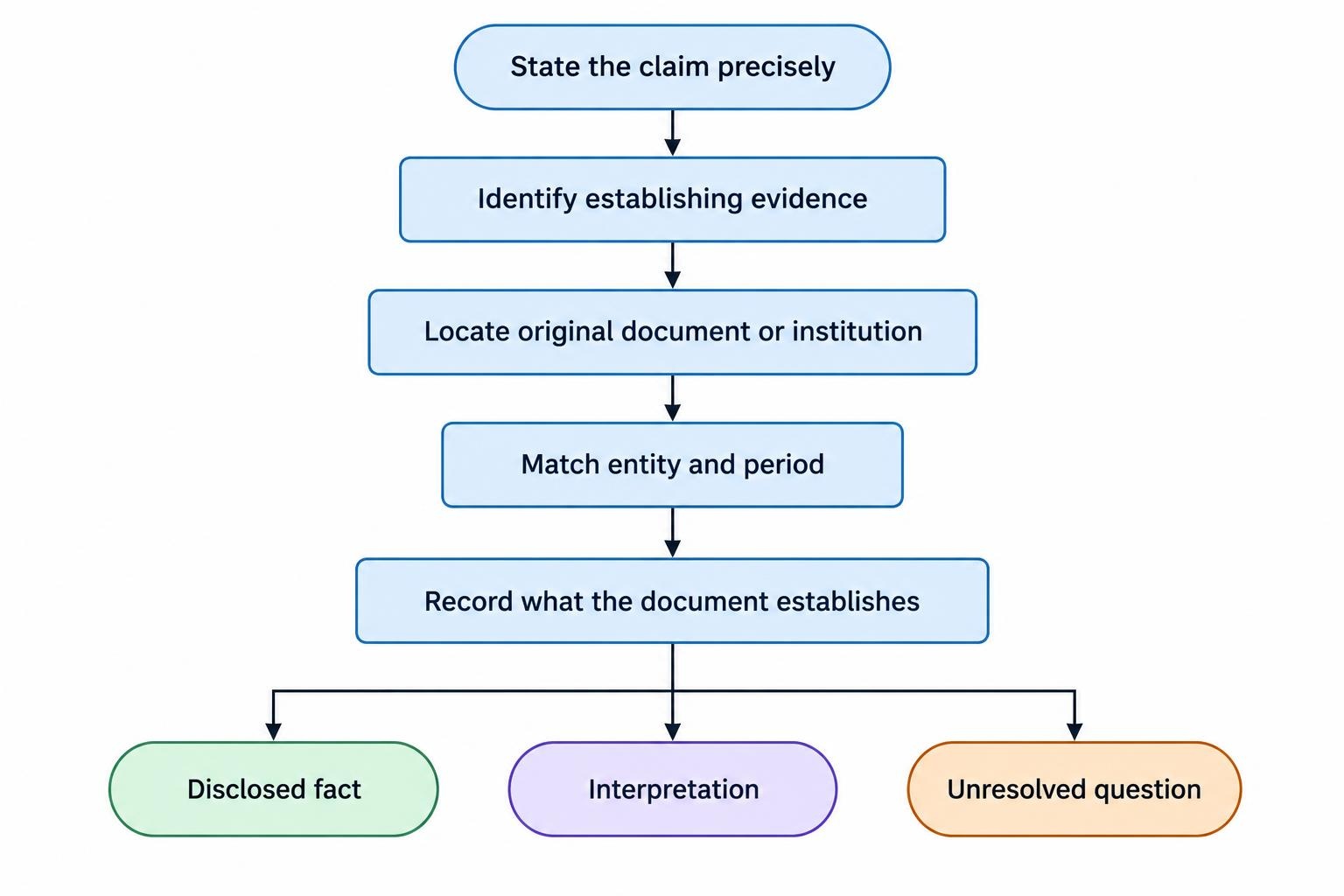
Write the central claim in one plain sentence. “The company reduced its annual revenue forecast” is testable. “Management has lost control” is an interpretation. “The shares are about to collapse” is a prediction. These statements require different evidence, even when they appear in the same article.
Keep the wording precise. Has a company signed a contract, entered negotiations, or announced that it expects to sign one? Has a regulator proposed a restriction or adopted it? Does a report describe an allegation, a formal finding, or a settlement? Do not allow a headline to flatten those distinctions.
Next, identify what would establish the claim. A management forecast needs the company’s announcement. An interest rate decision needs the central bank’s policy release. An allegation about a business may require court documents, named witnesses or independently obtained records. This gives the verification process a destination rather than another browser tab.
Find the Original Document
For U.S. reporting companies, use the SEC’s guide to researching investments through EDGAR to locate public filings. Annual reports appear on Form 10-K, quarterly reports on Form 10-Q, and current reports on Form 8-K. EDGAR also identifies amendments with “/A” after the form type. Match the company, reporting period and document date before reading further.
For other claims, go directly to the institution responsible for the announcement. Use a company’s investor relations section for its release, a statistical agency for economic data, or the relevant regulator for an enforcement announcement. Reach the institution through an independently located address, rather than relying entirely on a link supplied in a suspicious message.
| News claim | Evidence to check | Detail to confirm |
|---|---|---|
| A company changed its outlook | Official earnings release and accompanying materials | Previous forecast, new forecast and applicable period |
| A central bank changed policy | Official policy statement | Decision, effective date and conditions |
| Economic growth accelerated | Statistical release and methodology notes | Comparison period, adjustments and revisions |
| A regulator took action | Official order, complaint or announcement | Allegations versus findings and current status |
| A takeover was announced | Transaction announcement and agreement, where available | Offer terms, approvals and closing conditions |
Primary evidence establishes what the issuer or institution disclosed. It does not settle every question about accuracy, motives or future outcomes. Read it alongside independent scrutiny, not instead of it.
Check Dates, Versions and Missing Context
Record three dates where relevant: when the event happened, when the underlying document was released, and when the article was published or updated. A newly shared article is not necessarily new information. Treat “today” and “yesterday” as prompts to find an absolute date.
Suppose a post shared on October 19, 2026 links to a company announcement dated October 19, 2023. The matching day and month do not make the announcement current. Check the year, the reporting period and any later updates before adding it to your research.
Read beyond the first version. Look for correction notices, replacement documents and later statements that change the original account. If an article says it has been updated, identify what changed. A revised headline may leave the earlier, more dramatic wording circulating in screenshots.
Keep publication timing separate from economic timing too. A report published in October may describe activity during September or an earlier quarter. Use the period covered by the data in your notes, not just the date above the headline.
Verify the Numbers, Not Just the Headline
For every important figure, check the unit, currency, reporting period and comparison basis. Revenue growth over the previous quarter is not the same comparison as growth over the previous year. A rise from 4% to 5% is one percentage point, or a 25% relative increase. Both calculations can be correct while telling a different story.
Check whether an earnings headline uses GAAP results or an adjusted measure. The SEC’s non-GAAP financial measures guidance addresses reconciliations and potentially misleading presentations. For your own review, read the reconciliation between the adjusted result and the comparable GAAP figure. Identify the expenses or gains removed before accepting a claim about improving profitability.
Consider a hypothetical company reporting a 30% increase in adjusted earnings while GAAP earnings decline. Do not select whichever number supports your existing opinion. Examine the adjustments, compare their treatment with earlier periods, and ask whether the excluded costs matter to your assessment of the business.
Apply the same care to an “earnings beat.” Check whose forecast supplied the comparison, when it was collected, and whether the forecast and actual result use the same accounting basis. Without that match, the word “beat” tells you less than it appears to.
Keep the verified result separate from your investment judgment. The next step belongs in a review of earnings announcements and long-term investment theses, rather than in the source check itself. A number can be accurately reported without making a share attractive at its current price.
Allow for revised economic data
When checking economic news, identify which version of the estimate the article used. For U.S. payroll data, the BLS technical notes on employment estimates state that preliminary estimates are revised in each of the following two months as more survey responses arrive. Compare an older article with the release available at that time, not only with a later revised figure.
For current research, use the appropriate updated release and note any revision that affects your interpretation. For a review of past decisions, preserve the original estimate as well. Otherwise, you risk judging an earlier decision using information that was not yet available.
Test Whether Reports Are Truly Independent
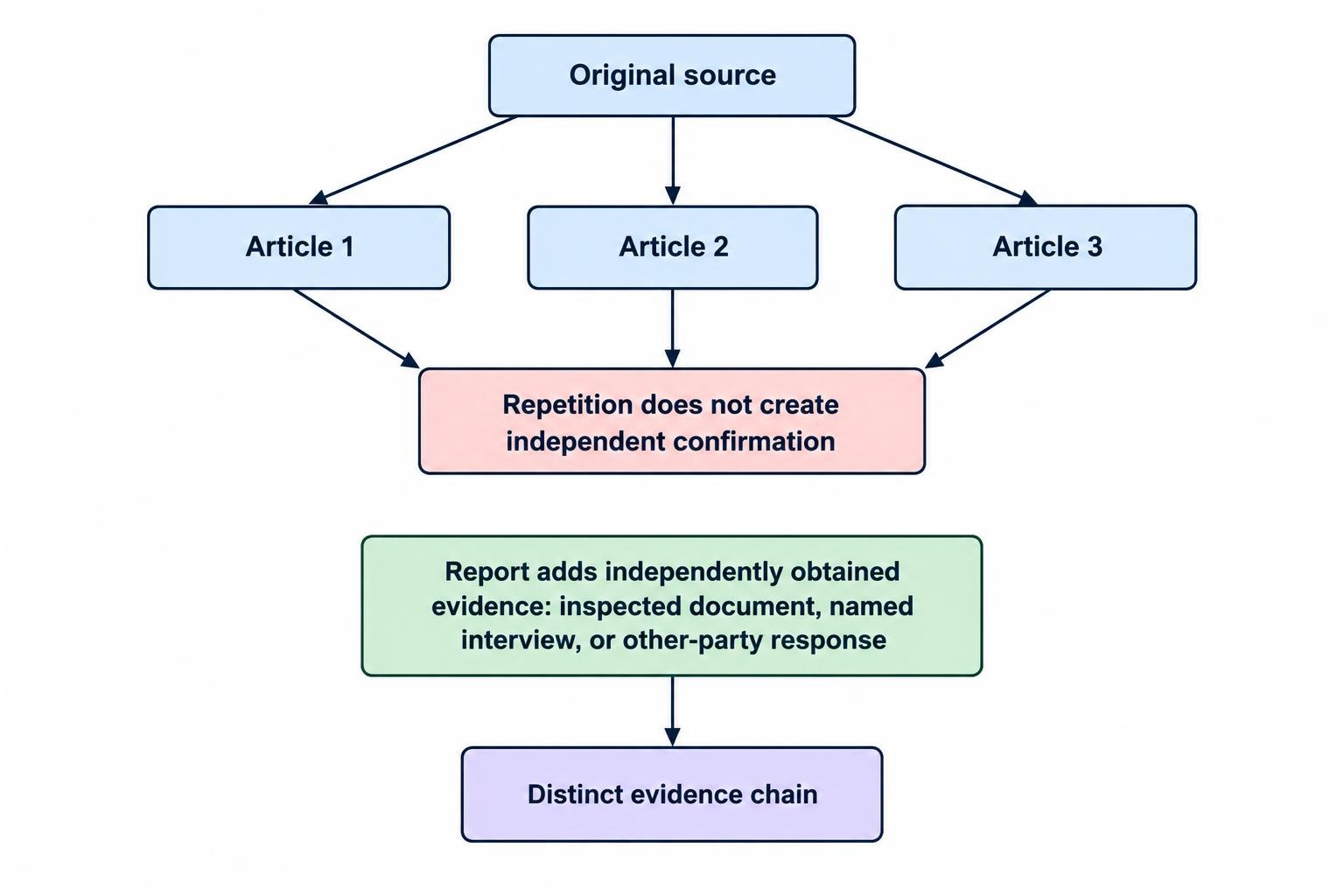
Three articles do not necessarily provide three confirmations. Inspect their sourcing. If each relies on the same anonymous post, press release or wire report, you have found one evidence chain repeated three times.
Look for reporting that adds something independently obtained: a named interview, an inspected document, a response from another party, or a separately verified observation. Different wording is not independent evidence. A fresh headline does not create a fresh source.
Anonymous sourcing requires judgment rather than automatic acceptance or rejection. Check whether the publication describes how the source knows the information, explains the reason for anonymity, and distinguishes the source’s account from established facts. Treat an unconfirmed report as unconfirmed, even when it comes from a publication you normally trust.
If a paywall prevents you from inspecting the reporting, do not treat a search snippet as a substitute. Find accessible supporting evidence or leave the claim unresolved. Guessing what the missing paragraphs probably say is not verification.
Check Identity, Incentives and Promotion
Inspect who published the claim and what they disclose. Look for an identifiable author, relevant reporting history, ownership information, correction procedures and sponsorship labels. These are useful checks, not guarantees. Evaluate the evidence in the article even when the publisher passes them.
For stock recommendations, examine financial incentives as well as identity. The SEC investor alert on social media stock tip scams warns about impersonation, misleading promotions and manipulation. If someone claims to represent an investment firm, verify that relationship through independently obtained contact details. Finding a real professional with the same name does not authenticate the person messaging you.
Read position and compensation disclosures. Ask whether the writer holds the security, has received payment, sells access to recommendations, or benefits from attracting subscribers. A disclosed interest does not automatically invalidate the research. It tells you where to apply more scrutiny.
Treat urgency as a reason to slow down. “Buy before the announcement” is a sales instruction, not evidence. Requests to move into a private group, send money or share account credentials should stop the research process from turning into a transaction.
Handle Screenshots, Videos and AI Summaries Carefully
Use screenshots as pointers to evidence, not as the evidence itself. Locate the original page or document and compare its wording, date and surrounding paragraphs. If the original cannot be found, record that gap. A logo and a tidy chart do not authenticate a claim.
For a quoted interview or speech, find the full recording or official transcript where available. Check what question preceded the answer and whether the speaker was discussing a current decision, a hypothetical situation or an earlier event. Do not infer authenticity from appearance or voice alone; verify through the original publishing channel.
AI output needs the same treatment. Generative systems can produce confident but false statements, a risk covered in the NIST generative AI risk profile. Require a traceable document for each material claim, then open it and inspect the relevant passage. A convincing citation is not useful if the document does not support the sentence.
You can ask an AI tool to organize documents, flag inconsistencies or extract figures for checking. Keep the verification standard unchanged. Check whether each figure matches the original table, whether uncertainty survived the summary, and whether a forecast was accidentally rewritten as an accomplished fact.
For a fuller review process, use the checklist for checking AI summaries for errors and unsupported claims. Repeating the question to another model may produce another answer, but it does not replace checking the underlying evidence.
Keep a Short Verification Record
A compact research note makes later review easier. Record the claim, original document address, publication time, relevant passage or table, and any unresolved question. Save enough context to explain why you accepted or rejected the claim without having to reconstruct your browser history.
Use a small set of status labels consistently:
- Verified: Original evidence supports the claim as written.
- Partly verified: The event is supported, but a figure, condition or interpretation remains unresolved.
- Unconfirmed: The available reporting does not establish the claim.
- Contradicted: Reliable evidence conflicts with the claim.
- Outdated: The information concerns an earlier period or has been superseded.
Before changing a portfolio assumption, write down what the verified information changes: expected revenue, financing needs, cash generation, or another factor in your thesis. If you cannot explain that connection, keep the item as research rather than turning it into an action.
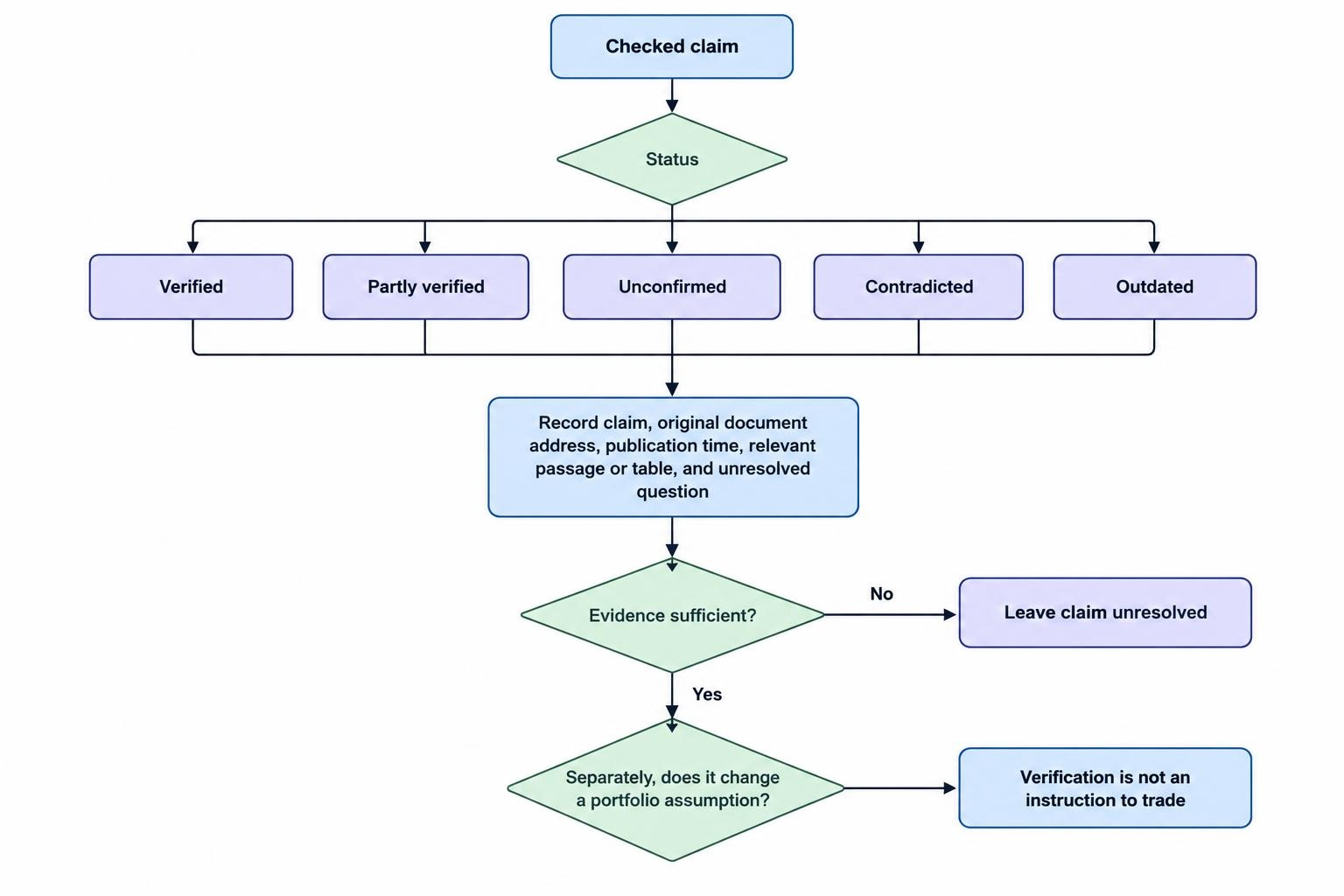
For repeated monitoring, build this record into news alerts around your investment watchlist. The stopping rule is straightforward: when the evidence remains incomplete, leave the claim unresolved. You do not need to solve every rumor. You do need to avoid treating one as an established fact.