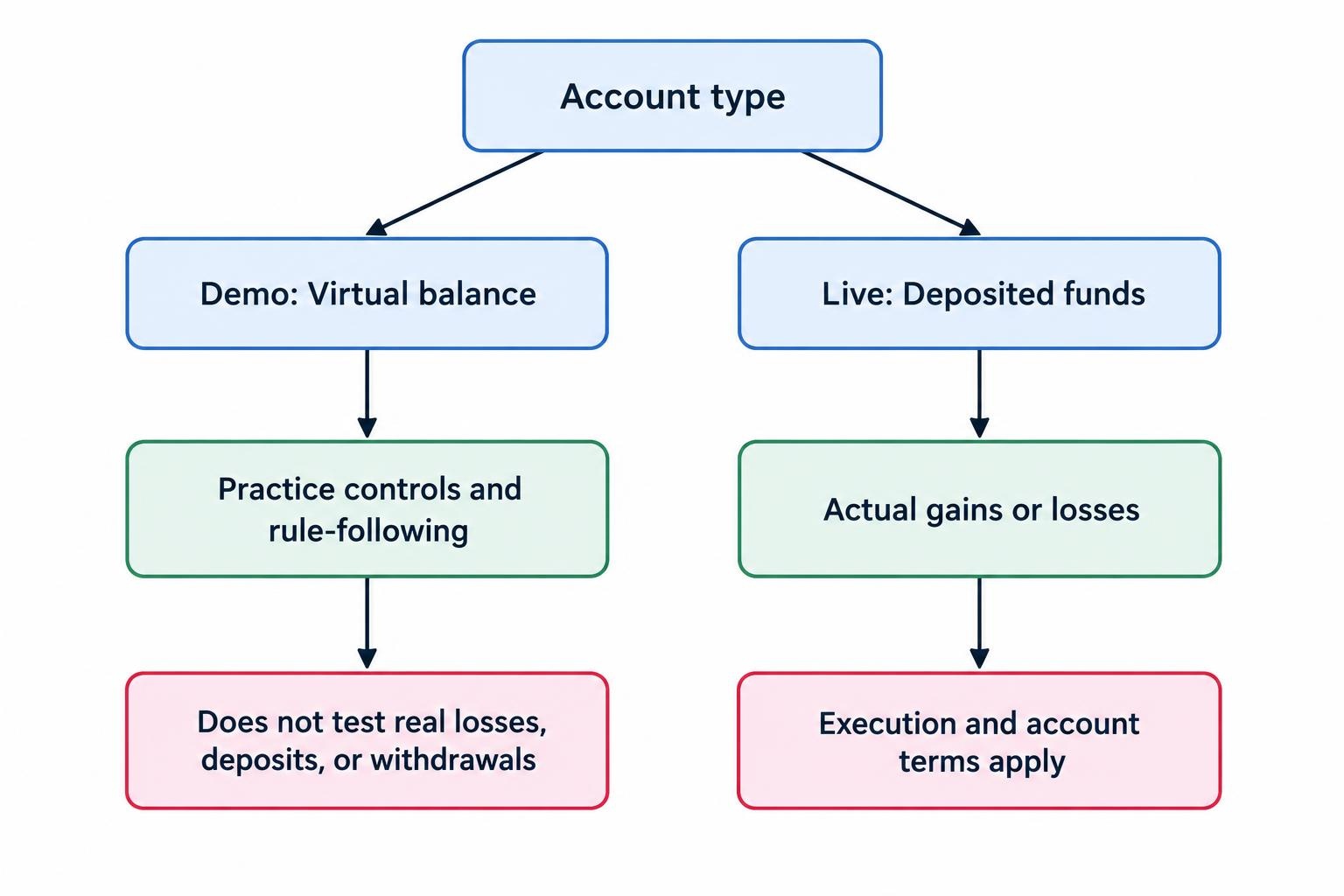
A binary options demo account lets you practice with a simulated balance rather than deposited money. A live account puts actual funds at risk. The screens may look alike, but the accounts answer different questions: a demo can show whether you understand the controls and can follow a trading plan; it cannot establish that you will earn money, receive the same execution, or withdraw funds successfully.
The useful comparison is not simply “virtual money versus real money.” It is whether the practice environment reproduces the contract terms, costs, timing, and restrictions that would apply to a live trade. Even a close match leaves one gap: simulated losses do not cost you anything.
This guide focuses on assessing demo results and recognizing what they leave untested. Moving to live trading is optional, not a graduation requirement.
Binary Options Demo Accounts and Live Accounts Compared
In a demo account, the balance and trading results are simulated. In a live account, accepted trades create actual financial exposure under the contract’s rules. Neither a working demo nor an attractive account dashboard establishes that a provider is authorized to serve you.
| Area | Demo account | Live account |
|---|---|---|
| Account balance | Virtual funds used for practice | Deposited funds and actual gains or losses |
| Trade acceptance | Depends on the simulator’s assumptions | Depends on the venue’s rules, available prices, and order acceptance |
| Payouts and costs | Must be checked against live contract terms | Determined by the accepted contract and applicable fees |
| Response to losses | Can test rule following without financial loss | Tests decisions while actual money is at risk |
| Deposits and withdrawals | Does not test either process | Subject to account terms, verification, and processing arrangements |
| Evidence of profitability | A hypothetical record, not a live result | An actual result, but not a promise of future performance |
Check availability before assessing either account. For U.S. readers, commodity binary options offered through unregistered offshore platforms are not interchangeable with contracts available on registered U.S. exchanges. The CFTC’s binary options fraud guidance distinguishes registered exchange trading from unregistered platforms and describes the risks of the latter. Access to a demo does not establish permission to trade live.
What a Demo Account Can Help You Learn
A demo is useful for learning the order process without paying for every mistake. You can practice selecting a contract, checking the expiry, entering an order amount, reviewing the confirmation, and finding the settlement record.
Use it to answer practical questions. Can you distinguish the chart’s displayed price from the price used to determine settlement? Do you know whether the contract requires a price to finish above a threshold, at or above it, or within a stated range? Can you identify the last time an order may be submitted?
Those details matter more than clicking the correct direction button. A broadly correct market view can still produce a losing contract if the threshold or expiry is wrong. The guide to binary options pricing, expiry, and settlement covers those contract mechanics separately.
A demo also provides a setting for rehearsing a written process. Record why a trade qualifies before entering it, then compare the decision with your rules afterward. The objective is to find mistakes you can identify and correct, not to produce an impressive screenshot.
Why Demo Performance Does Not Prove Live Readiness
Financial pressure is missing
Following a plan after five simulated losses is not the same test as following it after five losses of deposited money. A live loss may prompt hesitation, a larger recovery trade, or an entry that does not meet the original rules.
Hypothetical trading cannot fully represent the effect of financial risk, including a trader’s ability to withstand losses and keep following a program. These constraints are addressed in the NFA’s notice on hypothetical performance results. A profitable demo record should therefore remain labeled as simulated performance, not treated as an income forecast.
You can make practice more disciplined by keeping a realistic balance and refusing to reset it after losses. That improves the exercise, but does not make it equivalent to live trading. A reset button is not a risk control.
The simulator may not reproduce every live condition
Do not assume that demo order acceptance, quoted returns, available contracts, or early exit features match the live account. Compare the published terms and ask what the simulator models. Where the documentation does not answer a question, mark that part of the test as unverified.
On an order book, immediate simulated execution would not establish that an actual order could trade at the displayed price and size. For a fixed stake contract, check whether the live account offers the same net winning return at the moment of entry. These are different execution models and should not be assessed as though they were identical.
Execution uncertainty is also separate from fraud. Complaints documented in the SEC and CFTC investor alert on binary options fraud include withheld customer funds, identity theft, and software manipulation. A successful demo session cannot rule out any of those problems.
Compare Net Results, Not Just Win Rates
A win rate means little without the amount earned on a win, the amount lost on a loss, and any charges. Use the actual contract structure rather than a headline payout percentage.
Consider a hypothetical fixed stake contract. You risk $10, receive the $10 stake back plus $8 profit when correct, and lose $10 when incorrect. With no fees, refunds, or ties, the break even win rate is:
$10 ÷ ($10 + $8) = 55.56%
If 100 trades produce 55 wins and 45 losses, winning trades earn $440 while losing trades cost $450. The net result is a $10 loss. More wins than losses, but still less money.
If the net winning profit falls from $8 to $7, the break even rate rises to 58.82%, under the same assumptions. A demo strategy assessed at one payout cannot simply be carried across to a lower payout without recalculation. The separate guide to calculating binary options break even win rates covers the arithmetic in more detail.
Do not apply that fixed stake example unchanged to an exchange contract bought at a market price. For a hypothetical contract purchased for $60 that settles at either $100 or zero, holding to settlement produces a $40 profit or a $60 loss before fees. Its break even probability is 60% before charges.
In both cases, log net profit and loss. Also distinguish the total amount returned from profit alone; counting returned capital as earnings makes a record look better without improving it.
How to Run a More Useful Demo Test
Set the conditions before starting
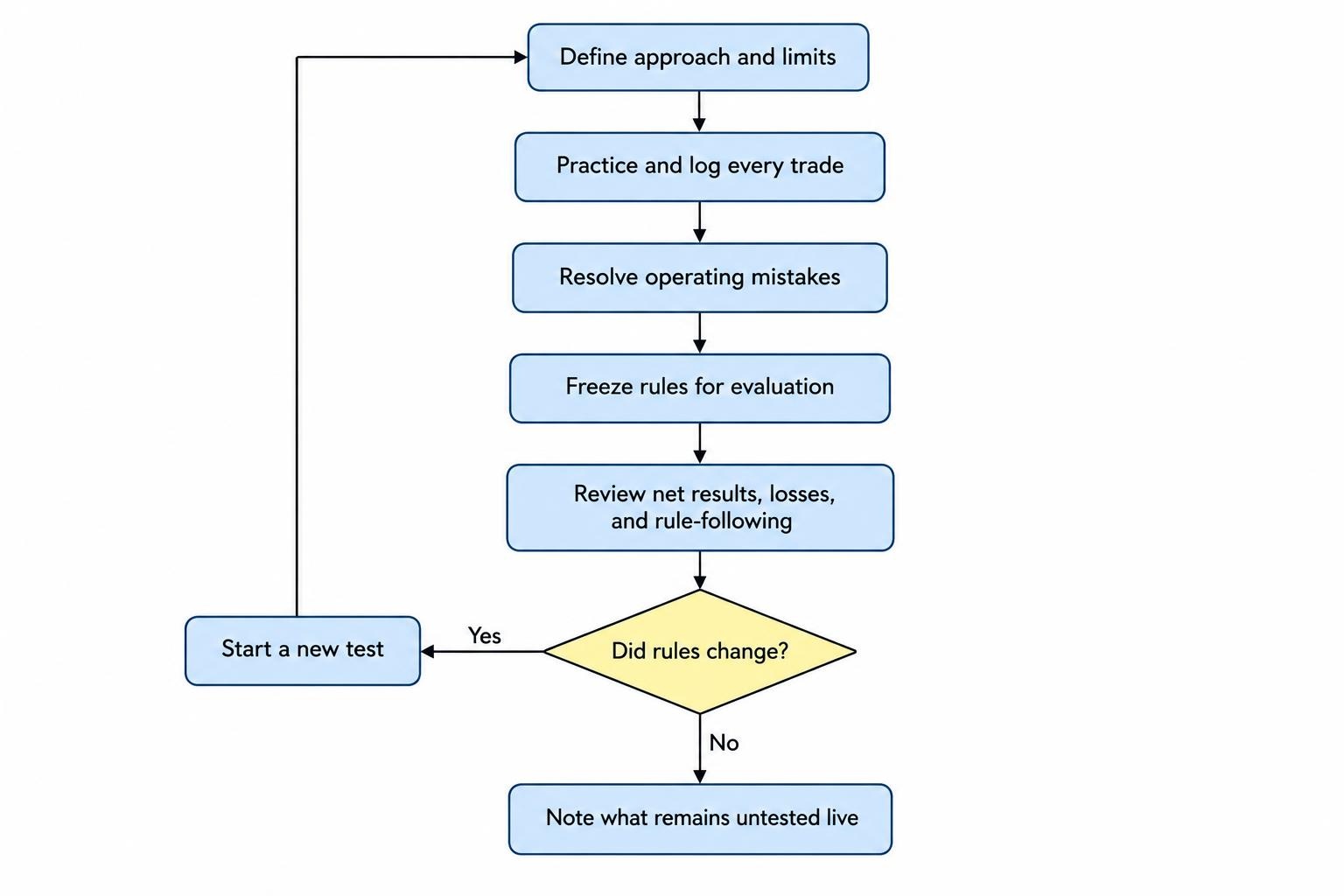
Choose one clearly defined approach rather than changing direction after each result. Write down the eligible contracts, trading hours, entry conditions, expiry selection, order size, and reasons to skip a trade.
Use a virtual balance that reflects the amount you could genuinely afford to lose, if you ever considered live trading. Practicing with $100,000 while planning around $200 produces a poor comparison, especially if minimum order sizes would consume a much larger share of the smaller balance.
Set a session loss boundary and a maximum number of open positions. Treat related trades as connected exposure: several contracts based on the same price move are not independent simply because they have separate order numbers.
Keep a complete record
Record the contract, direction, threshold, expiry, order time, accepted terms, amount at risk, fees, settlement outcome, and net result. Add whether the entry complied with the plan and whether a technical problem occurred.
Preserve losing sessions. If you reset the demo balance, retain the earlier record and mark the reset. Otherwise, the account history becomes a collection of survivors rather than a complete test.
The methods used in trading journals and performance tracking can help separate a profitable outcome from a well executed decision. A rule breaking win is still a rule breaking trade; a valid losing trade does not automatically mean the process failed.
Separate changes from evaluation
Use an initial practice period to resolve operating mistakes and refine the rules. Then freeze those rules for a separate evaluation period. If you change the entry conditions halfway through, treat the revised approach as a new test.
There is no universal number of demo trades that proves readiness. A short winning run can occur by chance, while many trades taken during one narrow market condition may tell you little about other conditions. Review results across separate sessions and avoid treating closely related trades as independent evidence.
Evaluate the size of losses, the longest losing run, rule violations, and dependence on a handful of unusually profitable sessions. Ask whether the result would survive lower returns, higher costs, or missed entries. These checks challenge the record; they do not guarantee future profits.
What Must Be Checked Outside the Demo
A simulator cannot verify the legal entity holding customer funds, the firm’s permissions, withdrawal conditions, or the protections attached to an account. Those require separate checks before any deposit.
Match the legal name, domain, and contact details against official records. Check what the registration actually permits, not just whether a company name appears somewhere. The CFTC’s registration and background checking guidance provides a starting point for U.S. derivatives firms and professionals. Registration is not a guarantee against losses or misconduct.
Read deposit and withdrawal terms before accepting a bonus or transferring funds. Establish whether an incentive carries trading requirements, what charges apply, and which entity handles a dispute. Do not deposit simply to find out whether an unclear withdrawal policy works.
Pressure to fund an account because the demo performed well is not evidence that the service is suitable. Neither is an account representative’s willingness to help. The relevant test is whether permissions and terms can be independently checked and understood.
Should You Move From Demo to Live Trading?
No demo result creates an obligation to open a live account. Remaining in simulation, choosing another product, or deciding not to trade are valid outcomes.
Before considering live trading, you should be able to explain the contract’s maximum loss, calculate its net payoff, identify the settlement method, and follow your written rules without repeatedly resetting the test. You also need to resolve provider authorization and account terms independently of trading performance.
Geography can end the decision before performance enters it. In the UK, firms acting in or from the UK have been prohibited from selling, marketing, or distributing binary options to retail consumers since April 2, 2019. The FCA’s permanent retail binary options ban is not bypassed by first using a demo account.
Where live trading is lawful and you still choose to proceed, treat it as a separate assessment, not an extension of the demo profit curve. Set a loss budget that does not involve borrowed money or funds needed for living expenses. Do not increase exposure to recover losses or to make a small account produce a desired income.
A demo account is most useful when it exposes errors before money is at risk. Its success is measured by what you learn about the process and its weaknesses, not by how quickly it persuades you to deposit.